Business and Development
pp. 69-75 · Read in the full issue


Solomons' Reefs May Be A Vast
Laboratory For The Experts
From DR JIM BOUTILIER in Honiara
Two vessels were in Point Cruz roadstead in June which were repre sentative of different aspects of de velopment in the Solomon Islands.
The larger vessel was the Sitmar :ruise ship Fairstar, which put 900 ourists ashore for a day of shopping md sightseeing in Honiara, Pan pipe players performed for hem in the grounds of the Solomon slands Museum and enterprising slanders enjoyed a brisk trade in :urios, shells, and woodcarvings from mpromptu stalls which they had set ip near the waterfront.
The Fairstar passengers exemplify he growth of a modest tourist in lustry in the Solomons which has een not only an increase in tourism •y air, but also the arrival, at roughly wo-month intervals, of P and O iners and Russian cruise ships. Over ',OOO tourists visited the Solomons ast year and the Chief Minister’s ffice is preparing a policy paper on uture developments in the tourist in ustry.
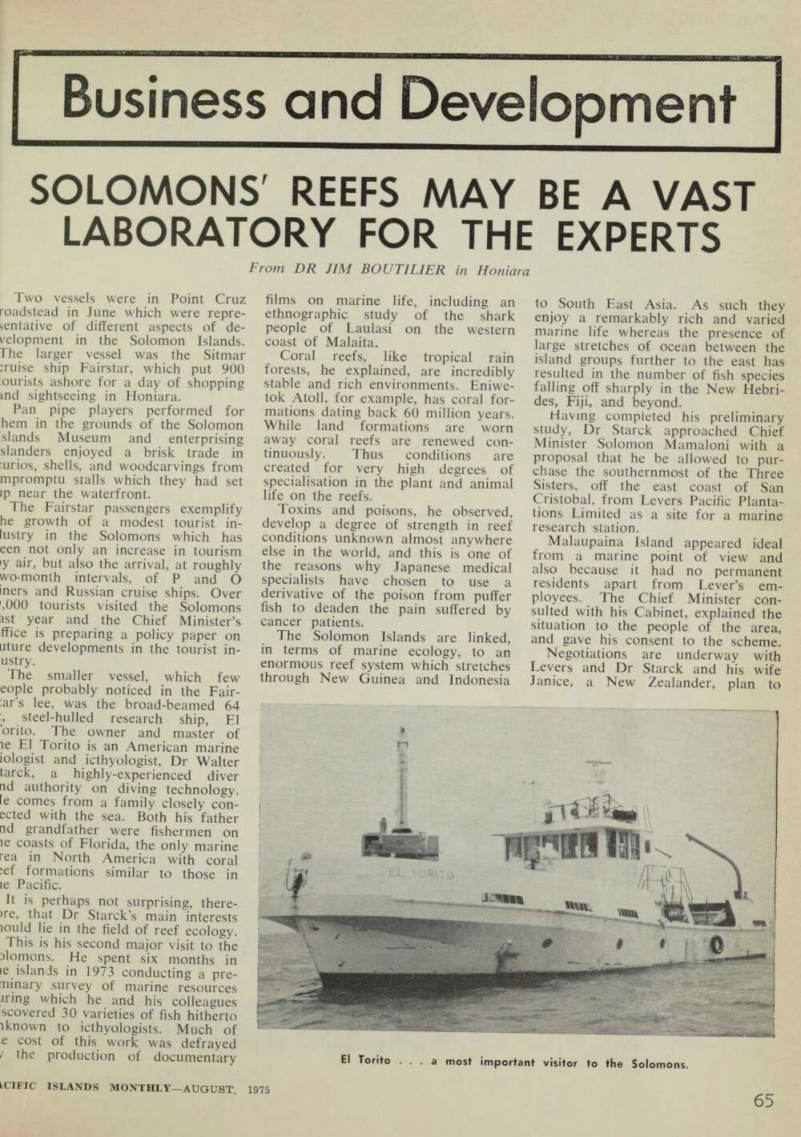
The smaller vessel, which few eople probably noticed in the Fair ar’s lee, was the broad-beamed 64 steel-hulled research ship, El brito. The owner and master of le El Torito is an American marine iologist and icthyologist, Dr Walter
tarck, a highly-experienced diver
ad authority on diving technology, le comes from a family closely con ected with the sea. Both his father ad grandfather were fishermen on le coasts of Florida, the only marine rea in North America with coral ; ef formations similar to those in le Pacific.
It is perhaps not surprising, there >re, that Dr Starck’s main interests lould lie in the field of reef ecology.
This is his second major visit to the Dlomons. He spent six months in ic islands in 1973 conducting a pre rninary survey of marine resources iring which he and his colleagues scovered 30 varieties of fish hitherto iknown to icthyologists. Much of e cost of this work was defrayed / the production of documentary
films on marine life, including an ethnographic study of the shark people of Laulasi on the western coast of Malaita.
Coral reefs, like tropical rain forests, he explained, are incredibly stable and rich environments. Eniwetok Atoll, for example, has coral formations dating back 60 million years.
While land formations are worn away coral reefs are renewed contmuously. Thus conditions are created for very high degrees of specialisation m the plant and animal lue on the reefs. toxins and poisons, he observed, develop a degree of strength in reef conditions unknown almost anywhere else in the world, and this is one of the reasons why Japanese medical specialists have chosen to use a denvative of the poison from puffer fish to deaden the pain suffered by Ca^f F P a V entS - T . • the Solomon Islands are linked, in terms of marine ecology, to an enormous reef system which stretches through New Guinea and Indonesia
to South East Asia. As such they enjoy a remarkably rich and varied marine life whereas the presence of large stretches of ocean between the island groups further to the east has resulted in the number of fish species falling off sharply in the New Hebri des, Fiji, and beyond.
Having completed his preliminary study, Dr Starck approached Chief Minister Solomon Mamaloni with a proposal that he be allowed to pur chase the southernmost of the Three Sisters, off the east coast of San Cristobal, from Levers Pacific Planta tions Limited as a site for a marine research station.
Malaupaina Island appeared ideal from a marine point of view and also because it had no permanent residents apart from Lever’s em ployees. The Chief Minister con sulted with his Cabinet, explained the situation to the people of the area, and gave his consent to the scheme.
Negotiations are underway with Levers and Dr Starck and his wife Janice, a New Zealander, plan to
El Tonto ... a most important visitor to the Solomons.
jegin work shortly establishing re icarch facilities. These will be avail ible to experts in the marine sciences md the Starcks hope that people will oin them in tackling some of the iroblems of reef ecology.
The potential of the reef environ nent, Dr Starck feels, is immense, ut hitherto many fisheries schemes ave failed because they attempted a apply in tropical seas fish-catching jchniques from northern waters.
There may be 200 different varieties f fish in temperate areas while in an rea like the Solomons there may be pwards of 2,000 varieties.
The limited number of varieties in alder regions is offset by the greater umber of fish within each variety, hus, bulk fishing techniques can be sveloped which are not readily aplicable where there are fewer fish I each variety.
Dr Starck hopes that his research ation will permit a study of more apropriate methods of fishing in opical waters, the preservation of ef environments, and the explora -3n of new areas of reef use.
There is, he observed, a substantial arket in North America for luarium fish. These fish are the nail, brightly-coloured, coral reef ;h which reproduce swiftly, grow lickly and fetch the same prices as od fish 50 to 100 times their size, be Philippines exports millions of ’liars in tropical fish to the United ates each year, and sales of such h could, Dr Starck feels, contribute aterially to the national income of e Solomons.
iji brewery
loses down
Lautoka, the second biggest centre Fiji, may not be a “town with no er , but since June 27 it has been town with an inoperative brewery. ie South Seas Brewery closed sud nly that day, without notice. The mpany decided to recommend to areholders that it go into voluntary uidation.
The closure caused general gloom the town, not because of the ab ice of the beer, but because about people lost their jobs. The •sure was hard on the heels of a J which destroyed a furniture dory on the opposite side of the ad, causing some unemployment
riding rebuilding.
The brewery never really got off ' ground. One initial brand, No 1, s changed because it did not peal. As for the other brews, the mpany claimed they were excellent ahty, but the local drinker was used to Fiji Bitter and Fiji Lager,
brewed at Suva, that they did not want to switch.
Even though South Seas Brewing won 17 per cent of the market at Lautoka, it needed 30 to 40 per cent.
There will be substantial losses. The Fiji National Provident Fund was owed $210,000 according to the July, 1974, balance sheet. The Fiji De velopment Bank stands to lose its in investment of $75,000 in the brewery.
The July, 1974, balance sheet also showed a net loss of $359,000. The company then owed $442,500 to the Bank of New Zealand and $302,360 to Marac International Ltd. Assets were valued at $1,498,000. Cash in hand was $4O.
Television, a rival
to Fiji tourism
The introduction of colour tele vision in Australia is having an un predicted effect on the tourist in dustry in Fiji, according to the Fiji Visitors Bureau chairman, Mr Dick Warner.
Speaking at a recent meeting of the FVB board he said that instead of waiting a year or two till colour television sets become cheaper, Aus tralian people were buying them now.
Thus, they did not have the money to go for a holiday—to places like Fiji.
The industry is concerned about a continuing decline in the number of visitors, although the board is confi
dent that, long-term, there is reason to be optimistic. FVB officers in Australia and New Zealand reported rather gloomily on the economic situ ation in those countries, which sug gested they would provide fewer tourists. The withdrawal of several cruise ships from the South Pacific suggests this once lucrative traffic is falling off.
The board is also aware that Fiji is meeting competition from New Caledonia, where there is a gambling casino at Noumea. And there are enough gambling Australians who would regard that as a tourist attrac tion. Gambling casinos have been suggested for Fiji in the past, but the government has turned its face against them, just as it did, very firmly, against poker machines 12 or 13 years ago.
The board recognises that Fiji must be prepared to meet competition. The tourist industry has had it easy for too long, and needs to take a search ing look at itself, not only for its own sake, but also for the sake of Fiji.
NZ boost tor
Islands bananas
New Zealand has introduced a new system of payment for banana im ports from the Pacific Islands under which it will pay a premium of SNZI a case for quality premium grade.
The scheme is based on New Zea land’s wish to revitalise the ailing Pacific Islands banana industry. It will improve employment opportuni ties and should lift the quality of bananas sold to NZ consumers.
The basic price will be $NZ3.56 a case fob, but with the premium growers can earn 5NZ4.56 a case. The new pricing system is only one of the steps NZ is taking to help the banana industry. Other measures include changes in production and packaging methods, shipping and scientific re search. NZ is already providing banana research assistance worth SNZ 100,000 to Tonga and the Cook Islands.
Five million dollars
for the Solomons
The accent is on primary industry in a United Nations Development Fund $5 million programme for the Solomon Islands over the next five years. Particular attention will be paid to agriculture, livestock, fisheries and forestry, transport, health and vocational training.
A United Nations report said that in agriculture, local processing of fruit and vegetables could offer the best opportunities for additional in
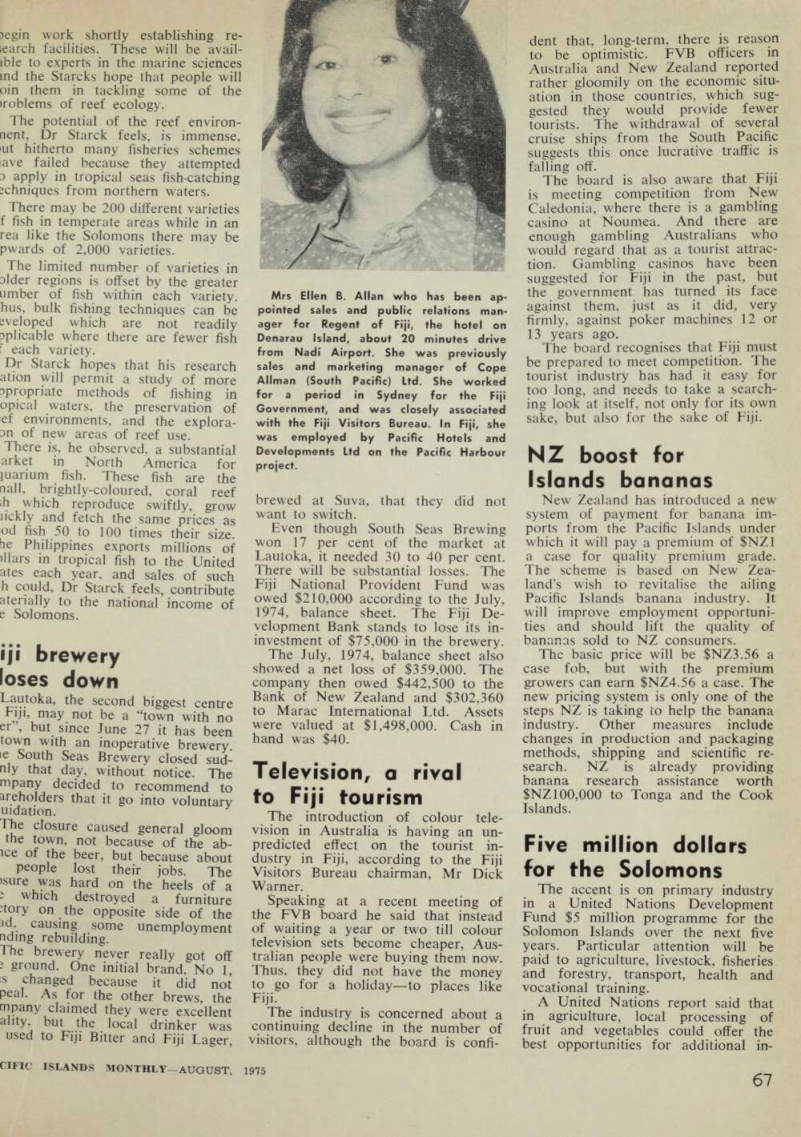
Mrs Ellen B. Allan who has been ap pointed sales and public relations man ager for Regent of Fiji, the hotel on Denarau Island, about 20 minutes drive from Nadi Airport. She was previously sales and marketing manager of Cope Allman (South Pacific) Ltd. She worked for a period in Sydney for the Fiji Government, and was closely associated with the Fiji Visitors Bureau. In Fiji, she was employed by Pacific Hotels and Developments Ltd on the Pacific Harbour project.
come. Coconut research is also en visaged. Much of the aid will be supplied in the form of consultants and fellowships for Solomon Is landers.
The advice from consultants should ensure that various projects are pro perly launched.
Copra planters
feel the pinch
New Hebrides copra exports in the first five months of 1975 at 11,937 tonnes, were well down on the 15,438 tonnes exported in the corresponding period of 1974. Lower values re flected the decline of the world copra market.
Fiji planters too are feeling the pinch, so much so that the govern ment has introduced a subsidy scheme under which $2 million will be available to keep the price of grade one copra at $l9O a ton, double the grade one price in June.
However, the subsidy is no more than a palliative. It will ease the economic strain on planters till Christmas. Unless there is a dramatic increase in world prices before then, the government may have to look at providing another subsidy.
Copra mill
tor Micronesians
The Micronesian Industrial Corpo ration is able to press ahead and set up a copra oil mill on Palau. The president of the corporation, Mr Guy A. Luttrell, expects that, barring un foreseen delays, the mill will be operational in July, 1976. The copra storage building will be finished about the middle of December, and the corporation will be ready to buy the entire production of the Trust Terri tory from next January 2.
If necessary, copra will be bought from the Philippines to augment the mill output. The mill will be able to produce about 100 tons of oil and about 40 tons of copra cake a day.
Fiji town council
bocks new sawmill
An Australian company, Robb and Brown Ltd, of Queensland, is in terested in setting up a sawmilling venture oustide Savusavu in Fiji The savusavu Town Council recently approved the company’s plan for a -2-acre mill site on the town’s out skirts The company, in 1974, bought .ontrol of Whites Enterprises Ltd, a savusavu timber milling company.
Ihe Mayor of Savusavu, Cr Hugh
Thaggard, said the project was of vital importance to the future of the town, particularly as copra prices had slumped. He understood the com pany would invest about S 3 million in the project. The project would give fuller use of the Savusavu power station, which was running at only a fraction of its capacity.
A Mini-Moke
coming to PNG
Papua New Guinea will have a new heavy industry when British Leyland (Aust) and Aveling-Barford Pacific, which have formed a new company, start a vehicle assembly venture. The plant will be at Lae, and will be operated by Leyland Pacific Pty Ltd, which will aim at an export industry for the South Pacific Islands.
Initially, production will be con fined to the Leyland Mini-Moke, at the rate of 25 a month. Production
Australia saw the Industrial beginnings of independent Papua New Guinea at a huge Forest Industries Machinery Expo sition in north-eastern Victoria. This machine (pictured above) claimed to be the first ever to come out of PNG, called the "Chipper-Austin" Travelmill" was displayed and demonstrated at the Exposition by New Guineans. It is the end result of six years of research and development. The machine was originally designed and built as a grass roots saw mill which could be operated by New Guineans without supervision. Easily transported, rugged and of low cost, the mill can be set down and erected in the forest thus cutting log hauling dis tances to a minimum. There are eight such units operating in PNG and a further five under construction. The Djaul Island Timbers operate two Chipper- Austin Travelmills each with a production target of 5,000 super feet of sawn timber per day. The machines are manu factured and sold by J. Austin Engineer ing of Rabaul.
will be stepped later, and so will the local content of the vehicle.
A share in the new company will be available for Papua New Guinea people. Whether this will be by government shareholding, by Develop ment Bank involvement, or by direct share issues, will be decided by the government.
A survey by Aveling-Barford sug gested that local assembly would re duce costs sufficiently to enable the Mini-Moke to compete with Japanese vehicles in the 1,000 cc range.
Gilbertese hopes
for Christmas
Christmas Island may provide a substitute—though not as remunera tive—for the Gilbert Islands when revenue ceases to come in from Ocean Island phosphate which now provides about $lO million a year for the GEIC.
The GEIC Government recently sent a high-powered team to Christ mas Island to get first-hand know ledge of resources being developed by the Gilbert and Ellice Islands Development Authority.
The team comprised the Chief Minister, Mr Naboua Ratieta, the Minister for Commerce and Industry, Mr Otiuea Tanentoa, the Minister for Communications, Works and
Utilities, Mr Bwebwetake Areieta, and the Minister for Education, Training and Culture, Mr Roniti Teiwaki, with GEIDA officials, including the mana ger, Mr Soutar Brown, and scientific consultants from Honolulu.
The team saw a number of in dustrial sites, including those for the brine-shrimp factory, the copra in dustry and the fisheries industry.
There is also a site for a hotel, which will be the base for a tourist industry for the island. The brine-shrimp industry is likely to be the first to get off the ground. Markets have been found in Europe for this delicacy.
The seas off the island are potenti ally rich in fish resources.
PNG government
buys rejected cars
The PNG Government has quietly bought five of the controversial 25 Mercedes cars which precipitated a major political row earlier this year.
The purchase price is believed to be $lO,OOO each, and the cars will be part of the VIP fleet for inde pendence celebrations in September.
Late last year, the Transport Minister, Mr lambakey Okuk, ordered the 25 cars from Germany at a bulk order price totalling $185,000 —equal to $7,400 per unit.
Cabinet endorsed the order, but a political row erupted over what was described as unnecessary and irregular expenditure. The Chief Minister, Mr Michael Somare, cancelled the order on his own initiative as political pressures mounted.
However, the cancellation came too late to prevent the arrival of the cars —complete with fittings for pennants and flags. Since then the government
has been negotiating compensation
arrangements with the importers.
A few of the cars have been sold privately, but five are now being registered for the government.
Koreans to
develop PNG timber
The Papua New Guinea Govern ment will spend up to $3O million in the next 10 years to develop the Kapuluk timber area on the north coast of West New Britain. One of two Korean companies will be chosen to develop the area. The National Resources Minister, Mr Bruce Jeph cott, said a new town and an in dustrial complex would be established to meet development needs. The timber area covers about 180,000 hectares, and is estimated to contain about 5.8 million cubic metres of saw veneer log and 7.3 million cubic metres of pulpwood.
• Fiji cane farmers expect to earn record $43,405,000 payout from the 974 crop. Their payment of $20.50 ton from the Fiji Sugar Corpora on is more than double the previous ;cord payout—slo.o6 in 1972. They an expect even better in 1975, pro ided Fiji is able to meet its new Dmmitments to the European Eco omic Community. But one or two ;cent rumbles of discontent caused le Minister for Information, Ratu )avid Toganivalu, to say that dis aptions could cost Fiji millions of ollars. • The Bank of Tonga in its first sar of business, issued more than [)0 personal loans of about $l,OOO ach, mainly for housebuilding. The umber of inquiries increased as the jar drew to a close.
. . . and briefly • Another attempt is being made to set up a sheep industry in Papua New Guinea. A flock of about 900 ewes in lamb arrived from New Zealand recently to test the possi bility of establishing a combined mutton and cottage wool industry.
The late Sir Edward Hallstrom, of Sydney, more than 20 years ago, introduced sheep to the Highlands of New Guinea at Nondugl, as a wool industry experiment. The ex periment was discontinued several years later. • Papua New Guinea and Aus tralia have announced agreement in principle to a mutual long-term free trade policy after PNG achieves nationhood. The PNG Trade Minis ter, Sir Maori Kiki, and the Austra
lian Overseas Trade Minister, Mr Frank Crean, announced this in Port Moresby after three days of talks and said that officials from the two countries would meet soon in Port Moresby to begin drafting a formal agreement. • Mr Phillip Best, general man ager of Bums Philp (SS) Co Ltd, has been transferred to Burns Philp and Co Ltd in Sydney to become assistant to the general manager, Mr M. O’Connor. Mr Best, Fiji-born, joined Burns Philp in 1952, and held several senior appointments before becoming general manager of the South Sea company. He has been succeeded in Suva by Mr Ronald Rowland, who joined the company in 1974 after a career in commerce in Australia and the Far East.