through the
pp. 12-13 · Read in the full issue
Sanford gets through the front door
From AL PRINCE in Tahiti If window-dressing is the key to political success, then Francis San ford, Tahiti’s French National Assembly Deputy, was successful when he got his first private meeting with a President of the French Re public after always having been kept on the other side of the door with the two previous presidents.
But if Sanford accomplished any thing else during his 45-minute meet ing with President Valery Giscard d’Estaing, he was not telling anyone publicly. Sanford later said he and President Giscard d’Estaing discussed the new law to go into effect on January 1 changing French Poly nesia’s relationship with France. San ford said he presented the President with proposed legislation for internal autonomy for Tahiti.
“The project is now in the hands of the President of the Republic, and now he is the only one who can decide,” Sanford said with the drama befitting anyone who has just left the plush office of the President.
Sanford described his meeting with President Giscard d’Estaing as “positive” because it was the first time that he was received by a French President after having similar requests turned down by the late Presidents Charles de Gaulle and Georges Pompidou. And Sanford said he and the President will meet
again in October during the autumn session of the French National Assembly.
But Sanford will not be the only one back in Paris in October. The other politicians from Tahiti who accompanied him to Paris in June for meetings with Olivier Stirn, the French Secretary of State for Over seas Departments and Territories, will return to the French capital in October for more talks about Tahiti’s new relationship with France.
About the only new development from the June talks was Mr Stirn’s reference to France being represented in French Polynesia by a “high com missioner” instead of a governor, as has always been the case. But other than the name change, Mr Stirn did not budge from the stand he took when he visited Tahiti in March —no independence and no internal autonomy for Tahiti.
And the politicians from Tahiti did not budge from their split stand over whether the governor, or high com-
missioner, should be elected ir Tahiti or appointed by France. Anc there were apparently some verj heated discussions over this poin during the meetings of the Frencl Polynesia delegation with Mr Stirn.
But when the dust had settled everyone was back to square one Mr Stirn said the new law will give Tahiti greater autonomy, but not in ternal autonomy, by increasing the number of Government Council mem bers from the present five to seven having the members elected with eacl given a specific administrative arej of control in managing the local gov ernment. But Mr Stirn stood fast b} his insistence that the Governmen Council will be presided over by '< French-appointed high commissione: or, in the commissioner’s absence, i general secretary.
Mr Stirn told the delegation fron Tahiti that the new law he envisage: will provide for a new distributior of power with each authority mon clearly defined. He said this mean: a better separation of power betweei the roles of France and the territory so as to avoid complications am conflicts over who has what authority He said the decision-making authority of the Government Council will b< distinctly separate from the debating authority of the French Polynesii
Territorial Assembly.
But if Mr Stirn’s objective is tc avoid complications, he certainly doe: not appear to have accomplished tha in his meetings with the delegatior from Tahiti. The talks reported!) got off to a good start, but then th( fireworks began when the delegatior found out in greater detail what Mi Stirn had been talking about ir general terms when he was in Tahit in March.
Adding to the display of emotion: was the angry departure from Pari:
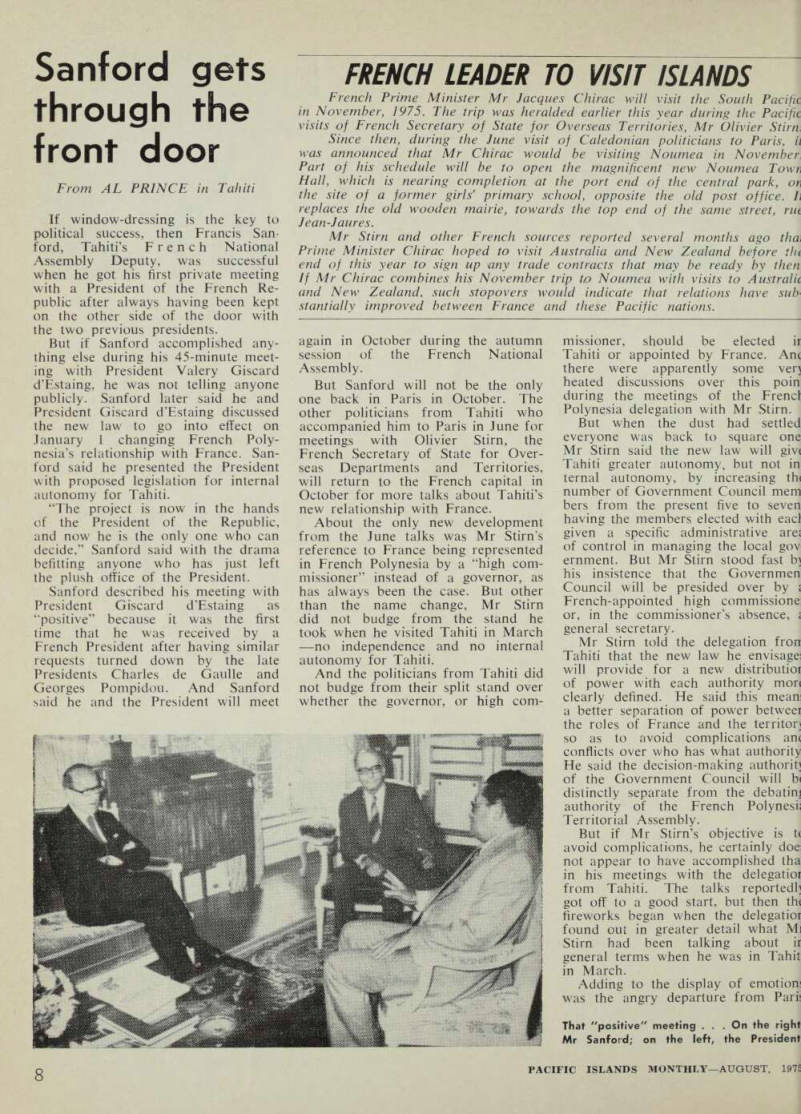
That "positive" meeting . . . On the right Mr Sanford; on the left, the President
of the president of the New Caledonia Territorial Assembly, Mr Yann Uregei, who later appeared to have only one thing in mind—total and complete independence from France.
But as furious as some of the politicians from Tahiti were, nobody walked out of the Paris meetings.
One reason could be, in a word, “nickel”, which, in the case of New Caledonia, translates into money, which, without France, Tahiti does not have much of.
And so the delegation from Tahiti remained in Paris in force, arguing, holding emotional press conferences, and still ending up where it was in March when Mr Stirn visited Tahiti and where it was before it left for Paris —split almost down the middle.
On one side is former Territorial Assembly President Gaston Flosse and the UDR, or Gaullist party, sup porting Mr Stirn’s programme except n asking that the Government Council have a vice-president elected py the Territorial Assembly. The point here is that Flosse and his sup porters want the territory to have its )wn representative on the Govern nent Council to balance the weight »f France’s appointed high commis ioner.
On the other side of the delegation rom Tahiti are Sanford and current Yrritorial Assembly President Frantz 'anizette, who want a Government ouncil without a governor or high ommissioner. They want the council lembers to be elected by the Terri pnal Assembly, with both the auncil and the assembly administer ig the territory, but with the terri fy having the final say over council -tions. And it follows, of course, lat this group wants the president P the Government Council to be ected.
So it all boils down to one ques an: Who is going to run the terri •ry—-the Government Council with French-appointed high commis aner presiding, the Territorial ssembly with control over the >uncil, or the council with an ipomted high commissioner and an scted vice-president?
As far as Mr Stirn is concerned, ere is no choice. Thus, it appears this point that the delegation from miti can either remain split or iite, knowing full well that they ight still end up with Mr Stirn’s ogramme.
But before anything becomes final, s delegation from Tahiti will be 'Ctmg in Paris with Mr Stirn in :tober, Mr Stirn will be visiting ihiti again before the end of the ar, with Sanford meeting with esident Giscard d’Estaing in be een. And the day of reckoning auary 1, draws closer.