Colonial Politics And The New
pp. 10-79 · Read in the full issue
Nationalism In The New Hebrides
From a special correspondent
The New Hebrides is expected to experience its first taste of elections in August. These elections, however, are not the long-awaited national general elections, but elections for the newly-created municipalities of Vila and Santo.
The last and final meeting of the old Advisory Council in April en dorsed plans for the establishment of the new municipal councils.
The creation of the municipalities and the introduction of universal suffrage at this local government level represents a victory for colonial interests against those of the young and determined New Hebrides nationalist movement. The primary component of this movement, the New Hebrides National Party, an nounced at the end of 1974 that it was opposed to the formation of municipal councils and that it would “make every effort possible to dis courage its acceptance by indigenous New Hebrideans”.
Quite correctly, the National Party views the municipal councils as a threat to decolonising interests in the New Hebrides. At one level the municipal council elections seemed likely to undermine the focus on the more important national elections, scheduled for later in 1975. Although Vila and Santo combined represent
only about 20 per cent of the New Hebrides’ total population (about 95,000 at the end of last year), their impact on the country is more sig nificant—as is the case with most towns. The National Party is genu inely concerned that the development of municipal political interests will only be at the cost of rural and national ones.
The towns are also important poli tically in quite another way: they are less anti-colonial than the country side. The role of the European popu lation is a clear indication of this: over the whole country Europeans barely comprise 2 per cent of the population; but in the towns their proportion is much higher, about 14 per cent when last measured in 1972 —and growing. There is little doubt that the Anglo-French colonial government hopes that a conservative political line will predominate in the municipal councils and that this will provide them with an institutional club with which to knock back the increasingly-radical demands of the National Party.
No doubt a constitutionalist would regard the recent reforms in the New Hebrides as a sign of political pro gress. But the limitations of the re forms, and the place of the municipal councils in particular, leaves very
considerable doubt concerning the degree of real progress achieved.
Although the population of New Hebrideans in the urban areas ac counts for two-thirds of the total
population, their representation is
little more than a half: 12 out of 24 seats in Vila; nine out of 16 seats in Santo. Moreover no separate account appeared to have been taken of the 20 per cent or so of other Pacific Islanders, Asians and people of other ethnic origins. Finally the
cross-voting system, which requires
voters to cast votes for candidates from all groups, seemed designed to minimise the impact of radical New Hebridean votes in the elections.
When the results of the New Heb rides’ first municipal elections be come available, a careful analysis of these should give some idea of how the contest between colonial and national politics in the New Hebrides is proceeding. A better test in the long run, however, might be provided by the national elections for the
Representative Assembly, possibly to
be held in November. After some intra-party uncertainties, the National Party appears to have decided to con test these elections and to attempt to secure as much constituency sup port for the party as it possibly can.
Preliminaries to the national elec-
ons had already begun in May. Both le French Resident Commissioner nd the president of the National arty, whom some might label as le chief protagonists in the present □litical tug-of-war, visited and Jdressed the general assembly of le Presbyterian Church which met n Emai island. The National Party id the pro-French parties were hold g conventions at mid-year, both to arify party policies and to plan icir electoral strategies.
The National Party, still based at e Anglican mission at Tagabe, near ila, had improved its offices with e addition of a typewriter and iplicating machine donated by sym ithetic friends. One of their first eductions was the premier issue of I US, a bislama-language news eet which the party hoped would netrate rural villages and urban ew Hebridean homes.
At least, the intending elections id the formation of a national jpresentative Assembly will provide forum for the first serious test of ength between the nationalists and e colonial government. The out me of course remains very much doubt at this stage. If, as few pect, the National Party wins a sounding victory, it would surely rtend the end of the road for the iglo-French colonialists.
On the other hand, a National rty rout would have a devastating ect on the nationalist movement, rhaps delaying further decolonis on for a decade or more. Con ued political stalemate, with the itional Party winning a respectable mber of seats but not enough to ntrol the Assembly, might give the lonial government the breathing ice it wants to implement its own litical programme, but it could o lead to frustrations and conflicts
of a kind which many well-meaning people, foreigners and nationals alike, hope that the New Hebrides will avoid.
Unfortunately, the elections to the Assembly may turn out to be little more than a numbers display. There are a number of questionable aspects concerning the Assembly itself which leave room for doubt concerning its effectiveness. Of the 42 Assembly members, 29 will be elected by uni versal suffrage, 20 from rural con stituencies and nine from the two main urban areas. The remaining members will be selected by and from special interest groups—six from the chambers of commerce, three from the co-operative societies, and four representatives from the customary chiefs.
From a New Hebridean point of view, the composition of the Assem bly, while a tremendous improvement on that of the old Advisory Council, leaves much to be desired. A mini mum of 12 Assembly members will be foreigners—six from urban con stituencies and all six representatives from the chambers of commerce.
The contrast between the size of the non-Pacific foreigner population (5 per cent) and their numerical strength in the Assembly is a stark one.
Some New Hebrideans also feel that the electoral provisions for the Representative Assembly, which were approved by the Advisory Council, are more likely to favour foreign interests. The age limit for voting in the elections was set at 21 years, rather than 18, and the modest resi dential requirements for voting and for candidacy in the elections are three and five years respectively. A lower voting age and tougher resi dential requirements might have better served New Hebridean interests.
Perhaps of more significance is the constitutional relationship between the Assembly and the colonial government. Despite objections from the Advisory Council, the colonial government is proceeding with a proposal to give the two resident commissioners joint control over the meetings of the Assembly. A counter proposal for the Assembly to elect from its own ranks an independent speaker is unlikely to be accepted by the colonial government.
Not only will the resident com missioners have joint control over the Assembly’s proceedings however, but they will also be able to return to the Assembly any resolutions which are unacceptable to the
colonial government. The Assembly does have the power, by a two-thirds confirmation, to insist on certain legislation being enacted, but the composition of the Assembly is such that the likelihood of this occurring does not seem very high. Executive power very clearly remains in the hands of the colonial government, and even the Assembly’s legislative powers appear to be limited.
If in the short-term the new Assembly does not turn out to have contributed much to the decolonising impetus, there is no doubt that the New Hebrides’ political climate is getting hotter every month. The National Party is by no means the only active, non-government political organisation—although it may well be the only one which is really in dependent of government influence.
The pro-French alliance of UCNH MANH and the New Hebridean Nagriamel movement remains a close one. For most people the alliance is both paradoxical and uncertain.
From Nagriamel’s point of view, however, they have been very well treated by both French planters and government, and the material benefits which they have earned from the alliance are considerable.
The real problem is the deepening division which is emerging between French- and British-educated New Hebrideans. Although Nagriamel’s leader, Jimmy Stephens, has at tempted to retain an independent status, he is intensely jealous of the influence which the British-educated leaders of the National Party and the Presbyterian Church have had on the population. He sees their activities as undermining his own movement and has allied with French interest groups in an attempt to meet this challenge.
For their part, the National Party
Continued on p 75
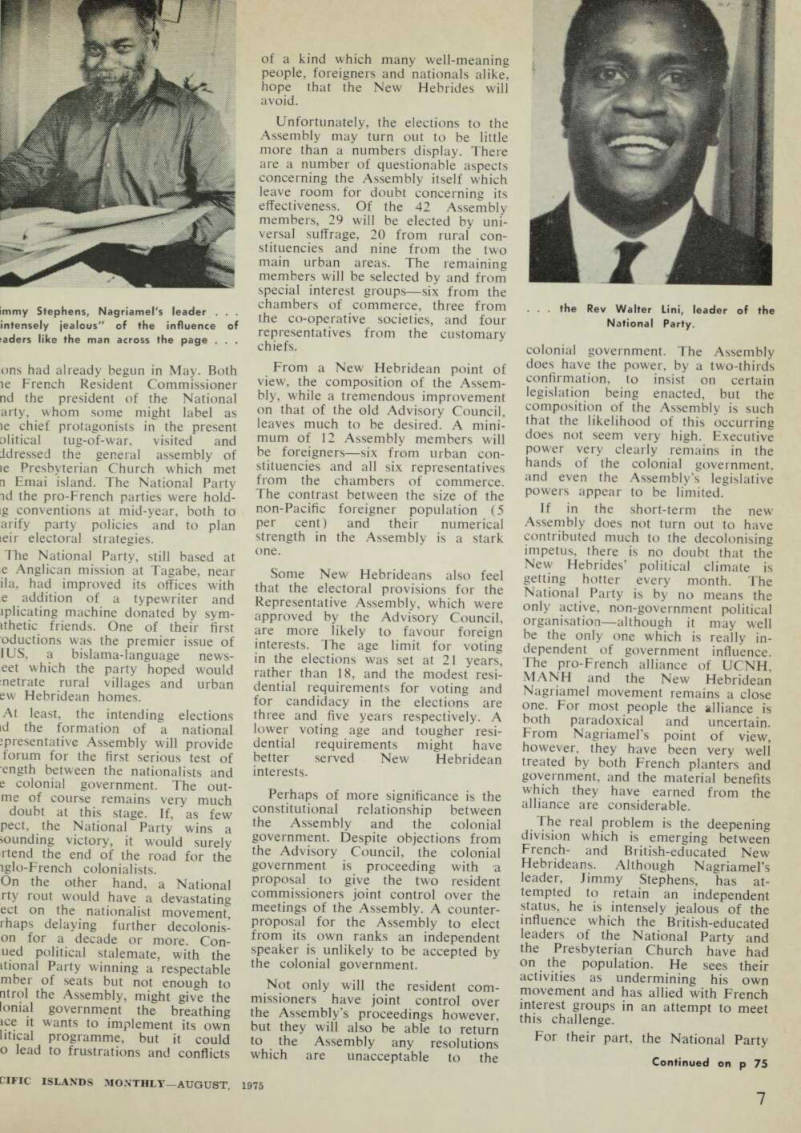
[?]mmy Stephens, Nagriamel's leader . . . [?]intensely jealous" of the influence of [?]aders like the man across the page . . .
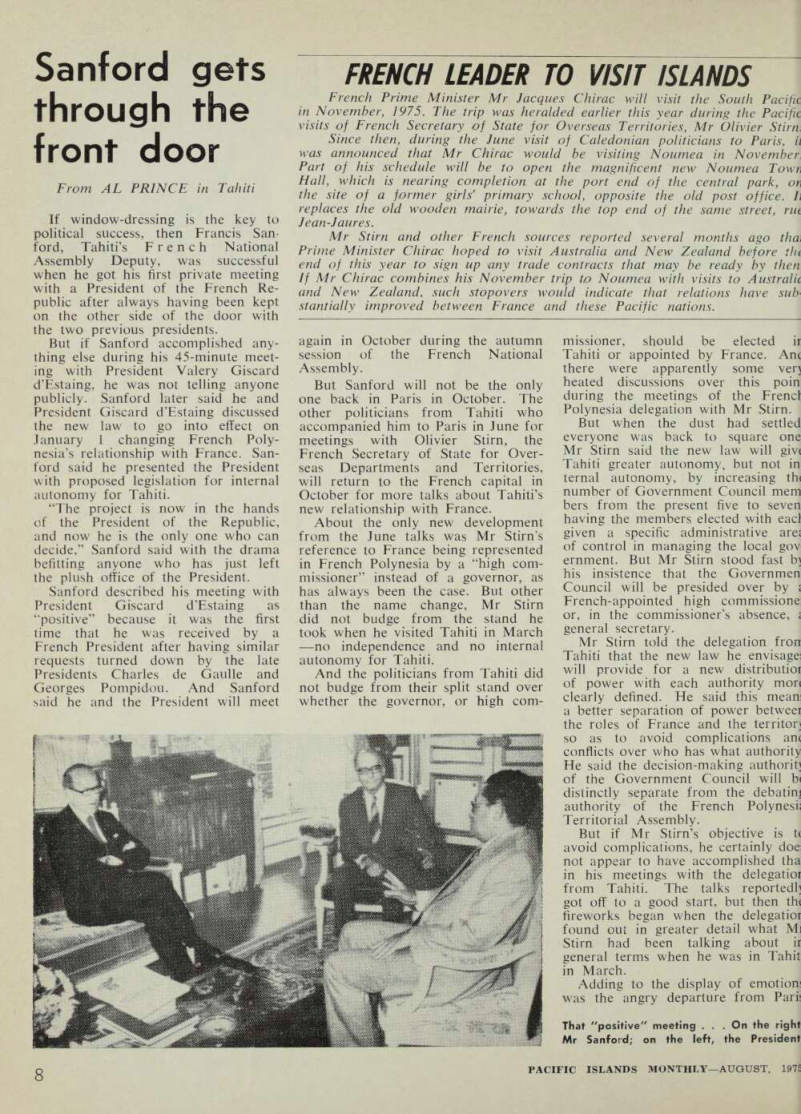
. . . the Rev Walter Lini, leader of the National Party.
eadership has failed to overcome the ;ulf that has emerged and which eems to be widening. Almost none >f the National Party leaders speak 'rench and only a few French ducated New Hebrideans have any onnections with the party at all. At he moment hardly one-fifth of the »Jew Hebridean population is French ducated—but with the activist policy if the French Government this is ikely to change rapidly over the next ew years. Unless the National Party an establish a secure base among rench and British-educated New lebrideans, as well as among the ural community, its long-term pros ects for success as the leader of a ationalist movement must be doubt- Lll.
For the student of politics, the resent situation in the New Heb ides is a perplexing one. Will the lunicipal councils turn out to be the trong-arm of the government as Dme suspect? Will the new Repre mtative Assembly be prepared to ccept a role subservient to that of le colonial government? What will e the strength of the nationalists ithin the Assembly? How stable is le UCNH-MANH-Nagriamel alli nce? Is there a chance that a new, lack nationalist united front will merge to combat colonial politics? hese are only a few of the un jrtainties which affect New Hebrides olitics today. Perhaps by the end f 1975, after the first real rounds f the political contest have been iayed, the nature and the likely Litcome of the conflict will be clearer.