Pita Lus, rebel, loner and master
pp. 16-17 · Read in the full issue
master of the unexpected
• Papua New Guinea's House of Assembly is a forum for many exciting and colourful parliamentarians. But few can match the fiery rhetoric and the pugnacious style of the maverick member for Maprik, PNG’s Minister for Police, Pita Lus. From Port Moresby. Keith Jackson writes of the Lus phenomenon.
Pita Lus has always been the rebel, the loner, the master of the un expected.
When he got to his feet in Papua New Guinea’s Constituent Assembly at the fag end of May and bluntly suggested the critics of the govern ment should be executed (see box), followers of his stormy political career sighed with gratitude. The fire of controversy still burns in the soul of Pita Lus. The spark of anger has not been doused.
Back in 1934, Pita Lus’s father killed a white man, a labour recruiter.
He was speared to death as he slept in camp near Lehinga village. The recruiter had marked Lus’s older brother as a likely prospect. The Sepik was a violent place in those days.
Lus’s father gave himself up and died while serving a three-year prison term in Rabaul. Pita Lus never knew his father—but perhaps the Lehinga murder explains something. Lus often uses the threat of sudden and brutal death to make a political point.
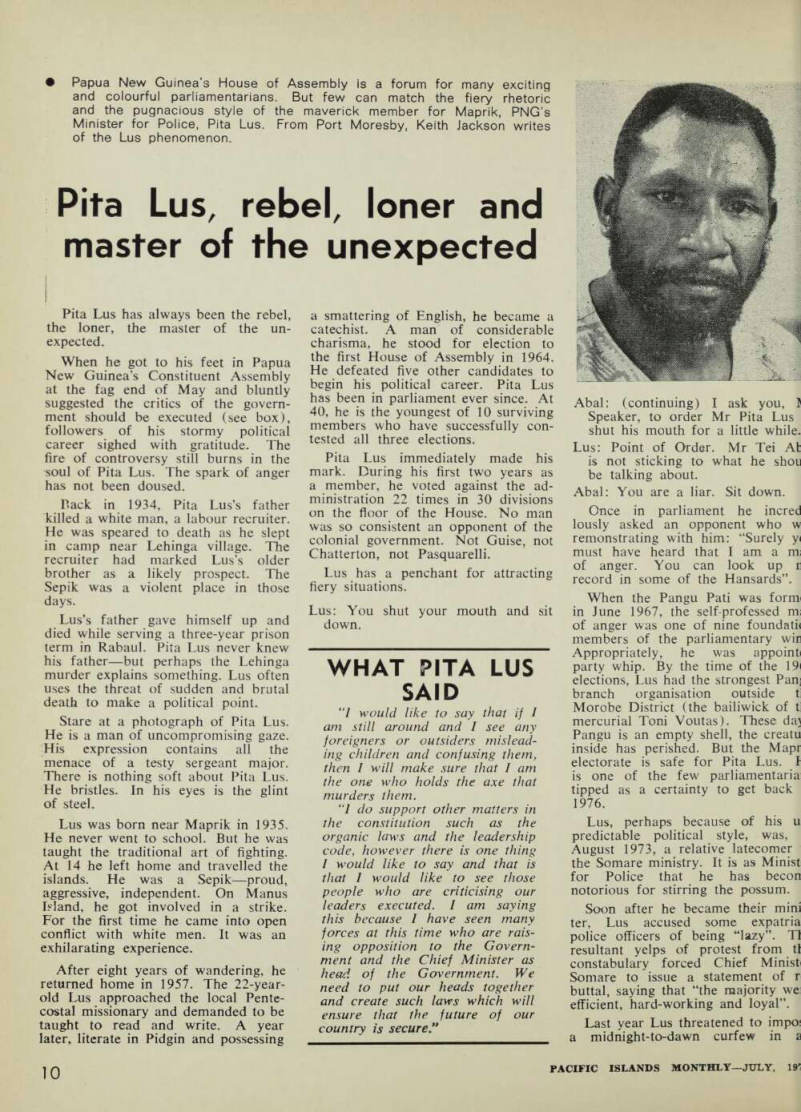
Stare at a photograph of Pita Lus.
He is a man of uncompromising gaze.
His expression contains all the menace of a testy sergeant major.
There is nothing soft about Pita Lus.
He bristles. In his eyes is the glint of steel.
Lus was born near Maprik in 1935.
He never went to school. But he was taught the traditional art of fighting.
At 14 he left home and travelled the islands. He was a Sepik—proud, aggressive, independent. On Manus Island, he got involved in a strike.
For the first time he came into open conflict with white men. It was an exhilarating experience.
After eight years of wandering, he returned home in 1957. The 22-year old Lus approached the local Pente costal missionary and demanded to be taught to read and write. A year later, literate in Pidgin and possessing
a smattering of English, he became a catechist. A man of considerable charisma, he stood for election to the first House of Assembly in 1964.
He defeated five other candidates to begin his political career. Pita Lus has been in parliament ever since. At 40, he is the youngest of 10 surviving members who have successfully con tested all three elections.
Pita Lus immediately made his mark. During his first two years as a member, he voted against the ad ministration 22 times in 30 divisions on the floor of the House. No man was so consistent an opponent of the colonial government. Not Guise, not Chatterton, not Pasquarelli.
Lus has a penchant for attracting fiery situations.
Lus: You shut your mouth and sit down.
Abal; (continuing) I ask you, J Speaker, to order Mr Pita Lus shut his mouth for a little while.
Lus: Point of Order. Mr Tei At is not sticking to what he shou be talking about.
Abal: You are a liar. Sit down.
Once in parliament he incred lously asked an opponent who w remonstrating with him: “Surely y< must have heard that I am a m; of anger. You can look up c record in some of the Hansards”.
When the Pangu Pati was form* in June 1967, the self-professed m; of anger was one of nine foundatu members of the parliamentary wic Appropriately, he was appoint) party whip. By the time of the 19( elections, Lus had the strongest Pan] branch organisation outside ti Morobe District (the bailiwick of t\ mercurial Toni Voutas). These da} Pangu is an empty shell, the creatu inside has perished. But the Mapr electorate is safe for Pita Lus. I is one of the few parliamentaria tipped as a certainty to get back 1976.
Lus, perhaps because of his u
predictable political style, was,
August 1973, a relative latecomer the Somare ministry. It is as Minist for Police that he has becon notorious for stirring the possum.
Soon after he became their mini ter, Lus accused some expatria police officers of being “lazy”. Tl resultant yelps of protest from tl constabulary forced Chief Minist Somare to issue a statement of r buttal, saying that “the majority we: efficient, hard-working and loyal”.
Last year Lus threatened to impo; a midnight-to-dawn curfew in a
Fort to cut the crime rate in Port [oresby. It was a proposal that won ide support from the city’s ex itriate community in particular, at the Government considered it 0 harsh a measure. The Con abulary did introduce night-time ot patrols, apparently as a compro ise.
Then there was the famous ‘let’s imb the villages’ statement of 1973 icn the Police Minister suggested at one way to stop inter-tribal fight g would be “to get some sort of imb and start clearing up the whole jss very quickly”. The impetuosity Lus’s rhetoric does lend itself to sinterpretation. Newspaper reports anaged to conjure up visions of an force blitzkreig against offending lages. In fact, Lus was thinking terms of a smoke bomb that would : eguard his police from violent re lation from warring tribal groups.
Last August he suggested that the it cure for juvenile delinquency >uld be to imprison both the offen rs and their parents: a harsh :asure of social correction that has m mooted by Australian disci narians from time to time.
Pita Lus is clearly no lamb. He’s boots-and-all politician in the luld of the former Premier of w South Wales, Sir Robert Askin. s is a self-made man. He had no ditional authority. He was de ved of an education. To him, itics has more to do with issues n with philosophies. -iis propensity to argue, his fero j of speech, his irreverence of lark and his willingness to enter -1 the outrageous have tended to t Lus in the role of the political bag with little of real worth to itribute. Such an impression is un tunate. .us is a dedicated parliamentarian 1 a hardworking minister. He has aped the slur of personal imputa i that many of his front bench [temporaries have attracted. People i’t so much object to Lus, they ect to what he says.
Jo Herlihy commented in a st perceptive portrait of Lus in the rnal Yagl-Ambu: “Lus is not im ne from the occupational disease
the politician—speaking before he
iks”.
I The PNG Government has roved a farm-out agreement be en Esso PNG Inc, and Endeavour Co NL and lOL Petroleum Ltd, ler which Esso will earn 50 per t interest in the prospecting nces held by the other two com ics. The licences over about 7,624 km (2,944 sq ml) onshore and hore on the western side of the If of Papua.