Fiji’s tourism cream turns sour and new ruins rise
p. 15 · Read in the full issue
new ruins rise on the Coral Coast
From VIJENDRA KUMAR in Lautoka
NO sooner had the echoes from the lali (wooden drums) heralding Fiji’s independence on October 10, 1970, died down, than there began a steady stream of carpetbaggers into the country.
They came from Honolulu, New York, San Francisco, Toronto, Sydney, Auckland, Hong Kong and other places where people play games with money. Brief cases packed with papers and plans, they talked of multi-million dollar hotel and resort complexes.
They were the people who were going to transform Fiji into a mecca for tourists.
Five years later, today, only one hotel is nearing completion.
Another has become a derelict even before it could be finished.
It turned out that some of these men who talked big had either empty pockets or were interested in making a quick profit by wheel ing and dealing in land. Virtually all freehold land along the coast of Viti Levu was quickly grabbed by speculators.
A company registered under the name of Nadi Bay Beach Corpora tion Ltd bought about 50 acres of prime agricultural land along Nadi Bay and talked of turning the area into Fiji’s Waikiki. It had plans to build seven hotels and a commercial complex. No thing has come of it so far. The only casualties are the tenant farmers who lived on the land and lost their sugar plantations.
A good example of inflated land prices through speculation was the sale of a 2i-acre section along the coast on Nadi Bay. The first buyer paid about $50,000 and he sold it for more than $250,000.
One of the first American com panies on the scene was the General Investment Corporation Ltd. It established an office at Nadi and according to its top executive, Chic Jonic, the future of tourism lay in Savu Savu, a coastal strip on Vanua Levu, the second largest island in the Fiji Group. He had a man there “picking up properties”. No one knows what has happened to de tailed plans and feasibility studies the company delighted in showing to any local visitor to its office.
The company then publicised another big venture which blew
up in its face, it acquired land near Nadi International Airport and planned to create an Inter national Marketplace, something along the lines of the famous Ala Moana shopping centre in Hono lulu. Only a derelict building and a half-buried sign of the vaunted venture stand along the roadside.
The last chapter in GlC’s activi ties probably closed last month with the auctioning of whatever was left of its executives’ furniture.
Other companies with exotic sounding names such as American Investment Company and Clear water Development Company have bought large tracts of land pre viously under sugar cane. Not even a workmen’s shed stands on any of the sites to show that they have plans to carry out hotel de velopment.
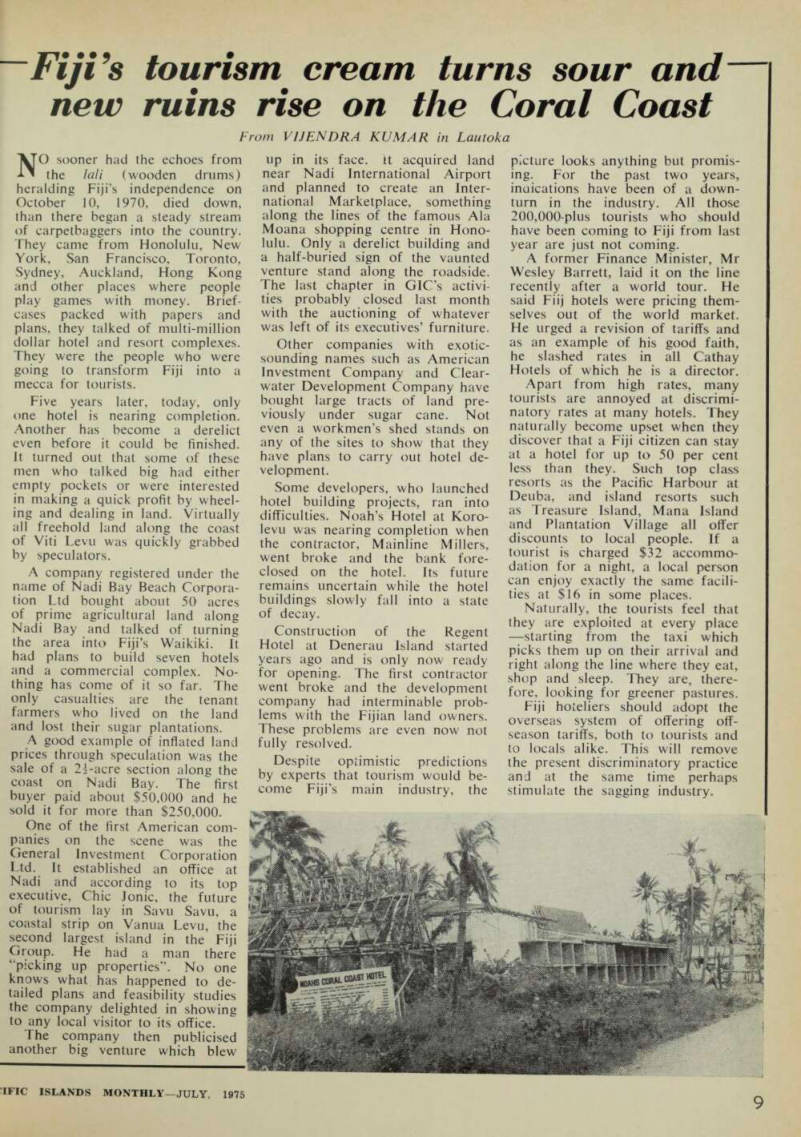
Some developers, who launched hotel building projects, ran into difficulties. Noah’s Hotel at Koro levu was nearing completion when the contractor, Mainline Millers, went broke and the bank fore closed on the hotel. Its future remains uncertain while the hotel buildings slowly fall into a state of decay.
Construction of the Regent Hotel at Denerau Island started years ago and is only now ready for opening. The first contractor went broke and the development company had interminable prob lems with the Fijian land owners.
These problems are even now not fully resolved.
Despite optimistic predictions by experts that tourism would be come Fiji’s main industry, the
picture looks anything but promis ing. For the past two years, indications have been of a down turn in the industry. All those 200,000-plus tourists who should have been coming to Fiji from last year are just not coming.
A former Finance Minister, Mr Wesley Barrett, laid it on the line recently after a world tour. He said Fiij hotels were pricing them selves out of the world market, He urged a revision of tariffs and as an example of his good faith. he slashed rates in all Cathay Hotels of which he is a director, Apart from high rates, many tourists are annoyed at discrimi natory rates at many hotels. They naturally become upset when they discover that a Fiji citizen can stay at a hotel for up to 50 per cent Jess than they. Such top class s °u S aS t ! le . Paci . fic Harbour at Deuba, and island resorts such as Treasure Island Mana Island Plantatl °7 Village all offer discounts to local people. If a u J lst j s char P e u d accommo- Nation for a night, a local person an e^ actl y the same facili that
-starling from the taxi* which
sh g OD and B see n Thev are there fore looking for greener pastures Fiji hotefiers should adopt the ftV prkpnk svNtpm nf nflFprina rtfF season tariffs, both to tourisfs and i nra ic Thk will
the present ditcrimmatoly p“
and at the same time perhaps stimulate the sagging industry.