Mata'afa, friend to all, who
p. 13 · Read in the full issue
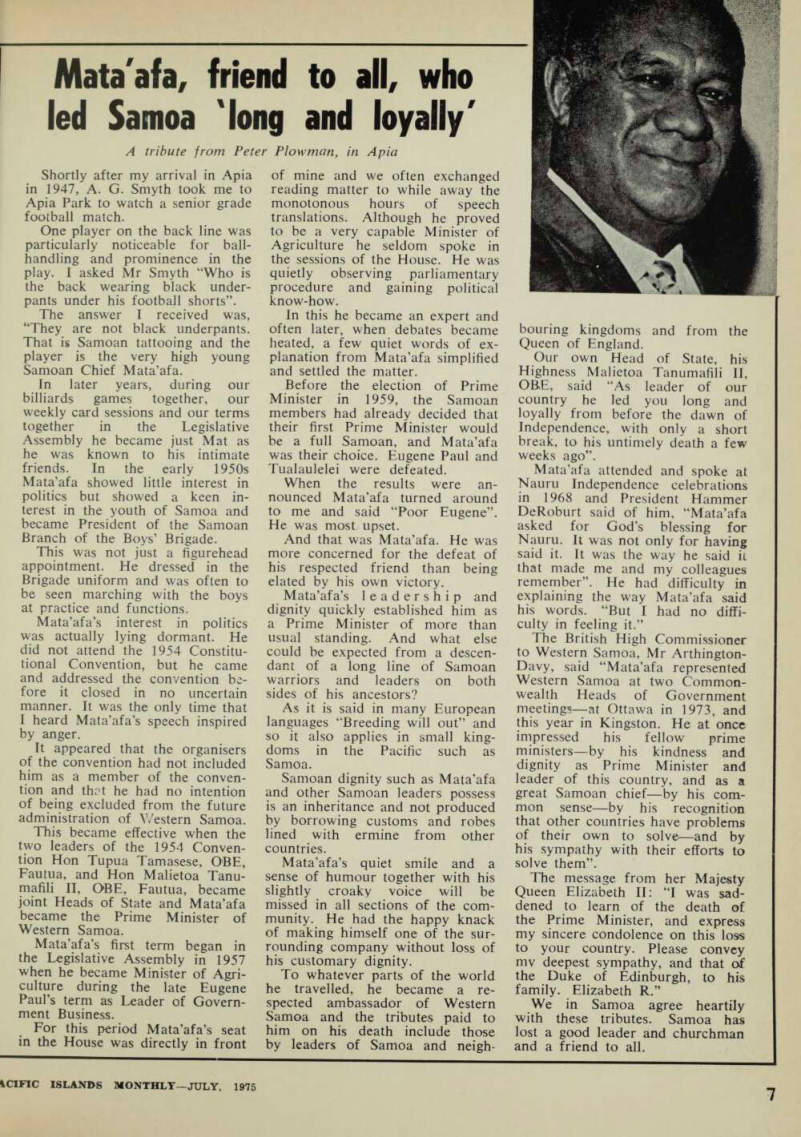
led Samoa 'long and loyally'
A tribute from Peter Plowman, in Apia
Shortly after my arrival in Apia in 1947, A. G. Smyth took me to Apia Park to watch a senior grade football match.
One player on the back line was particularly noticeable for ball handling and prominence in the play. I asked Mr Smyth “Who is the back wearing black under pants under his football shorts”.
The answer I received was, “They are not black underpants.
That is Samoan tattooing and the player is the very high young Samoan Chief Mata’afa.
In later years, during our billiards games together, our weekly card sessions and our terms together in the Legislative Assembly he became just Mat as he was known to his intimate friends. In the early 1950 s Mata’afa showed little interest in politics but showed a keen in terest in the youth of Samoa and became President of the Samoan Branch of the Boys’ Brigade.
This was not just a figurehead appointment. He dressed in the Brigade uniform and was often to be seen marching with the boys at practice and functions.
Mata’afa’s interest in politics was actually lying dormant. He did not attend the 1954 Constitu tional Convention, but he came and addressed the convention be fore it closed in no uncertain manner. It was the only time that I heard Mata’afa’s speech inspired by anger.
It appeared that the organisers of the convention had not included him as a member of the conven tion and that he had no intention of being excluded from the future administration of Western Samoa.
This became effective when the two leaders of the 1954 Conven tion Hon Tupua Tamasese, OBE, Fautua, and Hon Malietoa Tanu mafili 11, OBE, Fautua, became joint Heads of State and Mata’afa became the Prime Minister of Western Samoa.
Mata’afa’s first term began in the Legislative Assembly in 1957 when he became Minister of Agri culture during the late Eugene Paul’s term as Leader of Govern ment Business.
For this period Mata’afa’s seat in the House was directly in front
of mine and we often exchanged reading matter to while away the monotonous hours of speech translations. Although he proved to be a very capable Minister of Agriculture he seldom spoke in the sessions of the House. He was quietly observing parliamentary procedure and gaining political know-how.
In this he became an expert and often later, when debates became heated, a few quiet words of ex planation from Mata’afa simplified and settled the matter.
Before the election of Prime Minister in 1959, the Samoan members had already decided that their first Prime Minister would be a full Samoan, and Mata’afa was their choice. Eugene Paul and Tualaulelei were defeated.
When the results were an nounced Mata’afa turned around to me and said “Poor Eugene”.
He was most upset.
And that was Mata’afa. He was more concerned for the defeat of his respected friend than being elated by his own victory.
Mata’afa’s leadership and dignity quickly established him as a Prime Minister of more than usual standing. And what else could be expected from a descen dant of a long line of Samoan warriors and leaders on both sides of his ancestors?
As it is said in many European languages “Breeding will out” and so it also applies in small king doms in the Pacific such as Samoa.
Samoan dignity such as Mata’afa and other Samoan leaders possess is an inheritance and not produced by borrowing customs and robes lined with ermine from other countries.
Mata’afa’s quiet smile and a sense of humour together with his slightly croaky voice will be missed in all sections of the com munity. He had the happy knack of making himself one of the sur rounding company without loss of his customary dignity.
To whatever parts of the world he travelled, he became a re spected ambassador of Western Samoa and the tributes paid to him on his death include those by leaders of Samoa and neigh-
bouring kingdoms and from the Queen of England.
Our own Head of State, his Highness Malietoa Tanumafili 11, OBE, said “As leader of our country he led you long and loyally from before the dawn of Independence, with only a short break, to his untimely death a few weeks ago”.
Mata’afa attended and spoke at Nauru Independence celebrations in 1968 and President Hammer Deßoburt said of him, “Mata’afa asked for God’s blessing for Nauru. It was not only for having said it. It was the way he said it that made me and my colleagues remember”. He had difficulty in explaining the way Mata’afa said his words. “But I had no diffi culty in feeling it.”
The British High Commissioner to Western Samoa, Mr Arthington- Davy, said “Mata’afa represented Western Samoa at two Common wealth Heads of Government meetings— at Ottawa in 1973, and this year in Kingston, He at once impressed his fellow prime ministers—by his kindness and dignity as Prime Minister and leader of this country, and as a great Samoan chief—by his com mon sense—by his recognition that other countries have problems of their own to solve—and by his sympathy with their efforts to solve them”.
The message from her Majesty Queen Elizabeth II; “I was sad dened to learn of the death of the Prime Minister, and express my sincere condolence on this loss to your country. Please convey mv deepest sympathy, and that of the Duke of Edinburgh, to his family. Elizabeth R.”
We in Samoa agree heartily with these tributes. Samoa has lost a good leader and churchman and a friend to all.