Tahiti Letter
pp. 10-12 · Read in the full issue
From Al Prince In Papeete
Tahitians Want Their Voice Heard
GOUGH WHITLAM, the roving Australian Prime Minister, stopped off in Tahiti en route to and after the British Commonwealth Prime Ministers’ Con ference in Kingston, Jamaica. But, before leaving the second time on May 11, Mr Whitlam and Governor Daniel Videau sat down to dinner for a second tete-a tete talk that reportedly produced some good results.
According to one knowledgeable source, “A lot of good things were said at the dinner”. Although the source declined to go into specifics about what was said, he left the strong impression that Mr Whitlam and Governor Videau took advantage of the informal atmos phere to say a lot towards improving relations between Australia and French Polynesia.
It was not that long ago that relations between the two became quite strained as the Australian public and labour unions mounted protest campaigns against France’s atmospheric nuclear testing programme on the French Polynesian atoll of Mururoa. The French nuclear testing programme has since gone underground, and so, apparently, has most of the protesting.
APOLITICAL delegation left Tahiti for Paris in early June with three questions weighing heavily on their minds and not necessarily making for a bon voyage.
The three questions were: • Would they be able to change the French Govern ment’s apparently firm position on a key part of a new governing law scheduled to go into effect next January 1? • Would the new group that took over in the French Polynesia Territorial Assembly by two votes on May 29 be able to hold that majority when the delegation re turned from Paris about mid-June? • Will Tahiti be able to avoid recording its first fiscal budget deficit in history?
The delegation’s visit to Paris was staged against the background of the March visit to French Polynesia by Mr Olivier Stirn, French Secretary of State for Overseas Departments and Territories, and an interview in Paris with Mr Stirn by Michael Anglade, editor of the Tahiti French language newspaper, La Depeche. The main issue is the role the French-appointed Governor of French Polynesia should play in a reformed Government Council set up under the new law changing the relation ship between France and French Polynesia.
The government’s position is that the governor should have an equal voice on the Government Council with the six other members, and also serve as its appointed President. However, the majority of political leaders in Tahiti appear opposed to this, preferring to have
the president elected by the people. This was one of the key wrinkles to be ironed out during the delegation’s week-long visit to Paris.
But persuading the government to change its mind will not be easy, and may not even be possible as Mr Stirn indicated when asked during the interview if he had changed his mind on the key issue.
He said, “I’m not in the habit of changing the in tentions Tve stated. The representative of the State (the Governor) will always remain a member of the Government Council, and being such a member will be its President.
“There are not 36 possible solutions. .Either Polynesia will be an independent state or Polynesia remains part of the French Republic. Independence is a position that could have been admitted if it had been wanted, which was not the case, and, therefore, good liaison is required between the territory and the State. It is only normal that within the Government Council of seven persons the State has its own representative. This does not seem shocking to me and is what the govern ment will propose.”
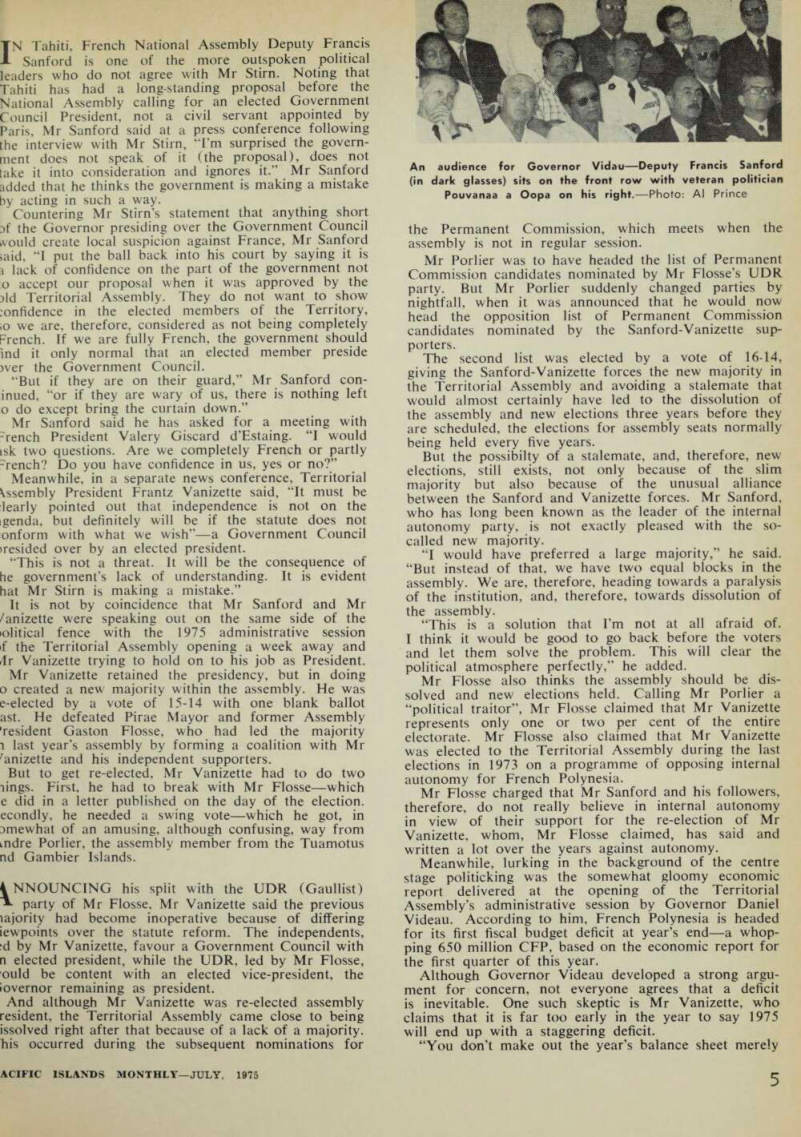
Long legs—first time unveiled in public?—and a short, short shirt. Mr Whitlam relaxes at the Bora Bora Hotel. — Photo: AI Prince
IN Tahiti, French National Assembly Deputy Francis Sanford is one of the more outspoken political leaders who do not agree with Mr Stirn. Noting that Tahiti has had a long-standing proposal before the National Assembly calling for an elected Government Council President, not a civil servant appointed by Paris, Mr Sanford said at a press conference following the interview with Mr Stirn, “I’m surprised the govern ment does not speak of it (the proposal), does not take it into consideration and ignores it.” Mr Sanford added that he thinks the government is making a mistake by acting in such a way.
Countering Mr Stirn’s statement that anything short Df the Governor presiding over the Government Council would create local suspicion against France, Mr Sanford >aid, “I put the ball back into his court by saying it is a lack of confidence on the part of the government not o accept our proposal when it was approved by the aid Territorial Assembly. They do not want to show ;onfidence in the elected members of the Territory, io we are, therefore, considered as not being completely French. If we are fully French, the government should ind it only normal that an elected member preside )ver the Government Council.
“But if they are on their guard,” Mr Sanford con inued, “or if they are wary of us, there is nothing left o do except bring the curtain down.”
Mr Sanford said he has asked for a meeting with -rench President Valery Giscard d’Estaing. “I would isk two questions. Are we completely French or partly -rench? Do you have confidence in us, yes or no?”
Meanwhile, in a separate news conference, Territorial Assembly President Frantz Vanizette said, “It must be learly pointed out that independence is not on the igenda, but definitely will be if the statute does not onform with what we wish”—a Government Council (resided over by an elected president.
“This is not a threat. It will be the consequence of he government’s lack of understanding. It is evident hat Mr Stirn is making a mistake.”
It is not by coincidence that Mr Sanford and Mr Vanizette were speaking out on the same side of the •olitical fence with the 1975 administrative session if the Territorial Assembly opening a week away and Ar Vanizette trying to hold on to his job as President.
Mr Vanizette retained the presidency, but in doing o created a new majority within the assembly. He was e-elected by a vote of 15-14 with one blank ballot ast. He defeated Pirae Mayor and former Assembly 'resident Gaston Flosse, who had led the majority i last year’s assembly by forming a coalition with Mr 'anizette and his independent supporters.
But to get re-elected, Mr Vanizette had to do two lings. First, he had to break with Mr Flosse—which e did in a letter published on the day of the election, econdly, he needed a swing vote—which he got, in amewhat of an amusing, although confusing, way from mdre Porlier, the assembly member from the Tuamotus nd Gambier Islands. iNNOUNCING his split with the UDR (Gaullist) party of Mr Flosse, Mr Vanizette said the previous lajority had become inoperative because of differing iewpoints over the statute reform. The independents, ;d by Mr Vanizette, favour a Government Council with n elected president, while the UDR, led by Mr Flosse, ould be content with an elected vice-president, the iovernor remaining as president.
And although Mr Vanizette was re-elected assembly resident, the Territorial Assembly came close to being issolved right after that because of a lack of a majority, his occurred during the subsequent nominations for
the Permanent Commission, which meets when the assembly is not in regular session.
Mr Porlier was to have headed the list of Permanent Commission candidates nominated by Mr Flosse’s UDR party. But Mr Porlier suddenly changed parties by nightfall, when it was announced that he would now head the opposition list of Permanent Commission candidates nominated by the Sanford-Vanizette sup porters.
The second list was elected by a vote of 16-14, giving the Sanford-Vanizette forces the new majority in the Territorial Assembly and avoiding a stalemate that would almost certainly have led to the dissolution of the assembly and new elections three years before they are scheduled, the elections for assembly seats normally being held every five years.
But the possibilty of a stalemate, and, therefore, new elections, still exists, not only because of the slim majority but also because of the unusual alliance between the Sanford and Vanizette forces. Mr Sanford, who has long been known as the leader of the internal autonomy party, is not exactly pleased with the so called new majority.
“I would have preferred a large majority,” he said.
“But instead of that, we have two equal blocks in the assembly. We are, therefore, heading towards a paralysis of the institution, and, therefore, towards dissolution of the assembly.
“This is a solution that I’m not at all afraid of.
I think it would be good to go back before the voters and let them solve the problem. This will clear the political atmosphere perfectly,” he added.
Mr Flosse also thinks the assembly should be dis solved and new elections held. Calling Mr Porlier a “political traitor”, Mr Flosse claimed that Mr Vanizette represents only one or two per cent of the entire electorate. Mr Flosse also claimed that Mr Vanizette was elected to the Territorial Assembly during the last elections in 1973 on a programme of opposing internal autonomy for French Polynesia.
Mr Flosse charged that Mr Sanford and his followers, therefore, do not really believe in internal autonomy in view of their support for the re-election of Mr Vanizette, whom, Mr Flosse claimed, has said and written a lot over the years against autonomy.
Meanwhile, lurking in the background of the centre stage politicking was the somewhat gloomy economic report delivered at the opening of the Territorial Assembly’s administrative session by Governor Daniel Videau. According to him, French Polynesia is headed for its first fiscal budget deficit at year’s end—a whop ping 650 million CFP, based on the economic report for the first quarter of this year.
Although Governor Videau developed a strong argu ment for concern, not everyone agrees that a deficit is inevitable. One such skeptic is Mr Vanizette, who claims that it is far too early in the year to say 1975 will end up with a staggering deficit.
“You don’t make out the year’s balance sheet merely
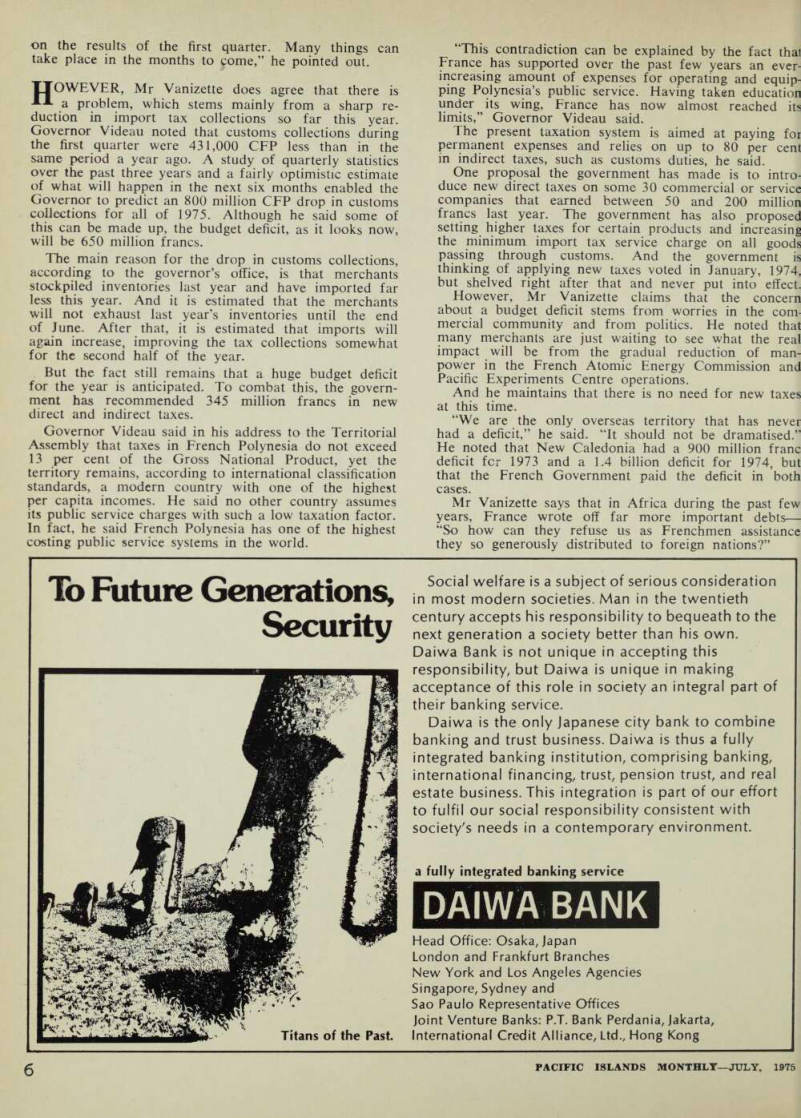
An audience for Governor Vidau—Deputy Francis Sanford (in dark glasses) sits on the front row with veteran politician Pouvanaa a Oopa on his right.— Photo: Al Prince
on the results of the first quarter. Many things can take place in the months to pme,” he pointed out.
TTOWEVER, Mr Vanizette does agree that there is a problem, which stems mainly from a sharp re duction in import tax collections so far this year.
Governor Videau noted that customs collections during the first quarter were 431,000 CFP less than in the same period a year ago. A study of quarterly statistics over the past three years and a fairly optimistic estimate of what will happen in the next six months enabled the Governor to predict an 800 million CFP drop in customs collections for all of 1975. Although he said some of this can be made up, the budget deficit, as it looks now, will be 650 million francs.
The main reason for the drop in customs collections, according to the governor’s office, is that merchants stockpiled inventories last year and have imported far less this year. And it is estimated that the merchants will not exhaust last year’s inventories until the end of June. After that, it is estimated that imports will again increase, improving the tax collections somewhat for the second half of the year.
But the fact still remains that a huge budget deficit for the year is anticipated. To combat this, the govern ment has recommended 345 million francs in new direct and indirect taxes.
Governor Videau said in his address to the Territorial Assembly that taxes in French Polynesia do not exceed 13 per cent of the Gross National Product, yet the territory remains, according to international classification standards, a modern country with one of the highest per capita incomes. He said no other country assumes its public service charges with such a low taxation factor.
In fact, he said French Polynesia has one of the highest costing public service systems in the world.
“This contradiction can be explained by the fact that France has supported over the past few years an ever increasing amount of expenses for operating and equip ping Polynesia’s public service. Having taken education under its wing, France has now almost reached its limits,” Governor Videau said.
The present taxation system is aimed at paying for permanent expenses and relies on up to 80 per cent in indirect taxes, such as customs duties, he said.
One proposal the government has made is to intro duce new direct taxes on some 30 commercial or service companies that earned between 50 and 200 million francs last year. The government has also proposed setting higher taxes for certain products and increasing the minimum import tax service charge on all goods passing through customs. And the government is thinking of applying new taxes voted in January, 1974, but shelved right after that and never put into effect.
However, Mr Vanizette claims that the concern about a budget deficit stems from worries in the com mercial community and from politics. He noted that many merchants are just waiting to see what the real impact will be from the gradual reduction of man power in the French Atomic Energy Commission and Pacific Experiments Centre operations.
And he maintains that there is no need for new taxes at this time.
“We are the only overseas territory that has never had a deficit,” he said. “It should not be dramatised.”
He noted that New Caledonia had a 900 million franc deficit for 1973 and a 1.4 billion deficit for 1974, but that the French Government paid the deficit in both cases.
Mr Vanizette says that in Africa during the past few years, France wrote off far more important debts— “So how can they refuse us as Frenchmen assistance they so generously distributed to foreign nations?”