Magazine Section
pp. 43-45 · Read in the full issue

The Islander The Japanese And
The Sea Could Not Kill
By W. H. Percival
Sixteen months before the Japanese occupation forces on Ocean Island massacred about 200 Gilbertese labourers a few days after the end of World War 11, seven Gilbertese made a desperate attempt to escape from the island.
They were employed by the Japanese as fishermen and they left Ocean Island about midnight on April 4, 1944, in three canoes, ostensibly on another fishing trip.
Only one man, Nabetari, then aged 24, survived after spending seven months in a drifting canoe. His feat of sustained courage and endurance is probably unmatched in the recent history of the Pacific Ocean.
The seven men believed that they would shortly be murdered by their captors because food had become very scarce and the Japanese were learning to fish for themselves. Food stealing was punishable by death, and in 1943 some islanders had been publicly beheaded for this offence.
The escape plan was put forward by a man named Bateriki who said he was a good navigator and would lead them to another island. They would leave that same night. They stole some Japanese water bottles, filled them, and put them in their three sailing canoes, along with a few coconuts. They planned to sail to the Gilberts about 240 miles to the east and against prevailing winds and currents.
Four of the escapees, Nabetari, Bateriki, Teieru and Taebo, all came from Nikunau Island in the Gilberts -as did Kabunare, the sole survivor of the massacre of August 1945. The three other men were Reueru, Teka mmo and Kaiaia.
The following night a storm blew out all their sails and the canoe with navigator Bateriki and two others aboard, became separated from the Dthers and was not seen again.
After that the two remaining canoes were roped together at night.
The coconuts and water were soon consumed and, with the sails gone, they could only drift westwards with the current and prevailing winds.
They existed on fish, rainwater and the blood of captured sharks. Rain water was caught in the remains of a sail stretched from the hull to the outrigger. Bonito, which sometimes followed the canoes, were caught with red feather lures. Gilbertese fisher men had observed that seabirds with red tail feathers caught bonito by flying low over the sea. The red feathers attracted the fish which leaped out of the sea to snap at them —and were caught themselves. When Nabetari and his companions caught more fish than they needed for im
mediate use they preserved the sur plus by sun-drying.
Five months later the second canoe was lost from sight. Now only Nabetari and Reueru were left. Some weeks later another mishap occurred when they were shark fishing.
When sharks followed them they suspended a rope noose in the sea near the hull. One man attracted the shark into the noose by waving his hand in water ahead of the noose. As the shark attacked, the arm was with drawn and the noose was drawn tightly over the tail of the fish.
By this time both men were weak from malnutrition and exposure. A shark was sighted and Reueru used
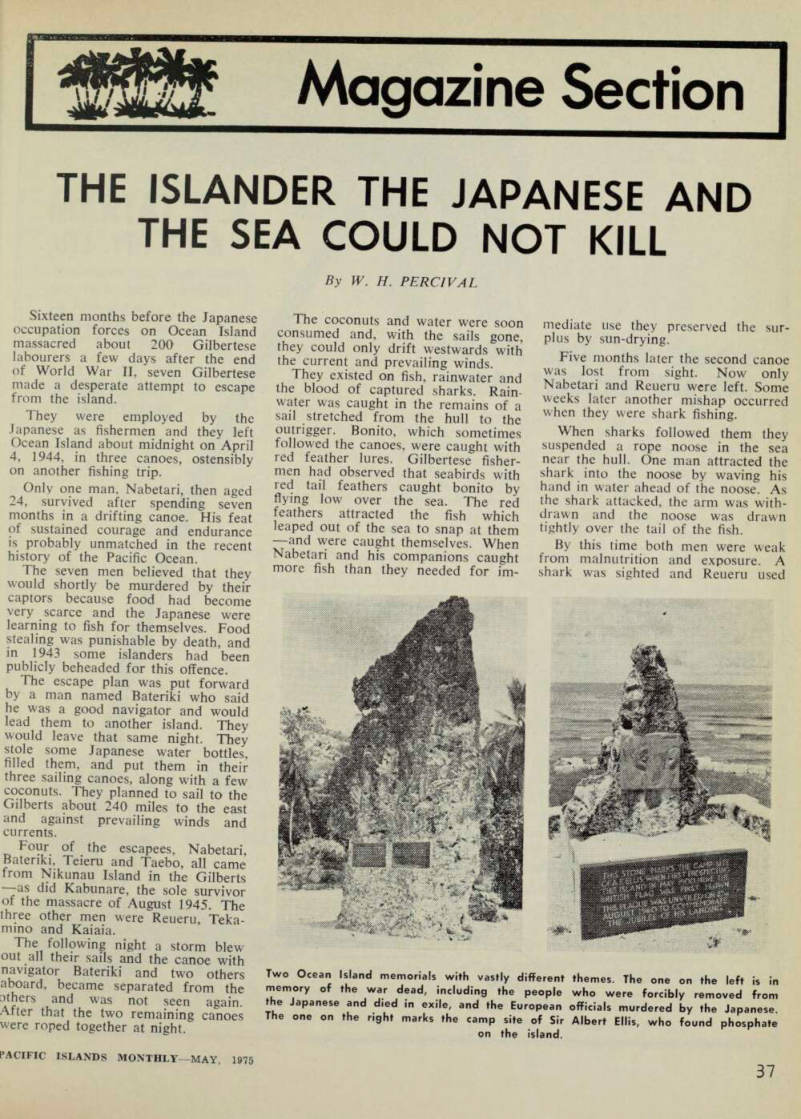
Two Ocean Island memorials with vastly different themes. The one on the left is in memory of the war dead, including the people who were forcibly removed from the Japanese and d.ed in exile, and the European officials murdered by the Japanese.
The one on the right marks the camp site of Sir Albert Ellis, who found phosphate on the island.
the white palm of his hand as bait.
The shark attacked—and Reueru was badly bitten on the upper arm. All Nabetari could do was bandage the wound.
One night, about a week later, both men were asleep when something overturned the canoe. Nabetari awoke to find himself in the sea close to the capsized craft. He located Reueru and gave him a paddle and a tin to help support him while he righted the canoe. By the time he succeeded in righting the outrigger Reueru had dis appeared. He searched for him again at first light. But Reueru had gone forever, Nabetari continued his long drift west, too weak to paddle and ignorant of where land lay. Twice a high flying aircraft flew over him but failed to see either the canoe or the piece of cloth he waved. Once he sighted a ship a long way off, but the ship did not spot him. Some time after this a ship passed so close to him he plainly saw the crew. It appeared to be a naval vessel—and it did not stop to pick him up.
“This ship was very close to me and I could see the men on it,” Nabe tari said later. “I think they were Japanese. The ship had one high mast, was high at the bow and low at
the stern. It was travelling very fast as though it was being chased.”
Nabetari was very weak when he finally sighted land and was washed up on the reef the following day. In the words of the doctor who treated him: “This native arrived in an ex treme state of physical exhaustion, covered with sores and with his hair falling out.”
Nabetari crawled up on an empty beach, rested there that afternoon and slept there that night. The next day he set off to find a village by crawling in the shallows so that the buoyancy of the sea supported him and eased his painful labour. Late that after noon he sighted a village and was found by an old man and three young ones whose language he could not understand. They carried him to the village where he was cared for during the next four days. Then a European doctor arrived by launch, presum ably after the villagers had got word to him.
Nabetari learned that the name of the place was Maron, but did not know if that was the name of the village or the island. He had reached one of the Ninigo Islands which lie near New Guinea’s north-east coast and about 125 miles north-west of
Manus in the Admiralty Group. It was then early November 1944, and he had drifted about 1,800 miles in seven months.
He was taken to the Australian Base Hospital at Manus where he made a partial recovery after three months treatment. From the little he was able to tell them, the authorities realised that he could give valuable military information regarding the Japanese defences on Ocean. As soon as he was strong enough, he was flown to Tarawa for interrogation.
At Tarawa, where he recovered completely, he was taught map read ing by an Army Intelligence officer.
He then gave military information which, when cross-checked, proved to be amazingly accurate. He also gave information about the fate of the six Europeans who elected to remain be hind on Ocean Island to care for the natives when it was known that the island would shortly be invaded by the Japanese, and when they could have been evacuated with the rest of the European staff. The six all died as a result of malnutrition and Japanese brutality.
A few years ago, Nabetari was working as a butcher on Ocean Island, a happily-married man with a family.