A blue lagoon and a ride
pp. 39-41 · Read in the full issue
with Her Majesty's mails
By Michael Hook
You can walk from Betio to the adjoining islet of Bairiki at low tide.
Many do so, and even carry bicycles across when the water is up to their knees or higher, but the passage is a good half-mile in length and ex posed to a fierce sun.
Her Majesty’s mails and their smiling, brown, kilted bearer travel in the mail launch back and forth every two hours or so from dawn to dusk, and, in my day, for one Australian shilling (or for nothing if “on duty”) anyone else could go the same way. It was a longer jour ney, but infinitely more pleasant.
Our house faced the lagoon and on any day that my duties took me to Colony headquarters on Bairiki, I could eat my breakfast in peace, knowing that I should hear that familiar chug-chug-chug long before the launch came into view on its first run of the day from Bairiki. From that moment I had at least 10 min utes before I need mount my bicycle and set off westwards along the bumpy road of dried reef-mud, un der the blessed shade of the coconut palms, for the harbour.
By the steps would be a colourful assembly of some 30 or 40 souls— honey-skinned islanders, all bare footed and most bare-headed except for a crown of frangipani blossoms (for a day’s outing on Bairiki would be something of a holiday, whatever the reason for going).
The women would be dressed in gay, cotton frocks with perhaps a riri (pandanus skirt) over the top of it round their ample hips, the men in coloured sulus, either bare chested or wearing bright Hawaiian shirts, and the children in nothing but the briefest of lavalavas.
Round about on the quay-side was their luggage, without which no Gil bertese or Ellice islander could em bark on even such a short journey— bundles of pandanus mats, cartons tied with string or flex, ancient suit cases long discarded by the im provident Europeans, wooden boxes, crates of squawking hens, bottles of coconut toddy and bicycles sadly in need of oil and attention.
Beside the travellers were at least as many “seers-off” plus a policeman
perhaps (who would look the other way, like the gentle fellow he was, when more than the “twenty-five souls” crowded into the launch).
The local postmaster was there with a bag of mail, and a dozen care free folk who had simply come to stand and stare. A gang of small boys, playing hookey from school, their naked golden bodies glinting and dripping in the sunshine, surged up the steps at the very last moment before the launch came alongside and leaped back into the water from the quay.
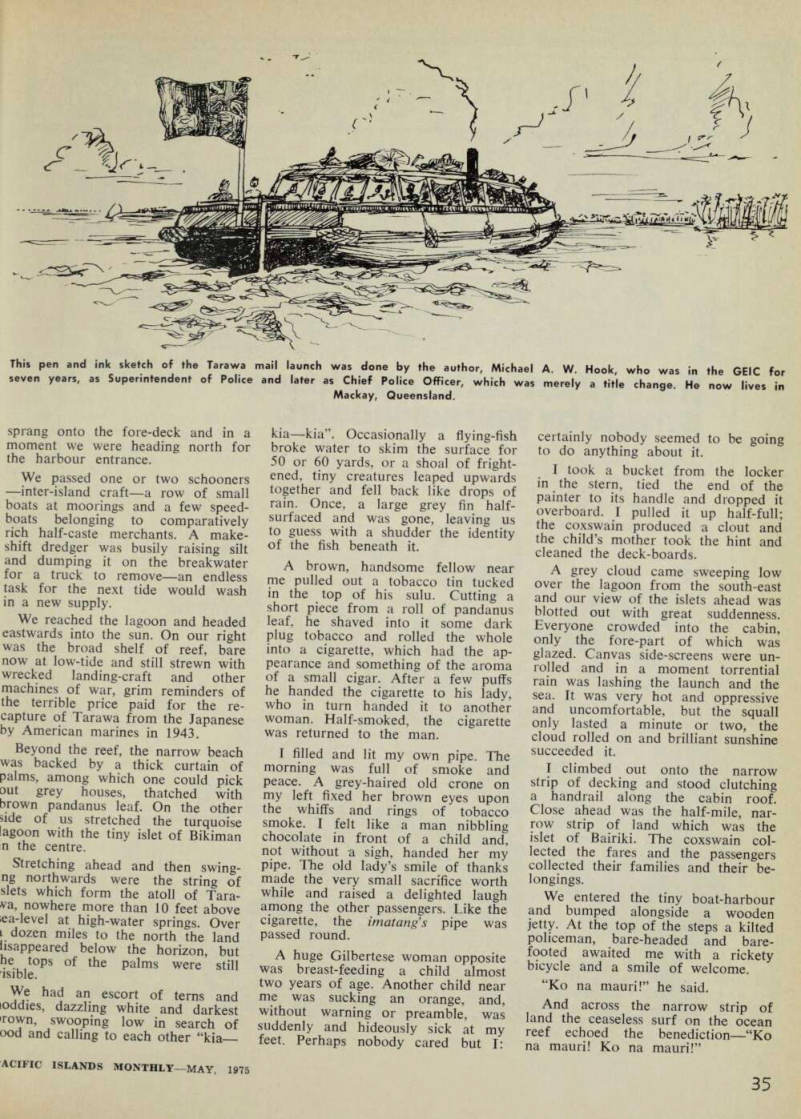
The launch was a stout, wooden vessel, painted white and green.
Over her stern hung a Blue Ensign, emblazoned with the crest of the Gil bert and Ellice Islands Colony, alas much tattered by the buffeting of the South-East Trades. She was a roomy craft, but appeared to be nigh burst ing with humanity and a varied col lection of goods atop the cabin roof.
Almost before the bow-man had leaped ashore with the painter and while the coxswain was still pulling in the stern with the boat-hook, a sort of human explosion took place.
There was a surge upwards of gay, laughing, shouting, brown folk and a simultaneous down-current of the hitherto passive people on the wharf.
To the inexperienced eye bedlam and chaos reigned. Baggage flew upwards: cartons were tossed downwards.
Bicycles seemed to have grown wings and rolls of mats floated like chaff in the wind. The extraordinary thing was that nothing and nobody fell into the water, except a couple of the small nude bathers, who were pushed in by the coxswain for tres passing on his launch.
I was last aboard, not out of pride or humility or politeness, but from simple caution, and I took a seat in the stern-sheets.
On the engine-cowl amidships was an alarm-clock of that shy variety which only goes when lying on its face. The engineer looked at it, lay it back face-down, nodded at the coxswain and swung the starting handle. The engine puttered loudly and confidently. The coxswain gave an order and put the helm hard over as we came astern. The bow-man
sprang onto the fore-deck and in a moment we were heading north for the harbour entrance.
We passed one or two schooners —inter-island craft—a row of small boats at moorings and a few speed boats belonging to comparatively rich half-caste merchants. A make shift dredger was busily raising silt and dumping it on the breakwater for a truck to remove—an endless task for the next tide would wash in a new supply.
We reached the lagoon and headed eastwards into the sun. On our right was the broad shelf of reef, bare now at low-tide and still strewn with wrecked landing-craft and other machines of war, grim reminders of the terrible price paid for the re capture of Tarawa from the Japanese by American marines in 1943.
Beyond the reef, the narrow beach was backed by a thick curtain of palms, among which one could pick out grey houses, thatched with brown pandanus leaf. On the other side of us stretched the turquoise lagoon with the tiny islet of Bikiman n the centre.
Stretching ahead and then swing ng northwards were the string of slets which form the atoll of Tara va nowhere more than 10 feet above lea-level at high-water springs. Over i dozen miles to the north the land lisappeared below the horizon, but he tops of the palms were still isible.
We had an escort of terns and ioddies, dazzling white and darkest Town, swooping low in search of ood and calling to each other “kia—
kia—kia”. Occasionally a flying-fish broke water to skim the surface for 50 or 60 yards, or a shoal of fright ened, tiny creatures leaped upwards together and fell back like drops of rain. Once, a large grey fin half surfaced and was gone, leaving us to guess with a shudder the identity of the fish beneath it.
A brown, handsome fellow near me pulled out a tobacco tin tucked in the top of his sulu. Cutting a short piece from a roll of pandanus leaf, he shaved into it some dark plug tobacco and rolled the whole into a cigarette, which had the ap pearance and something of the aroma of a small cigar. After a few puffs he handed the cigarette to his lady, who in turn handed it to another woman. Half-smoked, the cigarette was returned to the man.
I filled and lit my own pipe. The morning was full of smoke and peace. A grey-haired old crone on my left fixed her brown eyes upon the whiffs and rings of tobacco smoke. I felt like a man nibbling chocolate in front of a child and, not without a sigh, handed her my pipe. The old lady’s smile of thanks made the very small sacrifice worth while and raised a delighted laugh among the other passengers. Like the cigarette, the imatang’s pipe was passed round.
A huge Gilbertese woman opposite was breast-feeding a child almost two years of age. Another child near me was sucking an orange, and, without warning or preamble, was suddenly and hideously sick at my feet. Perhaps nobody cared but I:
certainly nobody seemed to be going to do anything about it.
I took a bucket from the locker in the stern, tied the end of the painter to its handle and dropped it overboard. I pulled it up half-full; the coxswain produced a clout and the child’s mother took the hint and cleaned the deck-boards.
A grey cloud came sweeping low over the lagoon from the south-east and our view of the islets ahead was blotted out with great suddenness.
Everyone crowded into the cabin, only the fore-part of which was glazed. Canvas side-screens were un rolled and in a moment torrential rain was lashing the launch and the sea. It was very hot and oppressive and uncomfortable, but the squall only lasted a minute or two, the cloud rolled on and brilliant sunshine succeeded it.
I climbed out onto the narrow strip of decking and stood clutching a handrail along the cabin roof.
Close ahead was the half-mile, nar row strip of land which was the islet of Bairiki. The coxswain col lected the fares and the passengers collected their families and their be longings.
We entered the tiny boat-harbour and bumped alongside a wooden jetty. At the top of the steps a kilted policeman, bare-headed and bare footed awaited me with a rickety bicycle and a smile of welcome.
“Ko na mauri!” he said.
And across the narrow strip of land the ceaseless surf on the ocean reef echoed the benediction—“Ko na mauri! Ko na mauri!”
This pen and ink sketch of the Tarawa mail launch was done by the author, Michael A. W. Hook, who was in the GEIC for seven years, as Superintendent of Police and later as Chief Police Officer, which was merely a title change. He now lives in Mackay, Queensland.