And A Presidential Blessing For
pp. 28-29 · Read in the full issue
Cuff-links from the White House ...
Marianas Political Covenant
From a Washington correspondent
Americans tend to surround their president, or at least the office of the presidency, with an aura of exalted mystery. The man in the office is treated with great respect, sometimes bordering on reverence. A visit with that man thus takes on some aspects of a royal court audience—a rare privilege, accorded to only a selected few.
Therefore, the 20 minutes that Gerald Ford spent in March with two members of the Mariana Islands Political Status Commission are being viewed as a significant symbol of high-level interest in the future of the Northern Marianas on the part of the US Government, as well as a distinct honour for the two young men involved.
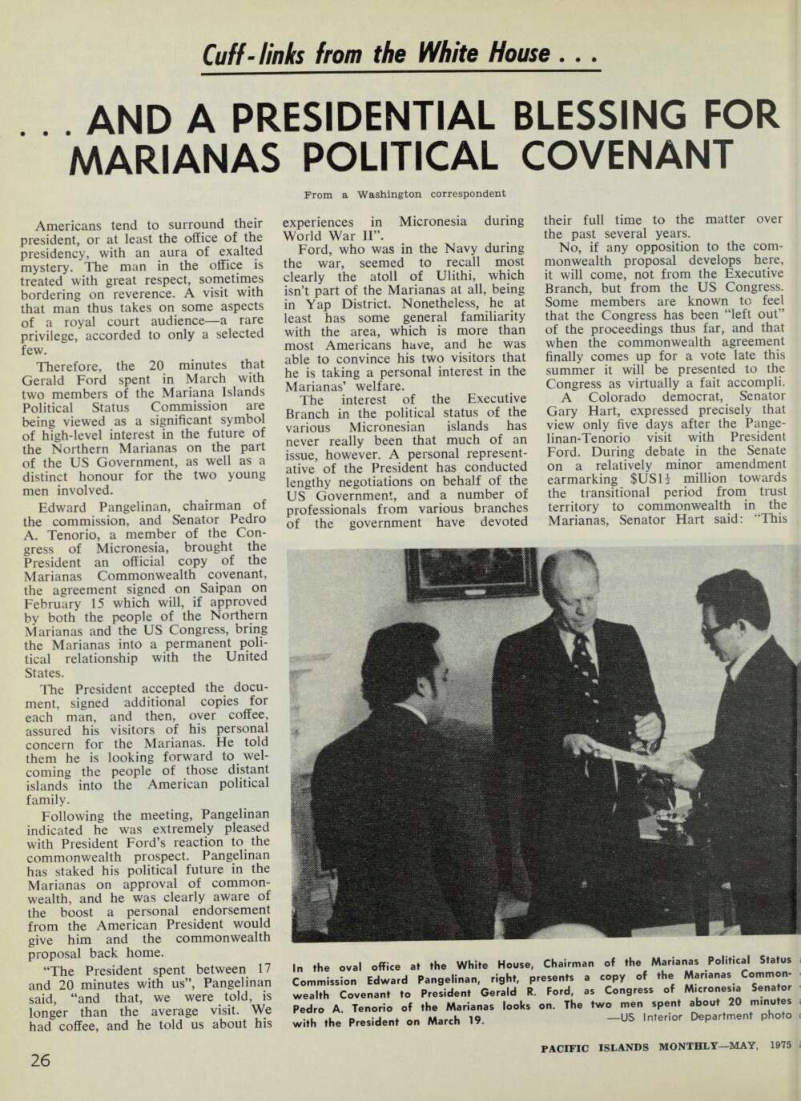
Edward Pangelinan, chairman of the commission, and Senator Pedro A. Tenorio, a member of the Con gress of Micronesia, brought the President an official copy of the Marianas Commonwealth covenant, the agreement signed on Saipan on February 15 which will, if approved by both the people of the Northern Marianas and the US Congress, bring the Marianas into a permanent poli tical relationship with the United States.
The President accepted the docu ment, signed additional copies for each man, and then, oyer coffee, assured his visitors of his personal concern for the Marianas. He told them he is looking forward to wel coming the people of those distant islands into the American political family.
Following the meeting, Pangelinan indicated he was extremely pleased with President Ford’s reaction to the commonwealth prospect. Pangelinan has staked his political future in the Marianas on approval of common wealth, and he was clearly aware of the boost a personal endorsement from the American President would give him and the commonwealth proposal back home.
“The President spent between 17 and 20 minutes with us”, Pangelinan said, “and that, we were told, is longer than the average visit. We had coffee, and he told us about his
experiences in Micronesia during World War II”.
Ford, who was in the Navy during the war, seemed to recall most clearly the atoll of Ulithi, which isn’t part of the Marianas at all, being in Yap District. Nonetheless, he at least has some general familiarity with the area, which is more than most Americans have, and he was able to convince his two visitors that he is taking a personal interest in the Marianas’ welfare.
The interest of the Executive Branch in the political status of the various Micronesian islands has never really been that much of an issue, however. A personal represent ative of the President has conducted lengthy negotiations on behalf of the US Government, and a number of professionals from various branches of the government have devoted
their full time to the matter over the past several years.
No, if any opposition to the com monwealth proposal develops here, it will come, not from the Executive Branch, but from the US Congress.
Some members are known to feel that the Congress has been “left out” of the proceedings thus far, and that when the commonwealth agreement finally comes up for a vote late this summer it will be presented to the Congress as virtually a fait accompli.
A Colorado democrat, Senator Gary Hart, expressed precisely that view only five days after the Pange linan-Tenorio visit with President Ford. During debate in the Senate on a relatively minor amendment earmarking SUSH million towards the transitional period from trust territory to commonwealth in the Marianas, Senator Hart said: “This
In the oval office at the White House, Chairman of the Marianas Political Status Commission Edward Pangelinan, right, presents a copy of the Marianas Common wealth Covenant to President Gerald R. Ford, as Congress of Micronesia Senator Pedro A Tenorio of the Marianas looks on. The two men spent about 20 minutes with the President on March 19. —US Interior Department photo
whole procedure raises serious ques tions of domestic and foreign policy that I believe Congress should con sider before we proceed any further down the road to making the Marianas Islands a part of the United States”.
The senator then went on to out line some of the problem areas as he sees them. He questioned the wisdom of creating a new group of American citizens at this time; said he doubts the strategic importance of the Marianas, and pointed out that the US will be paying lease money for land on Tinian for a base which the Defence Department at the present time has no intention of building.
The senator also suggested that the method of conducting the com monwealth negotiations—by separat ing the Marianas from the other five districts of the Trust Territory des pite the opposition of the Congress of Micronesia—may tend to work against the US in the United Nations.
The amendment was finally passed, 47 to 39. But the closeness of the vote surprised some observers, in cluding those in the Executive Branch who have worked most closely on the commonwealth. A lobbying effort is now said to be underway to try to bring some of those opposing senators around. But both pro- and anti-commonwealth people here agree that the covenant is going to be the subject of con siderable debate in the Congress be fore it is approved, if approved it ever is.
In the meantime, two members of the Marianas status commission have returned to Saipan with autographed copies of the covenant from Gerald Ford, along with his assurances of support for these newest would-be Americans. And, for good measure, each man was also given a pair of cuff-links bearing the Presidential Seal, as a souvenir of his visit to the Oval Office.
In Saipan, Mr Pangelinan, accord ing to the Micronesian News Service, refuted Senator Hart’s arguments and said the US Congress had not been left out of the deal. The $H million could not be handed over until the US Congress approved the covenant, which had also to be approved by a plebiscite in the Marianas.
Mr Pangelinan said he disagreed with Senator Hart’s suggestion that the Congress of Micronesia had any legal authority or right to dictate to the people of the Marianas the kind 3f political status which was most appropriate for them.
As administering authority under he trusteeship agreement, the United
. S hf e ri^? d J n to “respect the right of self-determination for the people of the Marianas. The United States’ decision to engage in separate status negotiations with the Marianas reflected US recognition of that obligation. The action of the United States in that regard had been recognised by the UN Trusteeship Council p nnrn ' .. th?t B thp l iT^ Senat S r K Hart,S ?nt l w? th 1 the! , us f w ou ld be paywhil L n 1 1? for land on Tinian which the Defence Department had no present intention of using, Mr
Pangelinan said the senator must have been misinformed, , . , xl cjrtl! 16 lf ?. ppr £ v f d both sldes .’ v^? ldc i T ? er Pe’ but dld not re fl uire > tbe United States to lease on f n 18, °° 0 j? ? Mananas, most of Man * S r de / ence Purposes.
Tbe De fence Department late last year announced its decision to defer c . onstruction of any substantial facili ties on Tinian. At present the depart ment’s plan was to use portions of Tinian for military training purposes only. s p p