Tough job
pp. 26-27 · Read in the full issue

for Samoa's Mrs Betham
From John F. Gallien
in Pago Pago Mrs Mere T. Betham, 42, director of the Department of Education (DOE), has one of the toughest jobs in American Samoa. Among her many responsibilities is the introduc tion of the Samoan language into a public school system that has been conducted in English since US Navy times.
“In the past our leaders have come out strongly about the need to be proficient in English”, she told me. “We have emphasised English teaching for proficiency en masse to the extent that we have become in sensitive to the individual needs of many Samoan children and thus contributed to the retardation of those children’s conceptual learning in both Samoan and English.
“Perhaps we have failed to recog nise the importance of putting some emphasis, if not equal emphasis, on proficiency in our native Samoan language”.
As DOE entered the 1960 s the importance of fluency in the Samoan language to Samoan students was not recognised, Mrs Betham said.
One result was that during the 1960 s and early 1970 s a lot of stu dents went through the educational
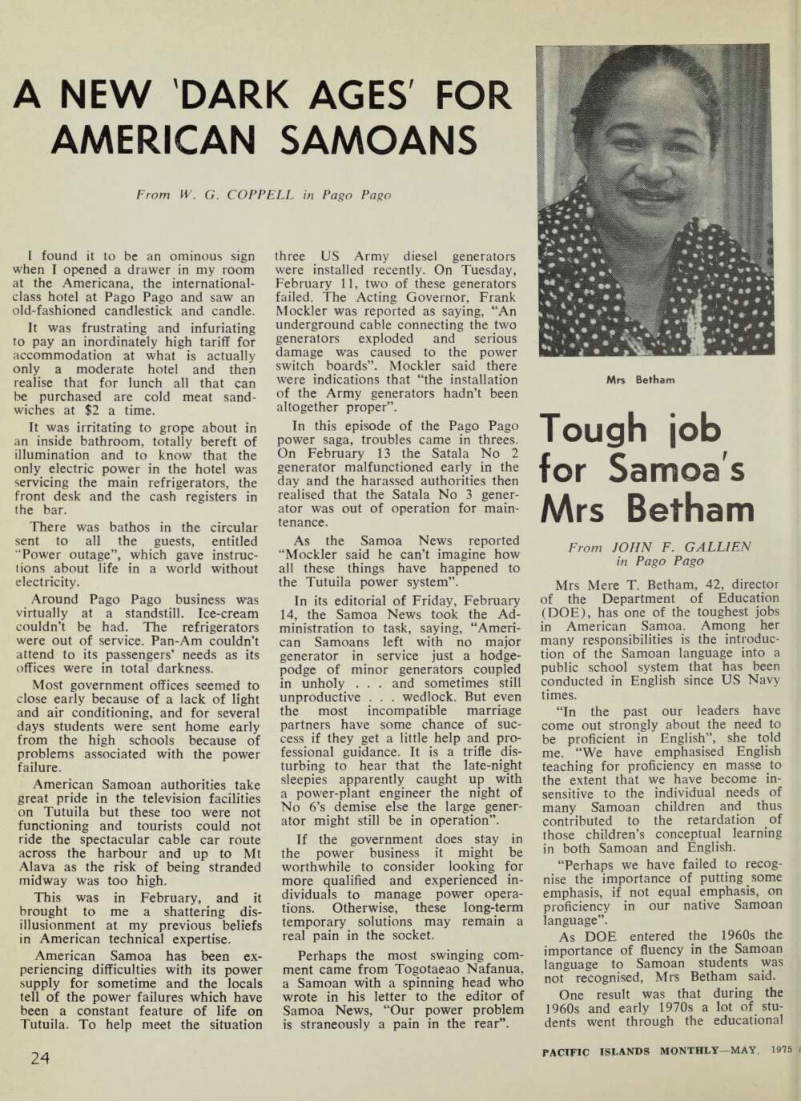
Mrs Betham
£1 ™ p° U f- u maStering either S Th? £Lf n t ghsh 'A a AwnMc ,-n 1 p d rch e ik d f d i U 1? readmg words in English, but lacked understanding of the message communicated through the reading.
“I really feel we did an injustice to those kids. It wasn’t their fault.
It was the fault of the system”, Mrs Betham said.
“That was the main reason DOE took a long look at itself and, in particular, examined the language teaching problem”.
Born in Fagatogo, American Samoa, Mrs Betham was a member of the first graduating class from S f* m0 i ai !i a r. Hlgh in 1 , 950 ‘ She attended Pomona College, Claremont, California for a year and graduated from Geneva College, Beaver Falls, ra. in 1934 with a BA degree in economics and a minor in education. one returned to American Samoa ana taugnt m Samoana. She was rp7ncta!°in1 C 96T i and P tas a, lhet e s n t Samoan to be a fi in IQ?] y p ,
As^,rk“cmr B o^ E m duc”nd
in 1972 was oromoted tn Dprmtv Director for Educational Services y I ast Tnlv a a xri, i '
Pulf 1 nL ! succeeded Nikolao
Pula as Director of Education.
Ia additi ?? td her educational fi°y k h r?’ rs Betham was on the rst pohtical status commission for American Samoa in 1969 and recently became the first member of the board of directors of the Council of Chief State School Officers elected from a territory In 1971 Mrs Betham became part of a group of Samoans and valasis under the leadership of Milton de- Mello, a former director of education, who saw the need for changing the system’s method of language education.
“Research has shown that familiarity in home language is necessary t 0 a mast ery of a second language”, she said. “Admittedly there are some children who assimilate very easily, but for most children it is desirable that the home language be learned first in order to enhance and facilitate the learning of, and in, a second language ‘1" the paSt three years we have !? ade •, *} tcm £ ts t ° em Ph a sise more l^ an d has heen, the teaching of the fl k a resu tße Brst three years ? f l choolmg now taught mostly ? n Samoan Wlth English skills being introduced and taught as a foreign language.
The amount of English taught to Samoan children increases during the first three grades as the children progress from year to year c'l * I, V 1 + u- Sam .°an is used for the teaching socia studies and science because Jt c f n A c ° nve y the abstract concepts ere - Maths 18 taught with En f hsh beca , use can con Y, ey con ' exan ?j )les just as easil y, Mrs am . said ; Individualised instruction and team tea chmg are also teaching methods which have been introduced nto tlie elementary schools in order to Better help students learn.
Early education in the Samoan language is an important step in a child’s educational growth because it enriches its cultural experience as well as makes it easier for that Samoan child to continue its edu cation in English, Mrs Betham be lieves. a time when many of our children would switch to English without difficulty, with everything
It*W ■"
their school ladder and without handicapping themselves”, she said.
But there will always be some children who will need to be taught in Samoan” g