in French Polynesia
pp. 61-63 · Read in the full issue
50 years of aviation in French Polynesia
An exhibition commemorating 50 years of aviation in French Polynesia was opened at the Tourist Board Pavilion on Papeete’s waterfront in February. The two principal participants at the opening were Father Patrick O’Reilly and Captain Hugh Birch, DFC, of Qantas.
Captain Birch was the pilot of the Catalina flying boat Island Voyager which flew on a proving flight into French Polynesia in 1950.
Father O’Reilly, whose qualities of authorship and scholarliness are renowned beyond the Pacific Basin, provided the basis for the exhibition through the release of his book Tahiti et I’aviation: histoire aeronautique de la polynesie francaise (Tahiti and I’aviation: an aeronautical history of French Polynesia).
A well-produced book, it contains a dramatic wealth of photographic and documentary evidence of the progress of aviation in one Pacific Island group.
In almost kaleidoscopic form the reader is taken from the first flight made over the Marquesas by Lt W. S.
Callaway, USN, in a floatplane of the cruiser USS Trenton in 1925. In 1929 the French and Tahitian dignitaries of Papeete grouped for flights over Tahiti in the amphibian and floatplane aircraft of the Taurville and January, 1936, saw the arrival of Escadrille E 8 which established a base at Fare Ute and which operated from the Zelee until 1941.
This squadron is remembered in French Polynesia, not only for its military activities but also for the help it rendered the territory in the health and administration spheres, Wartime aviation then enters the scene. In March, 1941, the USN floatplanes under Admiral Stone de monstrated their formation flying capabilities over Papeete’s waterfront and in February, 1942, an American floatplane base was established at Bora Bora which functioned until February, 1946. The French represen tative at the base was a youthful Francis Sanford, who is now the French Deputy for French Polynesia, and among the dignitaries who visited wartime Bora Bora was Eleanor
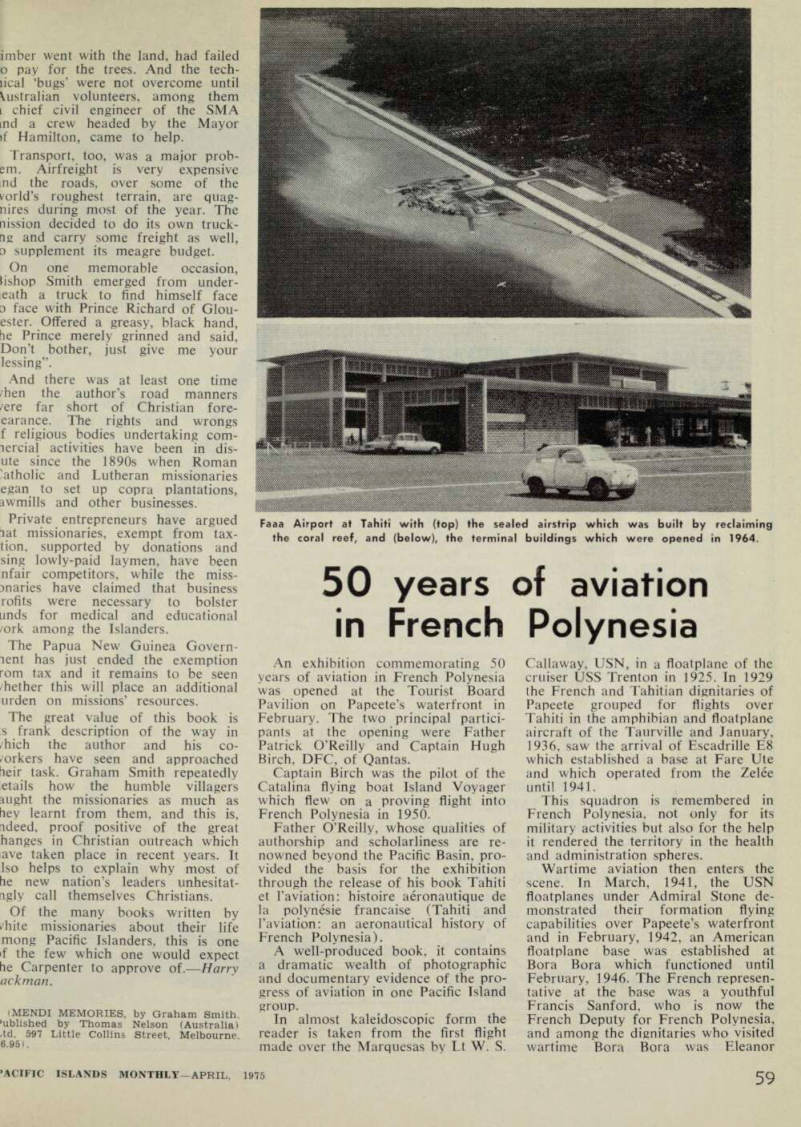
Faaa Airport at Tahiti with (top) the sealed airstrip which was built by reclaiming the coral reef, and (below), the terminal buildings which were opened in 1964.
loosevelt, wife of President Roose elt.
Mr Ralph Varady provided Father )’Reilly with evidence of one of the lore bizarre and lesser-known ind ents of the Pacific War. In July, 941, the German raider Atlantis iade a landing at Vana Yana in the uamotus, an incident unknown to the Lilies for some time.
The ship carried an Arado aircraft nd in a letter to Ralph Varady, Cap fin Bernhard Rogge, captain of the tlantis recalls a “what-might-have sen incident”.
“During our stay in the Pacific,” he rote, “we heard the announcement om Mr Churchill on the BBC.
"here is no raider in the Pacific.’ I msidered to send our plane to apeete to drop a message, ‘Still going rong. Ship 16,’ but I abstained om.”
The post-war era brought the pell ell expansion of aviation in the Paci :. Sir Gordon Taylor made his 'oving flights in the Catalina Frigate ird 111 in 1951 with visits to Papeete id Mangareva and Captain Douglas :arson spent 15 years in French flynesia. Up to 1970 he flew 9,000 )urs in Catalina and Bermuda flying >ats.
Seen alongside the efforts of the oneers, the recent accelerated de- Jopment of inter-island and interna )nal air travel is almost mundane id the establishment of today’s ench military and naval aviation esence is quite commonplace.
At 4,800 CFP the book may well considered expensive but is un mbtedly worthy of being a collector’s :m. Fortunately for the less wealthy e Societe des Oceanistes has also oduced a smaller condensed version
180 Cfp
W. G. Coppell.
(Tahiti Et L’Aviation: Histoire
Jronautique De La Polynesie
lANCAISE, by Patrick O’Reilly. Pub hed by Societe des Oceanistes, 1974. 100 CFP and (condensed) 180 CFP.)
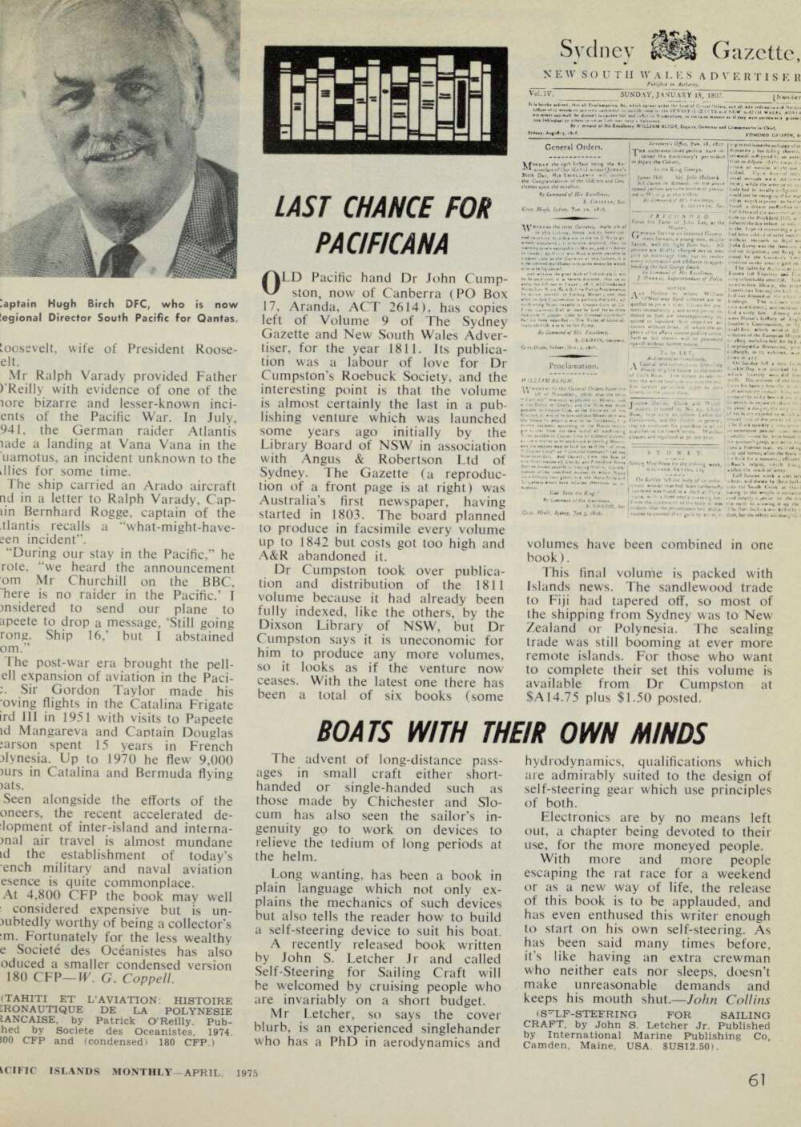
Captain Hugh Birch DFC, who is now [?]egional Director South Pacific for Qantas.