Book Reviews
pp. 59-61 · Read in the full issue

Mendi Memories: or how to learn while teaching
For many decades, the Christian faith and its propagators found fairly ready, often eager and rarely questioned, acceptance among Pacific Islanders. Polynesians, Fijians and, more recently, other Melanesians have, indeed, played a vital part in missionary outreach.
In recent years, in common with other ideals, ideologies and institu tions brought by European and other intruders, Christianity and the churches have been—and continue to be—subjected to criticism and attack by a growing number of Islanders.
There has been a noticeable fall ing off in church attendance, parti cularly in urban areas, even though most foreign missionary bodies have given way to indigenous church organisations, with Islanders filling most of the top positions.
Nevertheless, Christianity continues to be one of the most important in fluences throughout the Pacific, affecting almost every aspect of daily life, including politics. Some know ledge of the changes which the major churches are undergoing is, there fore, essential if one wants to under stand the situation as a whole.
Graham Smith, the author of Mendi Memories, has had a major part in bringing about those changes in the Southern Highlands of Papua New Guinea, He arrived there in 1962 to join the Methodist Overseas Mission at Mendi. Six years later, the United Church, a union of Presbyterians, Methodists and Con gregationalists in Papua New Guinea and the Solomon Islands, appointed him as bishop for its new Highlands Region. An islander took over as bishop when the author re turned to Australia in 1971.
The Huri and Tari people, among whom the author lived, were among the last large groups contacted by Australian patrol officers and other foreigners. They were using a stone age technology to survive in a harsh environment.
Much of this book is about the efforts of the missionaries to help the people to improve their material lot.
Take, for instance, the need for cheap power, where every drop of dieselene has to be flown from the coast, and transferred to a light air craft if destined for an out-station.
The missionaries’ first attempt got washed away.
After delicate negotiations with tribal landowners and digging a tun nel through a spur to leave un touched a sacred shrine, the elderly Queensland volunteer clearing the site for the second scheme barely escaped a fatal clubbing.
Ignorant of the traditional laws, the missionaries, assuming that the
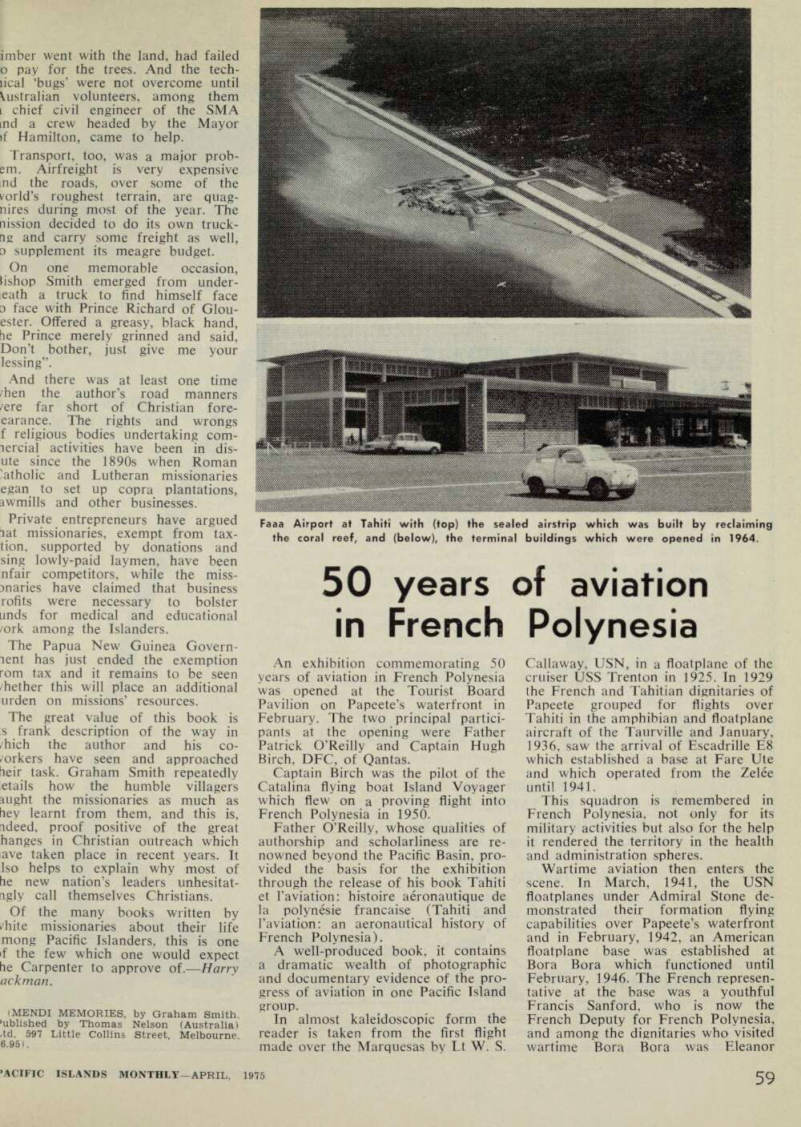
The Mendi Valley, scene of Bishop Smith's labours.
imber went with the land, had failed 0 pay for the trees. And the tech lical ‘bugs’ were not overcome until Australian volunteers, among them 1 chief civil engineer of the SMA md a crew headed by the Mayor if Hamilton, came to help.
Transport, too, was a major prob em. Airfreight is very expensive nd the roads, over some of the world’s roughest terrain, are quag nires during most of the year. The nission decided to do its own truck rig and carry some freight as well, □ supplement its meagre budget.
On one memorable occasion, lishop Smith emerged from under eath a truck to find himself face a face with Prince Richard of Glou ester. Offered a greasy, black hand, he Prince merely grinned and said, Don’t bother, just give me your lessing”.
And there was at least one time /hen the author’s road manners /ere far short of Christian fore earance. The rights and wrongs f religious bodies undertaking com lercial activities have been in dis ute since the 1890 s when Roman 'atholic and Lutheran missionaries egan to set up copra plantations, awmills and other businesses.
Private entrepreneurs have argued aat missionaries, exempt from tax tion, supported by donations and sing lowly-paid laymen, have been nfair competitors, while the miss anaries have claimed that business rofits were necessary to bolster Linds for medical and educational /ork among the Islanders.
The Papua New Guinea Govern lent has just ended the exemption rom tax and it remains to be seen /hether this will place an additional urden on missions’ resources.
The great value of this book is s frank description of the way in /hich the author and his co /orkers have seen and approached heir task. Graham Smith repeatedly etails how the humble villagers aught the missionaries as much as bey learnt from them, and this is, adeed, proof positive of the great hanges in Christian outreach which ave taken place in recent years. It Iso helps to explain why most of he new nation’s leaders unhesitat rigly call themselves Christians.
Of the many books written by /hite missionaries about their life mong Pacific Islanders, this is one if the few which one would expect
he Carpenter to approve of.
Harry
[?]ackman.
(MENDI MEMORIES, by Graham Smith, •üblished by Thomas Nelson (Australia) itd, &97 Little Collins Street, Melbourne. 6.95).