Yesterday
p. 51 · Read in the full issue
New Caledonia and French Polynesia were small in comparison with the French African territories and French metropolitan aid was essential to the development of both, said Mr Roger Duviau, State Secretary of the French Empire, in Paris after a visit in 1955 to the South Pacific. He said that all the people had had schooling and the French language was universally understood. There was no racial problem.
The seeds of French civilisation were bearing fruit, and should be cultivated with care. He described Tahiti and sister-islands as a "paradise on earth", and New Caledonia, as much larger, with different problems. The French population in New Caledonia gave great promise, but there were not enough people to develop the island's natural resources, he said.
Charged with having stabbed her lover to death while he was under the influence of drink, a Loyalty Islands woman was sentenced at Noumea to three years gaol. During the case the Procureur of the Republic (Attorney- General) strongly attacked France's greatest social problem—the excessive consumption of alcohol. A grim picture was painted of the consequences of the evil in France as well as in New Caledonia.
The Colonial Sugar Refining Co Ltd announced that it would close its pineapple cannery at Lautoka, Fiji, at the end of the 1955-56 packing season for economic reasons. The company had everything—land, workshops, engineers to make repairs to plant, chemists, soil control experts, men experienced in agriculture and the raw sugar. This caused a businessman to remark, "If the CSR cannot make a go of it, nobody else can". Hew right he was—all attempts to grow pineapples on a commercial scale since then, except for supplying local markets, have been failures.
PIM, in April, 1955, was rather critical of Canberra resistance to the diplomatic and official status of the man in charge of Papua New Guinea. He was known as Administrator and addressed as his Honour. Yet seven other territories, controlled by the British, French and New Zealanders, boasted such titles as Governor, High Commissioner and Resident Commissioner, and all were "his Excellencies".
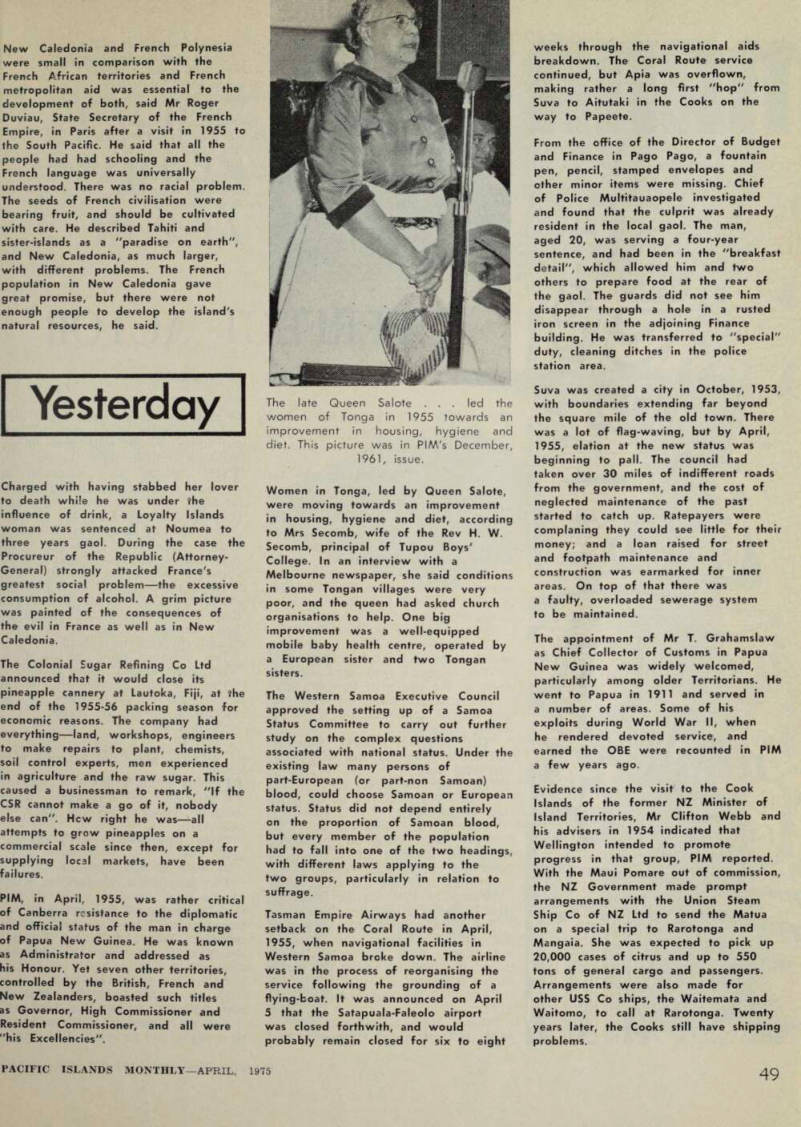
Women in Tonga, led by Queen Salote, were moving towards an improvement in housing, hygiene and diet, according to Mrs Secomb, wife of the Rev H. W.
Secomb, principal of Tupou Boys' College. In an interview with a Melbourne newspaper, she said conditions in some Tongan villages were very poor, and the queen had asked church organisations to help. One big improvement was a well-equipped mobile baby health centre, operated by a European sister and two Tongan sisters.
The Western Samoa Executive Council approved the setting up of a Samoa Status Committee to carry out further study on the complex questions associated with national status. Under the existing law many persons of part-European (or part-non Samoan) blood, could choose Samoan or European status. Status did not depend entirely on the proportion of Samoan blood, but every member of the population had to fall into one of the two headings, with different laws applying to the two groups, particularly in relation to suffrage.
Tasman Empire Airways had another setback on the Coral Route in April, 1955, when navigational facilities in Western Samoa broke down. The airline was in the process of reorganising the service following the grounding of a flying-boat. It was announced on April 5 that the Satapuala-Faleolo airport was closed forthwith, and would probably remain closed for six to eight
weeks through the navigational aids breakdown. The Coral Route service continued, but Apia was overflown, making rather a long first "hop" from Suva to Aitutaki in the Cooks on the way to Papeete.
From the office of the Director of Budget and Finance in Pago Pago, a fountain pen, pencil, stamped envelopes and other minor items were missing. Chief of Police Multitauaopele investigated and found that the culprit was already resident in the local gaol. The man, aged 20, was serving a four-year sentence, and had been in the "breakfast detail", which allowed him and two others to prepare food at the rear of the gaol. The guards did not see him disappear through a hole in a rusted iron screen in the adjoining Finance building. He was transferred to "special" duty, cleaning ditches in the police station area.
Suva was created a city in October, 1953, with boundaries extending far beyond the square mile of the old town. There was a lot of flag-waving, but by April, 1955, elation at the new status was beginning to pall. The council had taken over 30 miles of indifferent roads from the government, and the cost of neglected maintenance of the past started to catch up. Ratepayers were complaning they could see little for their money; and a loan raised for street and footpath maintenance and construction was earmarked for inner areas. On top of that there was a faulty, overloaded sewerage system to be maintained.
The appointment of Mr T. Grahamslaw as Chief Collector of Customs in Papua New Guinea was widely welcomed, particularly among older Territorians. He went to Papua in 1911 and served in a number of areas. Some of his exploits during World War 11, when he rendered devoted service, and earned the OBE were recounted in PIM a few years ago.
Evidence since the visit to the Cook Islands of the former NZ Minister of island Territories, Mr Clifton Webb and his advisers in 1954 indicated that Wellington intended to promote progress in that group, PIM reported.
With the Maui Pomare out of commission, the NZ Government made prompt arrangements with the Union Steam Ship Co of NZ Ltd to send the Matua on a special trip to Rarotonga and Mangaia. She was expected to pick up 20,000 cases of citrus and up to 550 tons of general cargo and passengers.
Arrangements were also made for other USS Co ships, the Waitemata and Waitomo, to call at Rarotonga. Twenty years later, the Cooks still have shipping problems.
The late Queen Salote . . . led the women of Tonga in 1955 towards an improvement in housing, hygiene and diet. This picture was in PIM's December, 1961, issue.