Magazine Section
pp. 39-42 · Read in the full issue

New Caledonia, Island Paradise'
Born Out Of A Convicts' Hell
By Helen Rousseau
Noumea, which today proudly boasts some of the most imaginative architecture in the South Pacific Islands, some of the most refined cuisine and the flashiest cars on its autoroutes, needs only to look back some 75 years to a time when starved French convicts crowded in stinking dungeons, murdered each other for a chunk of bread and, chained together For years on end, laboured to build the town’s first roads.
A graphic account of this hellish beginning to Caledonian history comes from Alphonse Delfaut, who, as convict No 1275, endured 30 years in the penal settlement centred on the Isle of Nou, in Noumea Harbour.
Delfaut’s struggle to escape; then to reform both his life and the system are vividly related in a manuscript unearthed by a young Caledonian intellectual, an autonomist member uf the Territorial Assembly, Paul Griscelli. The document was recently published in book form (Les Damnes Ju Pacifique) by the Kiwanis Club of Noumea which, by sales of this work, vas able to donate $A15,000 to a Noumea orphanage.
Raconteur Delfaut assumes a bare Jisguise to his identity by using the uom-de-plume of Daufelt to make lis autobiographical revelations. For : urther reasons of discretion, editor Griscelli replaced most names of other convicts by initials, since living persons could otherwise be easily :raced to their forebears, especially in he small farming towns where they are settled such as La Foa and Bourail. Unlike Australia, no one has constructed a “convict aristocracy”.
From his own and other accounts, t is obvious that Delfaut was a con vict of no ordinary intelligence and vigour. He arrived on the Isle of Nou n 1867, with the first convict ships From France. The prisoners were irst put to work building installations md roads, some of which still re
main, although He Nou is actually no longer an island: it was connected to the mainland at Noumea in 1972, by the new port installations built across the harbour.
He Nou convict gangs also worked at kilns for baking builder’s lime and at cutting granite stone. Under the first local French Governor Guillain, who arrived in 1862, the convicts also helped develop the island capital, a military post known as Port de France, until it was renamed Noumea in 1866.
The town’s foreshores consisted of an extensive swamp which the con victs had to fill in, by levelling down a bayside hilltop. In this way they filled in the Quartier Latin area which now includes the Noumea police station, museum and post office.
Delfaut himself was fortunate, at first, in being given a clerical position in the penitentiary administration service, but the authority which he gained there led to his downfall and a new departmental head, Colonel Charriere, had him sent straight to the horrors of convict prison life—the bagne (pron bahnye). Delfaut de scribed it as “that vast sewer where ignorance, perversion and shame wallow amid cowardice and contempt”.
He suffered that “cancerous wound which injects a frightful venom into the souls of those who stay there for long”.
He was not a man to submit easily to this humiliation. He voiced his protest by writing a vehement pamph let against Charriere for downgrading him. He also dared to resist an over seer who struck him unjustly and finally retaliated by killing the over seer. As a reprisal, an extra 40 years were added to his original term of 20 years hard labour. In addition, Char riere, overriding the judge’s decision, had him sent to the punishment block and chained up for five years to one of the worst criminals in the settle
ment. Here the punishments included starvation diet, terrible torture and the horror of being chained up with beings “depraved right through to the marrow in their bones”.
These were the depths to which a man could be cast in the Isle of Nou, yet in Delfaut’s case he had begun life with every promise of ease and comfort. The son of a provincial solicitor, he was originally educated by the Jesuits. But his father died a republican-socialist exile, under the Napoleonic empire and his mother died shortly afterwards of sorrow and despair.
Delfaut was left a young teenager shouldered with the task of support ing 10 younger brothers and sisters.
He strove bravely to provide for his family and joined the French Army in North Africa. But unable to tolerate insults, he struck a superior officer and was imprisoned.
He escaped, deserted from the army and fled to Tunisia where he prospered until the illness of a sister drew him back to France to her deathbed. The French Government granted him a “safe-conduct” to France, but on his return through Algeria this was revoked and he was promptly imprisoned. Again he fled, but with nowhere to go, in despera tion he disguised his identity and turned to crime as a forger. Betrayed by a friend, he was sentenced to 20 years hard labour.
The brutality of the penal setttle ment in New Caledonia drove many men to risk their lives in escape or even to choose the guillotine. Delfaut recorded that men did not pale as they walked towards their fate at the guillotine, since they knew that death would deliver them from the prison atrocities. He even told of prisoners deliberately killing each other in order to be sentenced to death and gain freedom on the edge of the fatal blade.
He also described the way in which
prisoners were terrorised in the bagne, not just by their overseers but by depraved fellow criminals, sexual perverts, robbers and murderers vhom other prisoners were afraid to denounce, because of the terrible re ?risals they suffered.
Delfaut made four attempts at escape, all of which failed for him self, but two were successful for his ;ollaborators. They were not the )nly men to escape. Probably the nost notorious getaway was that of denri Rochefort, who was among the political deportees sent to New raledonia and imprisoned on He dou, on the Ducos peninsula near Noumea and on the Isle of Pines.
Political deportees, such as Roche ort, included angry writers who con inued in New Caledonia to criticise he government and demand social eform. In 1874 Rochefort, a par icularly intelligent writer, managed sensational escape from Ducos board a sailing ship bound for Aus ralia.
As a result, severe penalties were riposed upon the public servants and lilitary judges responsible. Even free sttlers were expelled from Noumea i reprisal while the Governor was to Paris and penalised. At Jucos prison Charriere’s guards in icted harsher treatment upon the de ortees.
Another young prisoner, Frolet, as not so successful in his escape ttempts but caused quite a sensation i the colony. After disguising him -lf as a recently-arrived count from snegal, he made numerous friends mong the French administration and as on the point of making an □nourable marriage when his lentity was discovered.
Facing his sixth sentence for escape id theft, he was ordered back to veral more years of hard labour.
Then within 12 months he made an other daring escape attempt. It was the eve of July 14 when the tra ditional torch-bearing procession is held to commemorate the Storming of the Bastille. Frolet was this time identified at the procession although wearing a false moustache and fine suit. He was planning to attend the governor’s official ball and had vowed to dance with the governor’s wife.
Delfaut’s escape attempts were directed towards leaving the island altogether and reaching Australia.
His first plot was partly uncovered and he was sent inland, as was his friend Bossy. The other collaborators succeeeded, however, in getting aboard a coastal vessel, but they made the mistake of offloading the captain after throwing his sailors overboard.
Unable to navigate, they straight away ran on to a coral reef outside Noumea harbour and were speedily recaptured. Two were executed as a result while the others were sen tenced to a further five years of dragging the double chain in the punishment block.
One of the objects of the transpor tation system was to have this new French possession colonised and de veloped. Inland convict settlements thus experimented with raising silk worms, sugar cane, rice, tobacco, sheep, cattle and coffee, of which only the last two are maintained sig nificantly today.
Delfaut was sent inland around 1880, when he was assigned to assist ing a surveyor at La Foa. It was from there that he embarked upon three further escape attempts. His friend Bossy was sent to the northern tip of the island where gold and copper had been discovered.
Nickel, of course, was to become the island’s chief asset and the
pioneer in this industry, Irishman John Higginson, was in need of work hands. It is reported that to extract the nickel ore from his mines he was given 300 convicts to work for him for 20 years.
Delfaut’s friend Bossy was not idle in the northern mining area. With the aid of money sent from his family in France he managed to buy a ship and escape to Australia. Delfaut was included in the plot and had already prepared a horse, civilian clothes and false travel documents but when the necessary letter arrived to advise him of the departure date, the inter mediary receiving the letter was too drunk to pass it on . . . Delfaut missed the boat.
Delfaut then plotted with other La Foa convicts and, through friendly drinking sessions, won the collabora tion of a young French soldier. But once again the carefully-laid plans aroused suspicion. Delfaut was im prisoned and still behind bars when others deceived him and escaped by boat to reach Australia six weeks later.
At news of his impending further punishment downgrading to the bottom rank of convicts plus two months of solitary confinement on Nou Island Delfaut hastily sped to Noumea with his horse and civilian clothes. He planned to stow away aboard the Nindia sailing for Sydney, but the vessel left earlier than ex pected and he missed his chance by two hours. He still managed to hide inland for a while in the guise of a new settler, but was identified by a fellow convict and sent back to the Isle of Nou with five more years added to his sentence.
Before civilian governors were posted to New Caledonia, the last of the military and naval governors arrived in 1882. He was Pallu de la
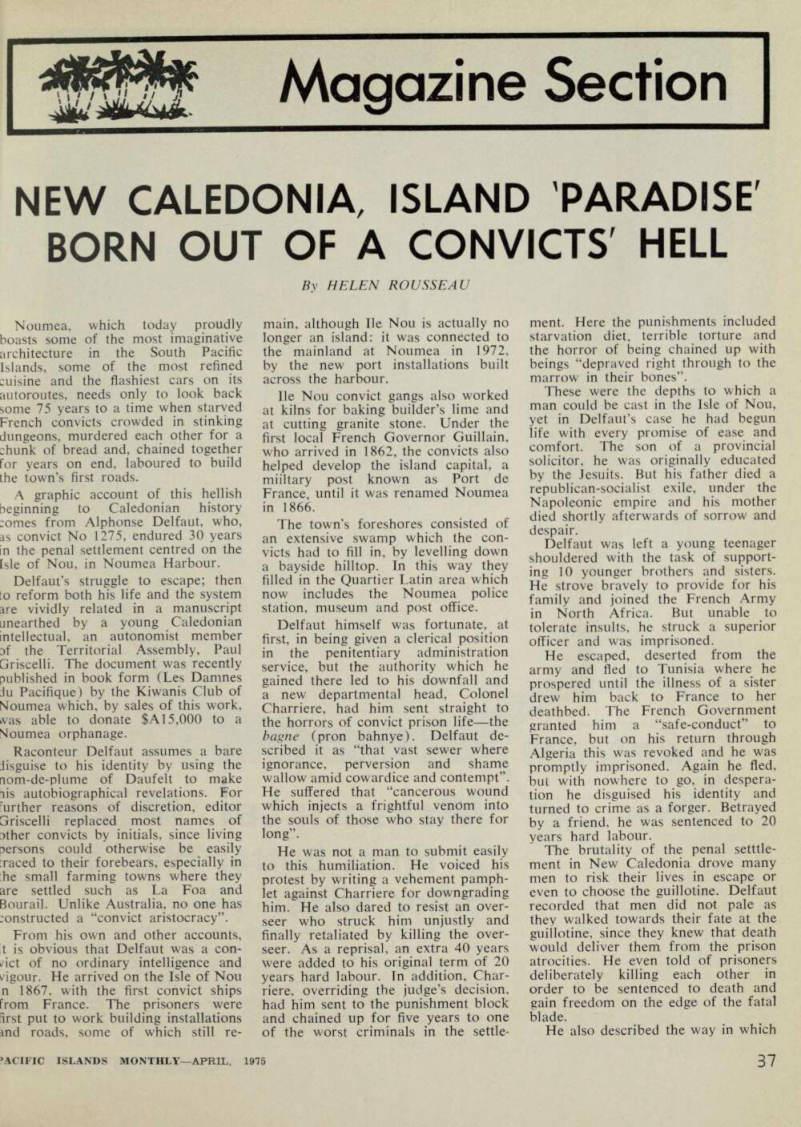
Convicts parade outside their barrack-like huts in the notorious lie Nou penal settlement. Some of the buildings have disappeared but the prison, Camp Est, is still used to accommodate Noumea's lawbreakers.
Barriere who, after only two years, left behind him the remarkable achievement of some 400 kilometres (200 miles) of new inland roads, to gether with the setting up of about 1,000 liberated men on inland proper ties.
One of the many problems faced by the young colony was finding suit able womenfolk to come and settle so far from France. For Noumea, young girls were brought cut from a French orphanage and established in what is still known as Orphelinat, a fashionable bayside suburb.
As fas as the inland was concerned, women prisoners were brought out from French gaols and settled in a Roman Catholic convent at Bourail.
Through introductions to liberated men in the area, about 200 marriages at least were arranged which resulted in Bourail becoming known as Bourail - les - vertus (Bourail - the virtuous).
Delfaut, that convict who so fre quently distinguished himself with his daring and vigour, came to play an active part in the development of inland New Caledonia. With 30 con victs at his command he was given the task of opening a road across the central mountains from one side of the island to the other, linking Houailou to Bourail. This task he achieved in the amazing time of eight months, despite the difficult moun tainous terrain and dense under growth.
In recompense. Governor Pallu
granted the convict provisional liberty while awaiting a pardon from France.
Local envy however rose against him, with protest letters against him written in the local press and sent to the Minister in France. A new gov ernor arrived, Delfaut’s privileged position was revoked and he was sent on another mission, this time to help set up a new agricultural centre near Kone and Pouembout, in the north.
His vigour and competence again aroused hostility and finally a superior brought a false accusation against him. The man, who had finally achieved much for the colony, was sent back to He Nou.
There he wrote his manuscript about the age of 64, just before the last convict ship arrived in 1898. At that stage, after about 30 years of convict life, his self-portrait was of a body weakened, and features dis figured, by suffering.
But one could see that “the flame still smoulders in him beneath the ashes, and that a slight spark would no doubt be enough to refire the flame in this ardent, impassioned soul”. If striving and material suc cess had failed to save him, in his heart he was a free man, nurtured by the respect of those who had honoured him with their confidence.
Finally, the steadfastness of his three or four close friends “would arouse the envy of many happy men on this earth”.
Delfaut's story was written not to arouse sadistic instincts, but to urge
reform. His detailed accounts of criminal psychology were intended to prove that the very horrors of prison inevitably drive men to further crime.
For this reason his analysis has won the interest of present-day legal re formers and lawyers; men such as Maitre Jacques de Felice, the leftist French lawyer who defended Regis Debray as well as Caledonian political prisoners such as Nidoishe Naisseline and, last year, 14 mem bers of the Union of Caledonian Youth (UJC).
These prisoners were sent to Camp Est, one of the original convict prisons, which still survive among other convict buildings on Nouville peninsula. Some of these installa tions are still occupied by other sectors of the French administration.
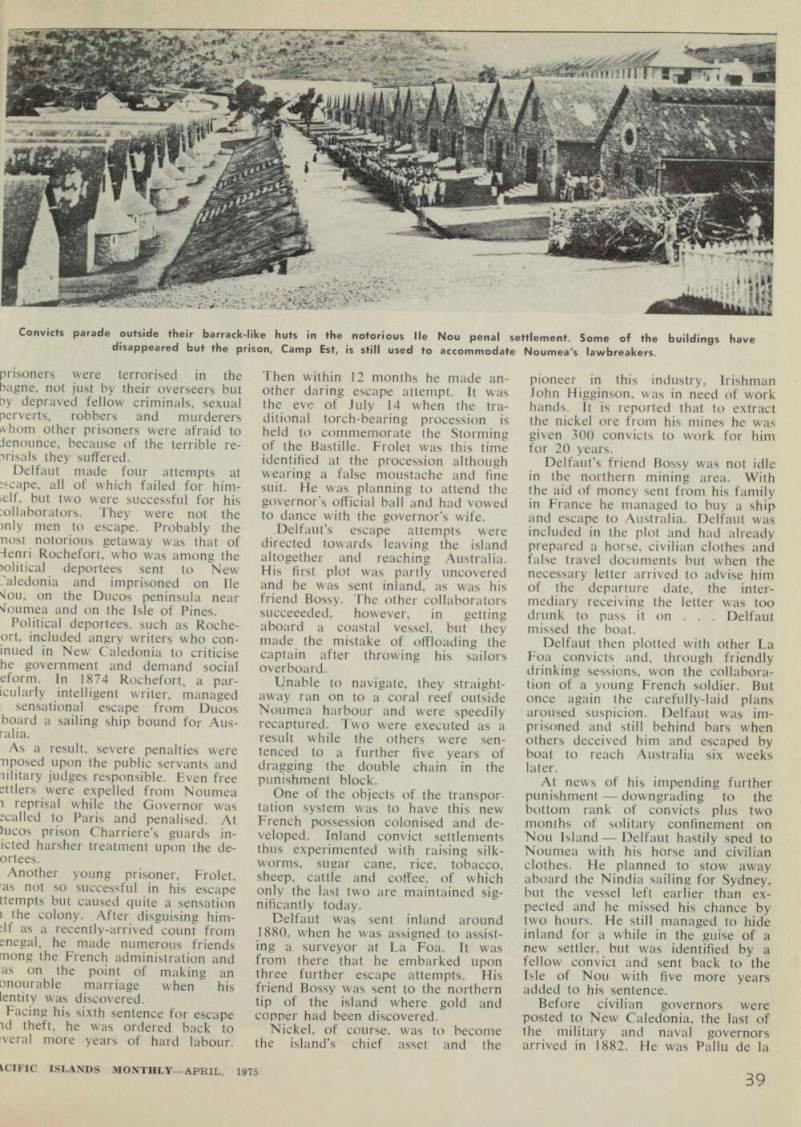
An unusual stone chapel from the convict period today provides a set ting for the most imaginative recon structed Theatre de I’lsle open-air theatre.
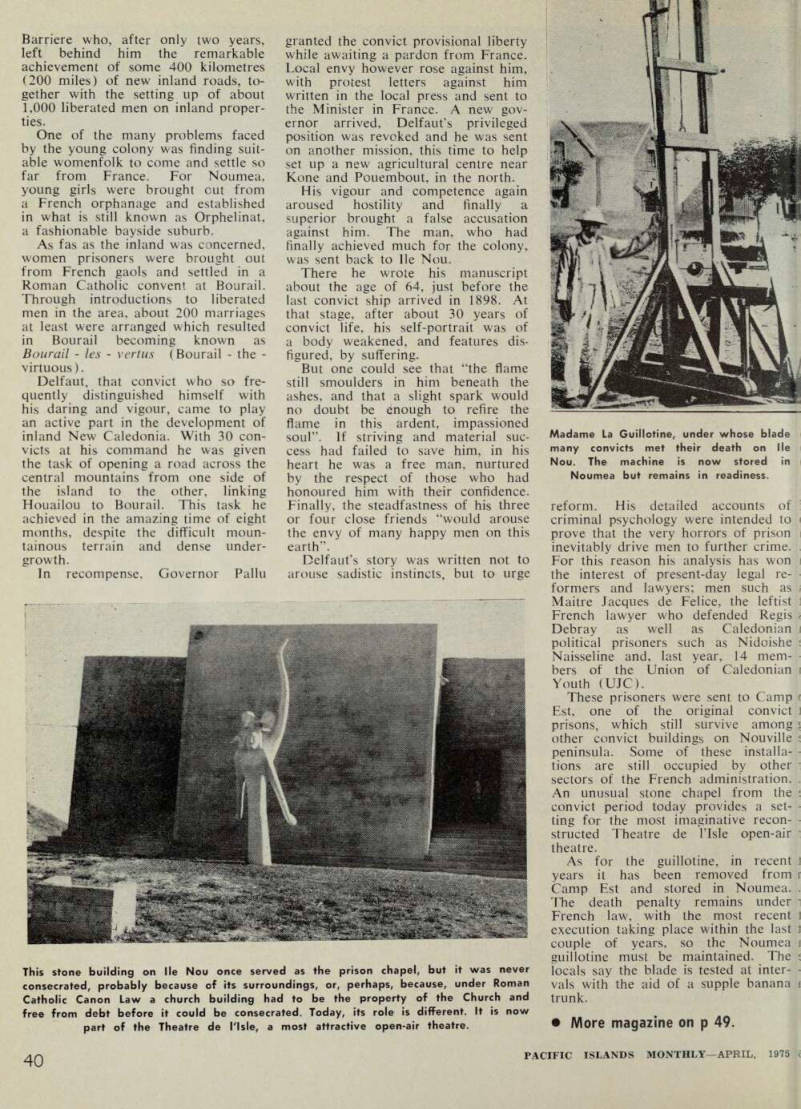
As for the guillotine, in recent years it has been removed from Camp Est and stored in Noumea.
The death penalty remains under French law, with the most recent execution taking place within the last couple of years, so the Noumea guillotine must be maintained. The locals say the blade is tested at inter vals with the aid of a supple banana trunk.
• More magazine on p 49.
This stone building on He Nou once served as the prison chapel, but it was never consecrated, probably because of its surroundings, or, perhaps, because, under Roman Catholic Canon Law a church building had to be the property of the Church and free from debt before it could be consecrated. Today, its role is different. It is now part of the Theatre de I'lsle, a most attractive open-air theatre.
Madame La Guillotine, under whose blade many convicts met their death on Ile Nou. The machine is now stored in Noumea but remains in readiness.