The Past
p. 31 · Read in the full issue
Looking After
For The Future
From a special correspondent at Rarotonga It is a continuing cause for regret that, throughout the Pacific Islands valuable historical records are being lost or damaged beyond recall, almost daily.
Government files, personal papers, diaries, photographs, old newspaper files, are the constant victims of the ravages of mould, fires, floods and insects. Frequently, also, material of great importance is destroyed by local people who do not realise its signifi cance as part of the historical record of their country.
Occasionally the unscrupulous out sider may be guilty of the un authorised removal of items which should be regarded as national treasures.
Considerable credit must be given to the Pacific Manuscripts Bureau under the direction of Mr Robert Langdon—a former assistant editor of PlM—at the Australian National University for all the sustained effort it has put into recording on micro film a wide range of Pacific Islands documents. Future historians and social scientists, particularly in the Pacific nations, will be indebted to Mr Langdon and the ANU libraries, which have directed and supported the work.
Fiji, alone and in partnership with the old Western Pacific High Com mission, has maintained a valuable National Archives, the value of which will be readily recognised by a host of writers.
Now the Cook Islands has recog nised the danger that history may pass it by through failure to preserve the things of history, and efforts are being made to establish a national archives. The Cook Islands Library and Museum Society is building an air-conditioned archives section at the rear of the museum and library at Avarua on Rarotonga.
The government has placed in the society’s hands a very large part of the accumulated government files and records harking back to the days of the Cook Islands Federal Parliament in the 1890 s.
Society members are busy sorting out these records and finding out :he amount of preservation work re quired, while, at the same time, the librarian, Mrs Carmen Temata, is
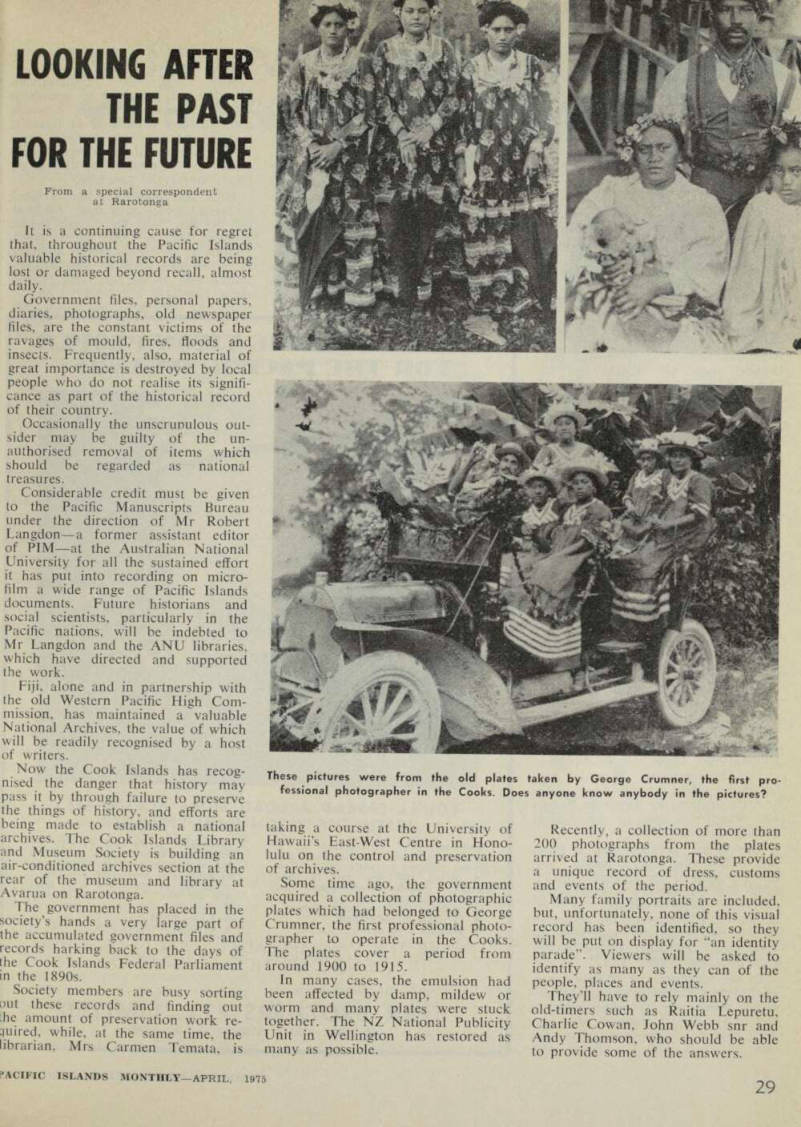
Recently, a collection of more than 200 photographs from the plates arrived at Rarotonga. These provide a unique record of dress, customs and events of the period, Many family portraits are included, but, unfortunately, none of this visual record has been identified, so they will be put on display for “an identity parade”. Viewers will be asked to identify as many as they can of the people, places and events, They’ll have to rely mainly on the old-timers such as Raitia Lepuretu, Charlie Cowan, John Webb snr and Andy Thomson, who should be able to provide some of the answers.
taking a course at the University of Hawaii’s East-West Centre in Honolulu on the control and preservation of archives.
Some time ago, the government acquired a collection of photographic plates which had belonged to George Crumner, the first professional photographer to operate in the Cooks.
The plates cover a period from around 1900 to 1915.
In many cases, the emulsion had been affected by damp, mildew or worm and many plates were stuck together. The NZ National Publicity Unit m Wellington has restored as many as possible.
These pictures were from the old plates taken by George Crumner, the first pro fessional photographer in the Cooks. Does anyone know anybody in the pictures?