It From The Gilberts' Side
pp. 27-29 · Read in the full issue
Ocean Island: A Letter Looks At
Mr Timai Tekaai, editor of the GEIC’s Atoll Pioneer has sent PIM a copy of a letter he has sent to the Australian newspaper, The Aust ralian, “so that” he writes, “Aust ralians can see the other side (our side) of the coin in the present Banaban kerfuffle for independence.
I would be most grateful if you can see your way to publishing it, wholly or in part, so that Pacific Islands Monthly readers may also be able to see our case”.
The letter follows publication in The Australian on February 6 of an article headlined “A colonialist status of our very own” which gives the Banabans’ side of the argument plus reference to the part the Aust ralian Federal Treasurer Dr Jim Cairns is reported to be taking in the case.
The writer, Bob Baudino, opened his article with, “The personal inter est of Dr Jim Cairns in the plight of 2,000 South Pacific islanders exiled from their tiny island home land, first by war and now by ex ploitation, is causing concern in our Department of Foreign Affairs”.
Mr Tekaai’s letter reads: Your issue of February 6 which included the article “A Colonialist Status of Our Very Own” has only just reached us here in the Gilbert and Ellice Islands. I hope that late as it is I may be allowed to com ment.
In content, the article is sub stantially correct although there are one or two inaccuracies. For exam ple, the Banaban landowners receive 15 per cent of phosphate revenue on some land but 50 per cent of the revenue from other land. But these inaccuracies are unimportant. What we fail to understand is why the people of one of our islands are being treated as a race apart.
Banaba is the Gilbertese name for Ocean Island. We also have Abemama, Butaritari, Tamana and so on. All these islands are occupied by our people. If the Banabans have a special position it is because it is on their particular island that a valu able mineral resource, phosphate, was found. Initially therefore they suffered most from the exploitation of our country’s only mineral wealth.
For this reason we sympathise with their claim for compensation. But it was the whole country which was exploited and we cannot accept that this compensation should be at the expense of the rest of our people.
Even here in the Gilbert and Ellice Islands we have heard of Dr Cairns and his reputation as a fighter for the underdog. But who is the underdog in the Banaban affair? The 2,000-odd Banabans liv ing on the relatively fertile island of Rabi with an income of $3,000,000 tax free this year, or the 55,000 other Gilbertese scratching a sub
sistence living on their drought plagued coral atolls and putting much of their share into reserves for the future?
We have also heard of Mr Apisai Tora and his reputation as a work ers’ representative. But who are the workers in this case? Are they the Banabans with their supermarkets and other capital investments in Fiji or the Gilbertese from our other islands who actually dig the phos phate? Is it not at least possible that the reason why no more than a hand ful of Banabans work on Ocean Island is because they are too well off to need to?
We wonder whether in the event of rich oil deposits being found under Tasmania Dr Cairns would rush to the support of a Tasmanian claim to independence or whether he might feel the wealth from the oil should benefit Australia as a whole.
Similarly, if a goldfield was found on Lau would Mr Apisai Tora feel obliged to add his weight to a peti tion for Lau independence or would he feel that all Fijian workers should benefit from the strike?
We freely admit we cannot poss ibly compete with the Banaban lobbying campaign. We would ask,
however, that those subjected to this lobbying should at least consider that there might be another side to the coin.
Timai Tekaai
Chief Information Officer,
Geic.
Tarawa.
Trouble Over Norsup
The Condominium Government of the New Hebrides has decided to build a new airstrip at Norsup on North Malekula, but it has come up against fierce opposition from the local inhabitants.
The site chosen seemed ideal to the British and French, being close to both their district agencies. They bought the land from a French owned company PRNH. (Plantation Reunies des Nouvelles Hebrides) which has operated a large coconut plantation in the area for well over 50 years. Indeed the PRNH claims undeveloped land and coconut plant ations stretching for miles along the east coast of Malekula including two of the largest plantations in the New Hebrides.
However, the Condominium Government could not have been unaware of the intense bitterness and hatred felt by the local inhabitants (especially of Tautu village) for PRNH, or of the fact that ownership of the land they purchased has been in question for many years.
The story of the original purchase of the land by PRNH is a familiar one in New Hebrides history. It tells of unfair dealings, of two ship-loads of French troops anchored off Nor sup while negotiations were proceed ing; of Vietnamese labourers brought in to clear and fence the plantation; of fences gradually being pushed further and further out until the local inhabitants of Tautu occupied only a tiny portion of rocky coast land; and of all native resistance being squashed by force of superior arms.
In addition to this long-standing land dispute, the land chosen for the airstrip was also the traditional route of the Tautu people to their gardens.
Three years ago, without any con sultation with the local people, the condominium landed their machinery and labour force and started to bull doze the area. This was the last straw for the Tautu people.
Led by Kennerrie Williams, a strong nationalist figure and secre tary of the North Malekula local council, the Tautu people retaliated by replanting the cleared land with young coconuts. The land was bull dozed again, and replanted again,
Letters
until the condominium decided to postpone development to allow time for negotiations and planning new tactics.
By the end of 1974, the govern ments had planned new tactics and determined to push them through regardless of local opposition. The first move was to close the old air strip at Norsup. The Condominium Department of Civil Aviation an nounced that the Norsup airstrip was not safe and would be closed indefinitely from December 10.
The announcement was somewhat of a surprise to the pilots of the local airline—Air Melanesiae. Some of the pilots had encountered dan gerous situations on the strip, but not worse than on other strips and not serious enough to warrant com plete closure. However the official word was—no more planes to Nor sup.
At the December meeting of the Advisory Council, the issue of the Norsup airstrip was tabled for dis cussion. As a result, a Commission of Inquiry into the situation was set up. The commission consisted of four members of the Advisory Coun cil—an Australian trader from Tanna, a French planter from Santo, and two New Hebrideans—the Air Melanesiae agent from Erromango and the ADCO member for North Malekula.
The commission had two meetings with the Tautu people. The first went well as the local people were willing to talk to the commission. They asked for time to think the matter over among themselves. They arranged a second meeting. In the meantime, the locals decided not to allow their traditional route to be developed into an airstrip. Their spokesmen reported the decision to the commission’s second meeting.
The commission made its recom mendations to the Resident Com missioners in Vila. A week later, the two governments announced “the new airstrip shall be constructed on the site originally selected—that is, on the land purchased from the PRNH by the Condominium Ad ministration”.
The rest of the communique pro mised generous terms to the Tautu people. It virtually recognised their ownership of the proposed site and
agreed to the annual payment of 40,000 NH francs (approximately SA4OO) for a 25-year lease. It pro mised them the right to use their traditional footpath across the air field and offered them priority of employment, sale of artefacts and contracts for bars or restaurants at the airfield.
The statement ended with a stern warning against any attempts to interfere in the construction of the strip.
The governments had, in fact, de termined to push ahead regardless of the feelings of the Tautu people, and despite the repeated attempts by the New Hebrides National Party to warn the governments of the possible consequences and persuade them to postpone the development until agreement was reached.
Even before the communique was published, police reinforcements had been sent from Vila and Santo, to make a total force of 100 police on the site. In addition, the French Government sent two ship-loads of local people from further north on Malekula to stand by in case of poss ible interference in the work from Tautu people.
In the face of this almost military invasion, the Tautu people could do little but be silent. They did, how ever, register their protest with a placard at the site and by returning the two tractors, documents and
money they had been looking after for the local council.
Once the communique was issued, of course, the governments claimed they could not dream of going back on their published regulation. If they did that, the public could no longer respect the government.
The two governments claimed that they acted as they did for the econ omic advantage of the whole country, and for the benefit of a larger group of people than just the immediate village of Tautu.
In fact, the government has de cided that economic development is of greater importance than justice for the local people. The whole in cident has brought out one fact clearer than ever, that is that the Condominium Government is not the Government of the New Hebrideans but the government of the white minorities who are direct subjects of Britain and France.
The dispute over the property at Norsup is not ended. It will break out in some other form in the near future. Who knows what the future of Norsup airstrip will be? The big thing is that the Condominium Government still has to learn to lis ten, to respect, and take seriously the views of New Hebrideans.
Vila Correspondent.
New Hebrides.
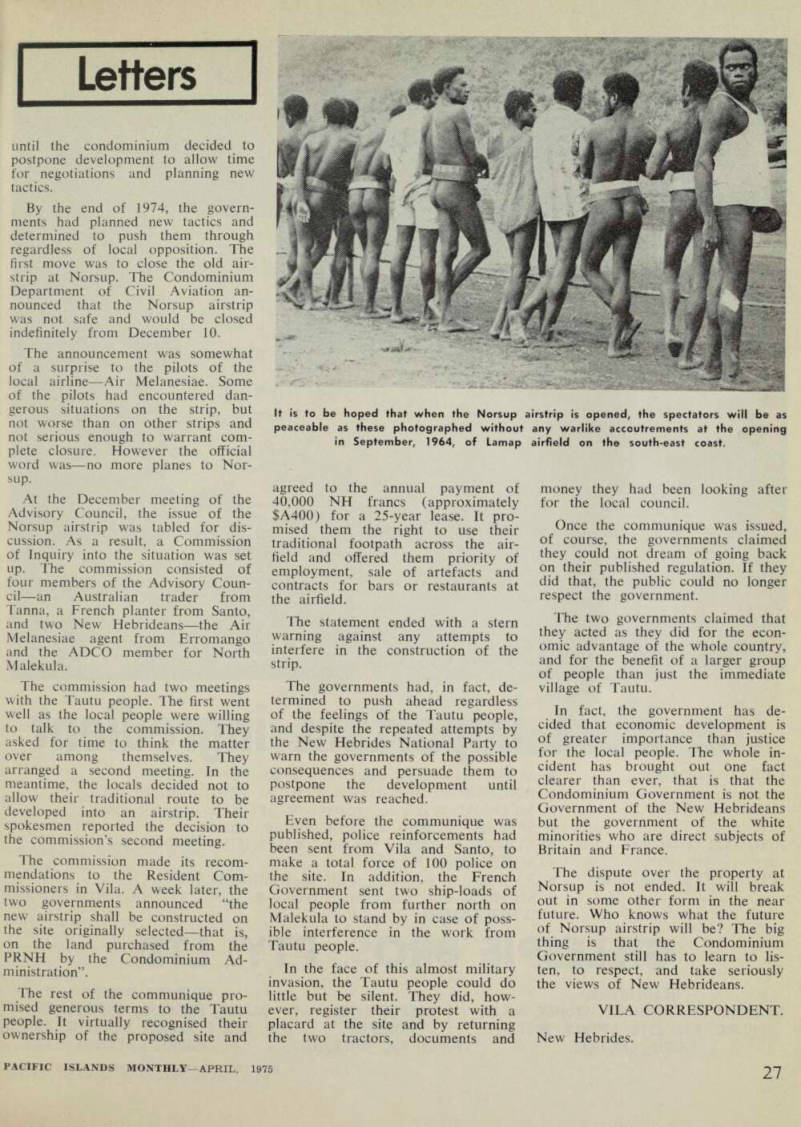
It is to be hoped that when the Norsup airstrip is opened, the spectators will be as peaceable as these photographed without any warlike accoutrements at the opening in September, 1964, of Lamap airfield on the south-east coast.