Tropica lities
pp. 20-24 · Read in the full issue
Will BSI
hear a ‘boom’?
The Solomons News Drum is the Solomon Islands’ first weekly news paper. Its first issue (except for a trial issue last year) was published on February 7, and was carried to many urban and rural centres by air within a day or two.
Particularly notable in its emer gence is the work of the Information Service staff, who believed in the need for it when no commercial publish ing group or individual could be at tracted to start an independent news paper, and the acceptance, eventually, by government of the unusual ar rangements for its publication.
Response by advertisers already has been an answer to any who doubted the need by the business community. The expected increased sales over the small fortnightly BSI News Sheet it replaces should be the answer to doubters who thought it was too early for such a need to be felt in the population.
News for The Drum, as it’s begun to be called already, is produced by the government’s Information Service.
But from there it goes to the Honiara commercial printery, Provincial Press, to be set and prepared for the press as well as for printing.
Advertising is collected by a mem ber of the Broadcasting Service staff, who also collects advertising for Solo mons Radio, the government radio station, and is also collected by a local hotel owner and enterprising businessman who has started what he calls an advertising agency.
Lastly, the distribution is just as big a mixture of hands, being carried out by the main newspaper and maga zine agency in town, The Bookshop, but also by the Provincial Bookshop which was set up a couple of years ago on a better business basis to pro vide Christian literature and other simpler English and Pidgin books for Solomon Islanders.
In fact. Provincial Press and its shop are business subsidiaries of the
Church of Melanesia, formerly the Anglican mission.
After all that co-operative effort, all that people living in the Solomon Islands are waiting for is to see whether The Drum will be allowed to give readers the real news of the community they have been looking for.
As an article in the February PIM (p 17) indicated, the government is far from being tolerant of a liberal official information service. If it sees The Drum as just an echo of its own thinking (and doing), what could be resounding “booms” will fade away to faint rub-a-dub-dubs.
Cook's 4*ompass
up for aii<*iion
An unnamed collector bought Captain Cook’s compass and sundial at an auction at Parramatta, Sydney, in February for $4,050. The day before the auction the Federal Government applied its export con trol regulations to prevent the com pass from leaving Australia. The successful bidder said later he was prepared to go to $B,OOO for the compass. He added that he would make sure it stayed in Australia.
The compass, which fits neatly into the palm of the hand, is in per fect condition. It was made by Pizzla, of Haddon Garden, London, leading compass makers in the 18th century. The compass was sold from the estate of a Sydney inventor, Gustavus Kopsh, who died in 1892.
more ‘‘slaves”
oil Norfolk
An old Norfolk Island custom of men working on the roads for several days each year, or paying $lO, has been ended—by Canberra. Canberra considered it to be in conflict with International Labour Organisation principles which condemned forced labour.
Under a 1936 ordinance men be tween 21 and 55 had to work up to 10 days a year in such “works for the benefit of Norfolk Island as the Administrator specifies”, or pay up.
The work included tending roads, commons, public reserves and other
Crown lands, as well as clearing away noxious weeds.
The Norfolk Island council went through the farce of approving thea Canberra edict, but the majority wasj very narrow. The Norfolk Islander,! did not think much of the saying editorially: “It was changed because the Nor folk custom seemed, in the minds oft< petty officials a long way away, too clash with International Laboun Organisation principles forbidding compulsory labour. What rot! Thea old tradition was used by a few* people, but it made sense and was, part of Norfolk. It’s preposterous too have the island’s flavour cut away too suit foreign ideas of legal tidiness,* and if Norfolk gains self-govern-i ment, the old custom ought to bes an early candidate for reinstatement”.' Men who worked under thea scheme did an eight-hour day. A/ man who worked less was fined 250 an hour for time not worked. If thea Administrator considered his world was unsatisfactory, a man could bea dismissed and required to pay offfi the balance of his unworked time ath 25c an hour. If he provided his ownn pair of horses and harness, or a earth or a plough, he was credited with thes equivalent of a day’s work done. Hea got three days’ credit for providing a motor vehicle.
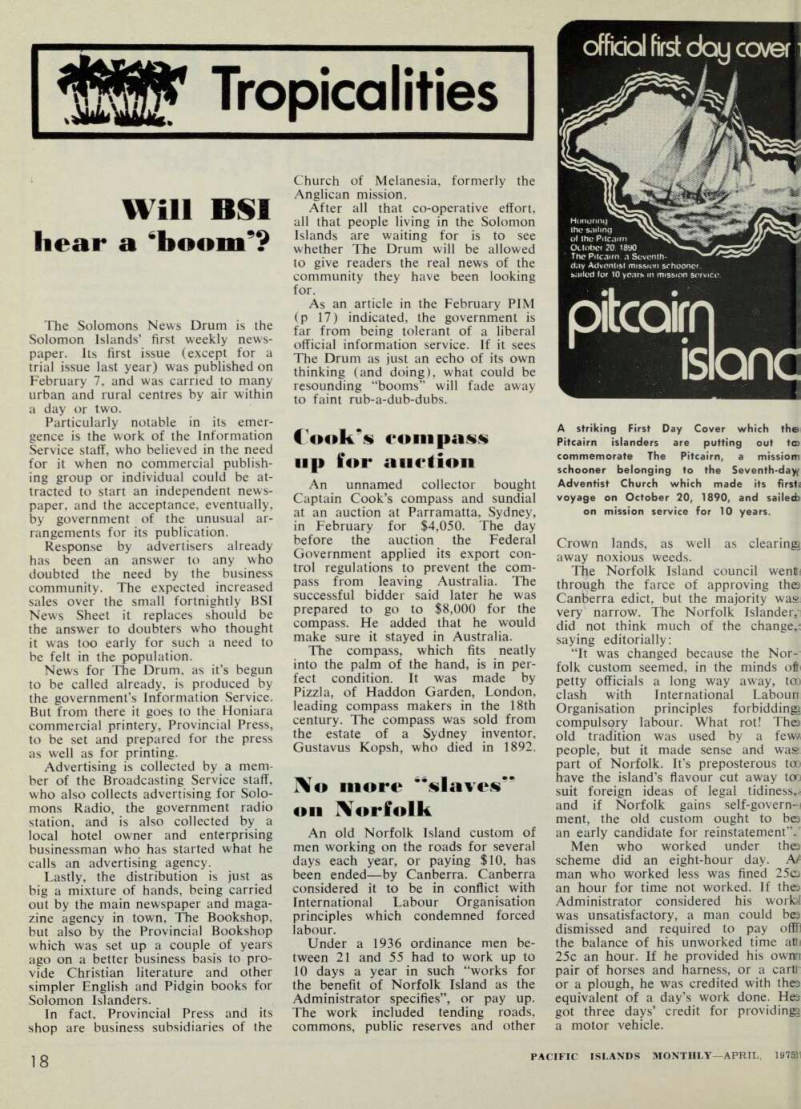
A striking First Day Cover which the Pitcairn islanders are putting out to commemorate The Pitcairn, a mission schooner belonging to the Adventist Church which made its first, voyage on October 20, 1890, and saile on mission service for 10 years.
PNG’s pav-oni
for women
International Women’s Year is get ting official recognition from the Papua New Guinea Government to the extent of $68,000. The Chief Minister, Mr Michael Somare, said IWY provided an opportunity for the government to show it was serious.
The country’s history so far showed women received less than their due in their share of government services, such as their limited access to educa tion extension services, and limited ownership and share in business and agricultural ventures.
Projects the government will finance are the establishment of child minding centres; a visit to the IWY conference in Mexico City by two PNG delegates; new training facilities in arts and crafts directed to women; establishment of rural community centres and rural cultural centres; organisation of a national women’s conference in PNG; and establish ment of a special fund to provide for projects requested by women’s groups.
■lig pig bring*
100 mnrli lurk
Joseph Kumbukiai, a 40-year-old New Guinean, wishes he hadn’t killed the biggest pig in his herd.
He killed the pig ceremonially when an Australian prospecting con sortium from BHP and Triako Mines started looking for copper on the Yandera lease which is part of his tribal area. The killing was a tra ditional “mark of significance” when the villagers gave permission for prospecting on their land.
They hoped their ceremony would ensure success for the prospecting programme, and would bring pros perity to the area.
But, now, results from the initial testing programme are so promising that Kumbukiai and his fellow vil lagers fear they may be overwhelmed by a major mining operation. They think the ceremonial killing of a middle-sized pig, instead of the biggest in the herd, might have been a better proposition.
Kumbukiai said his people feared that a major mining venture would force them from their homes into the “dangerous, sorcery-ridden” Ramu Valley which is not far from the Yandera area, but the Yandera people have a superstitious dread of the valley and no affinity with the people there.
Kumbukiai said relations between the village people and the prospecting
consortium were good, although there were some frustrations over obtain ing information about what was likely to happen.
Yandera is in the foot-hills of Mount Wilhelm, inland from the coastal town of Madang and border ing on the Eastern Highlands.
BHP and Triako have announced “encouraging” results from a testing programme on their copper prospect there and said they would continue their joint exploration under an agreement in which the BHP sub sidiary Dampier Mining Co would spend a further $2.7 million.
Calling all
Fiji ‘exiles’
Calling all people living in New South Wales, or anywhere else in Aus tralia, who were born or worked and lived in Fiji and don’t want to forget it!
If you’re interested in retaining an association with Fiji “exiles” and things Fiji, there’s a new society awaiting birth in Sydney. Its intended parents (dozens of ’em) are working hard to prepare for an inaugural meeting of a body which, at the out set, will be known as the Fiji-Australia Association with its headquarters (pro tern) at George Brown House, 5 Rogers Avenue, Haberfield, Sydney, which is the home and church of the Rev Jone Lagi, the Pastor to Pacific Islanders.
But, the association, although the germ of the idea was nurtured after a service at the Methodist Church at Haberfield, will be non-denomina tional.
The idea is to provide a club —they hope to build their own premises some day—as a rallying point for Fiji exiles, and do all the things such an association would like to do, not least of which is to help in every way any one from Fiji who finds herself (it’s Women’s Year) or himself in a “spot” in Fiji.
Supporting the first moves to form the association are 300 people but there are several thousand up and down the place who would qualify for membership, which will be open to all colours, creeds, persuasions, anything you like provided they have, or had, some link with Fiji.
It’s hoped to have the inaugural meeting in April.
Anyone interested can find out more from secretary of the steering committee, Mrs Tai Johnson at PO Box 148, Sydney (tel. 523-4695).
Chairman of the committee is Eliki Kaumaitotoya, who is training as an aero-engineer with Qantas in Sydney.
Nlan of ih< k \ciir
in m ieronesia
The Congress of Micronesia, which was busy in February and March with its first session since the elections last November, had one of its lighter moments late in February—choosing its nomination for the Man of the Year title. The nomination, proposed by Senator Roman Tmetuchl, is Yap Senator John Mangefel.
And no wonder; Senator John Mangefel provided most of the light relief to brighten last year’s business with his ready wit, his unusual reso lutions and even poetry. His last named offering brought the sugges tion from Senator Tmetuchl that he should also be named Hero and Poet Laureate of Micronesia.
The resolutions which found favour with Congress included one to sim plify Micronesia’s laws by replacing the TT Code with the Ten Command ments. Another urged the men of Micronesia to do their best to resolve the sex imbalance in the population, and one was even addressed to the Almighty asking Him to roll back the pages of history so that Micronesia could again become self-sufficient and self-governing.
His latest effort was this poem, Ode to Abe, which he read during the February session; These are times in Micronesia, so crucial and so critical; to find the way, to unify the micro body political. We sit a spell, scratch our heads, do some heavy thinking; comes to mind, famous man, Abra ham. President Lincoln. In US Civil War, of long ago, brothers became
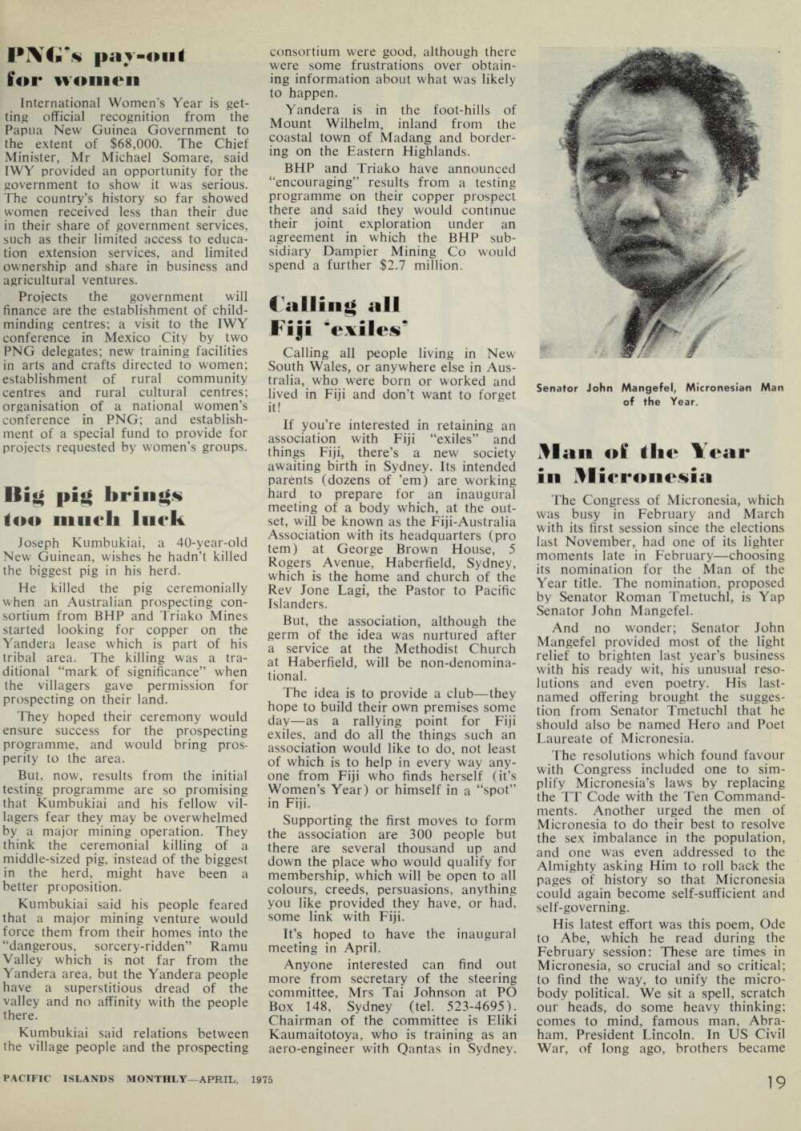
Senator John Mangefel, Micronesian Man of the Year.
foes, but democracy, and the Union stayed, as everybody knows. Old Abe was a master, his nation gone des perate; but he held the parts together, 3ne instead of separate. From this I drew a lesson, as any schoolboy :ould; America was example of unity, equality and good. Unity was the soil, which grew the flower democracy —despite recent Nixonian, presi dential hypocrisy. Despite all assur mces, my doubts began to grow, when seeds of discord, the US began o throw. They landed on our islands, irew by nights and days; and from hem, strange plants came in twisted ways. We are now in a quandary, :omplex, frustrating, and deep, to see \merican sow these seeds, and from hem. disunity reap. We see our ad ninistering authority, mother to Jncoln and others fool our Micro icsian family, our sisters and our mothers. Recent events if nothing, ;nforce our abiding awareness that \mericans truly believe, in the idea )f democratic fairness. But fine prin iple. actual practice often bothers— hey believe it for themselves, but not ilways for others. I recently visited DC, and Lincoln’s memorial place ind I saw that granite sadness, that ined and noble face. I was suddenly
struck, as the sun on his visage shone revealing soft tears, beneath those eyes of stone. The moral to this tale, if there is one to be found; America forsook the idea, of strength, thru unity bound.
Sbv birds
in Ill€* l ooks
A survey of bird life in the Cook Islands carried out in 1973 by Dr David T. Holyoak, under the sponsor ship of the International Council for Bird Preservation and the Smith sonian Institution has revealed the existence of seven birds previously unknown to science.
The survey was the first occasion on which birds of the Cooks have been studied.
The discoveries included two which are considered to be distinct species— the Mangaia kingfisher (Halcyon rufi collaris), and the Atiu swiftlet (Collocalia sawtelli), and two very distinctive new sub-species of the warbler (Acrocephalus vaughani).
Dr Holyoak also found that three bird species, known only to the Cooks, still survive. The fruit dove (Ptilino pus rarotongensis) and starling
(Aplonis cinerascens) of Rarotonga still survive in strength, but the fly catcher (Pomarea dimidiata) is now very rare. These birds are indigenous species.
By far the greatest number of birds seen in the Cook Islands are oceanic types that spend most of their lives over the open ocean, feeding upon various form of marine life. These sea birds are found on land only during their breeding seasons, and the commonest species seen in the Cooks are frigate birds, terns, tropic birds and boobies. Less frequently seen are albatrosses and storm petrels.
Suwarrow is a bird sanctuary where thousands of frigates and terns and smaller numbers of boobies breed, as they also do on Motu Kotawa, one of Pukapuka’s three islets. Frigate and bosun birds are seen in their hundreds on the small atoll of Taku tea, and are known on most of the other Cook Islands. Bosun birds are also called red-tailed tropic birds, and their scarlet tail feathers are valued by the islanders as decorations for their hats.
Migratory shore birds use the Cook Islands as wintering places after making amazingly long flights over the ocean from their breeding grounds
in Alaska and Siberia. These are ; Pacific godwits, American golden i plovers, wandering tattlers and bristle- ■ thighed curlews. These small, but ] hardy birds, return north in the ' spring.
The Cook Islands Government is < preparing legislation to give complete ; protection to the group’s indigenous < birds, and Dr Holyoak hopes to pub- lish a book shortly on the birds of i the south-east Pacific.
When this is completed, he intends < to start work on a popular, illustrated 1 booklet, on the birds of the Cook : Islands, which the Cook Islands i Library and Museum Society has i agreed to publish.
Korfolk’§ junior
boat builders
Fourth form pupils from the Nor- folk Island Central School are build- ing yachts, using as much local 1 material as possible, as a practical 1 exercise in woodwork. The class, in r 1974, started building an 8 ft Sabot J class sailing dinghy. It was finished t during the holidays by the manual f arts teacher, Mr David Regal, and I the science teacher, Mr John Smith..
The yacht performed satisfactorily \ during its shakedown cruise in Emily \ Bay.
Except for marine plywood and as few fittings, the boat was an all- - Norfolk product. The mast andt booms were built from famous Nor folk pine. About half the fittings z were machined at school. The sail! was sewn by Mr Smith’s wife.
The 1975 fourth formers are nowv building another boat. The first boat} will be raffled, and the money netted t will be used to buy materials for i more boats, as well as some equip- ment needed in the school wood- work shop. Mr Regal is aiming at} a fleet of at least four boats, to be s used for school racing on Emily Bay \ in the winter sports season.
Vvr lIM Kina*
N< k pi line’s post
A message in a bottle, dropped 1 from an Indian freighter in January, , has highlighted a beach on Lifou t Island in the Loyalty Group as a i favourite spot for currents to deposit reminders of distant ocean traffic.
The bottle message, dated July 17, , 1974. came from the radio officer i P. K. V. Menon, of Madras, India, . sailing aboard the MV Prabhu Puoyi i taking timber logs from New Zealand I to Yokkaichi in Japan. Dropped at sea 200 miles north of New Zealand, . at lat 26S and long 171 deg 39E, . the bottle had drifted 400 miles to c be discovered by fascinated Gale- donians in the Loyalty Islands.