Fiji’s ‘green gold’ is coming true
p. 18 · Read in the full issue
An exiled prophet’s vision of Fiji’s ‘green gold’ is coming true
From VIJENDRA KUMAR in Lautoka
FIJI’S history books make only passing mention of Apolosi Ranawai who soared to brief fame (or notoriety) in the 19305.
But his ghost still seems to haunt the country.
Writing in the March, 1939 issue of PIM, Gilchrist Alexander told of Ranawai’s abortive attempt to launch the first Fijian com mercial venture—the Viti Com pany. It was a co-operative move ment which was primarily con cerned with marketing bananas and other produce raised by Fijians.
Ranawai’s movement gathered considerable momentum but it was doomed to failure because of hos
tility from European planters,
businessmen and the British Co lonial Government. Given proper guidance and help, the venture could have helped emancipate and launch the Fijians into the com mercial world.
Ranawai, who was a com moner from Narewa village near Nadi, had a messianic effect on his followers who believed that he had divine powers. It is doubt ful whether his followers had the sort of affection the masses have for a popular leader. On the con trary, the more superstitious feared him.
After the formation of the Viti Company, Ranawai published the following statement in the Eng lish language newspapers; “Before I commence my business, I will let you know first the foundation of my work: “1. I shall love all my brethren.
“2. I shall honour all the chiefs.
“3. I will honour the King through all his subjects.
“4. I will fear the Lord, our God”.
Alexander wrote that soon after the company began operating, “the Wesleyan Methodist Mission suffered a huge financial loss when large numbers of Natives trans ferred their contributions, which they would ordinarily have given
to the mission, to the new company.
“To the government, Apolosi was anathema”.
Because of lack of experience and knowhow, Ranawai, who had declared himself the company’s managing director, and his corporate bedfellows soon found themselves in troubled waters.
They drank heavily and brawled among themselves. And Ranawai, in his own time, became a legendary womaniser. It is believed that he had more than a dozen wives.
Finally, power went to his head and he became involved in open conflict with the British Colonial Government. He was exiled to Rotuma but recalled after a few years and was put on the good behaviour bond. He forfeited it and the ov ® r "“® nt . ,^ ec ! h cisciin to ci remote islcincl in tne Yasawas. So Ranawai faded into
natfonaUs. SSS ST
ment died a sorry death.
Ranawai was not only a gifted orator but apparently had the gift
of prophecy. One of his prophetic utterances, which the Fijians re membered but did not understand for quite some time, seems to be
materialising now.
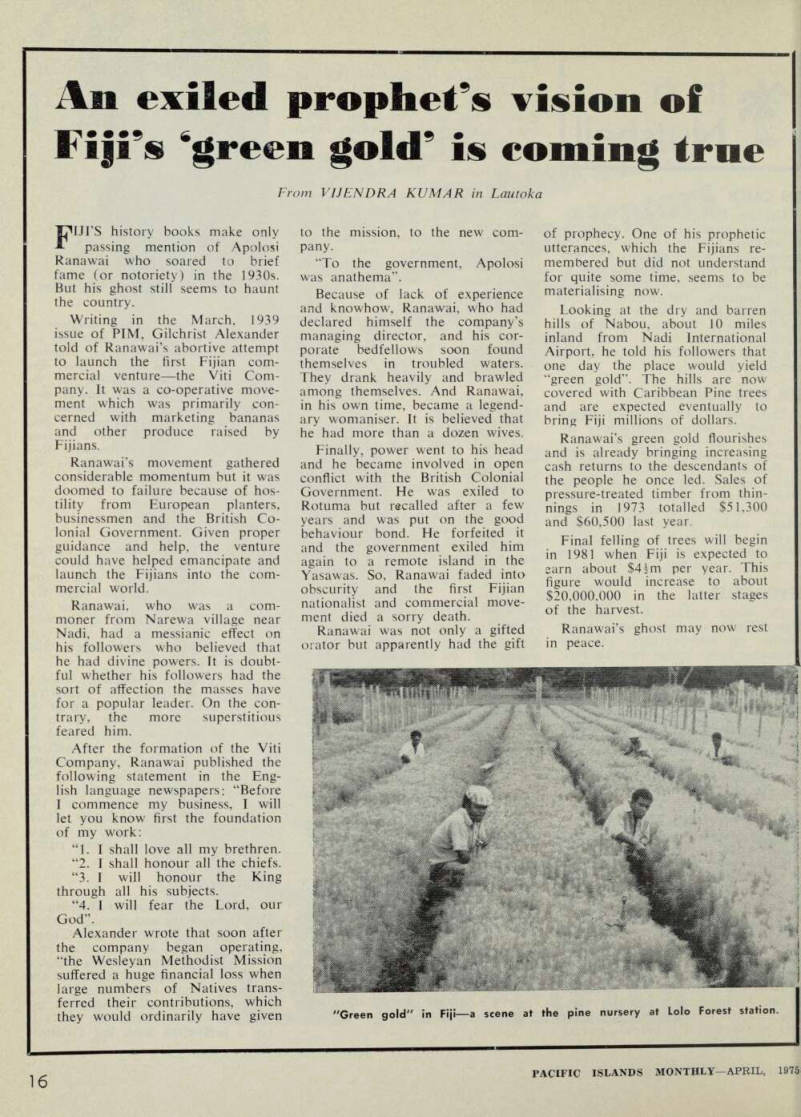
Looking at the dry and barren hills of Nabou, about 10 miles inland from Nadi International Airport, he told his followers that one day the place would yield “green gold”. The hills are now covered with Caribbean Pine trees and are expected eventually to bring Fiji millions of dollars, Ranawai ' s gre en gold flourishes and is already bringing increasing cash returns to the descendants of the people he once led. Sales of pressure-treated timber from thin nings i n 1973 totalled $51,300 an d $60,500 last year, T ~. , ( ... . , - n . • in 1981 when Fiji is expected to . i , tl •
hf “ctS
feZes? ‘ a,,6r 5,3865 of the han,est ' Ranawai’s ghost may now rest in peace.
"Green gold" in Fiji—a scene at the pine nursery at Lolo Forest station.