plan to fill planes
p. 67 · Read in the full issue
Air Pacifies cut-price plan to fill planes
Prom a Suva correspondent
Air Pacific plans to launch an aggressive marketing plan in an effort to increase the number of passengers carried on Fiji internal flights. Pas sengers who pay return fares at least 14 days in advance will qualify for discounts of up to 25 per cent; but there are a few qualifications before the scheme finally gets off the ground.
One is that the Air Transport Licensing Board has to give the scheme its blessing. Then a passenger will forfeit the fare if he cancels the flight without adequate notice. Also, a passenger will be required to spend a minimum time away from the start ing point, probably at least a night.
Thus, it is restricted to return flights.
The scheme looks as though it could generate a handy cash flow, particularly in a time of tight liquidity. It may also help the airline to improve traffic growth, which seems to be at zero, again through liquidity problems. There has been a downturn on some routes, particu larly the main one between Nadi and Nausori. The drop on this service has been as high as 10 per cent, which airline officials attribute to a drop in the number of tourists.
At the same time ordinary fares will rise by 10.7 per cent, for which government approval has been given, and an 8 per cent increase in regional
fares has been sought. The last hike in fares was in September, 1974, when the Nausori-Nadi charge rose by 13.6 per cent, and all other in ternal fares went up by 15 per cent.
The airline plans to streamline the fare structure by abolishing the three tier system of charging ordinary fares according to the baggage limit chosen by the passengers. It is intended to replace the 15, 20 and 30 kg limits by a flat 20 kg limit.
One reason for the advance fare system is an attempt to get rid of the expensive “no show” problem, where people book seats and then don’t use them. Most airlines look on a 3 per cent “no show” rate as accept able, but Air Pacific has a crippling 20 per cent rate, which causes big losses in revenue. The problem also damaged the airline’s reputation, as genuine late passengers could be left behind, or people could not order seats because the aircraft was booked out.
Air Pacific has had a bad time, and these latest moves could help it to get back to a proper basis from which to operate profitably. In the last 12 months it absorbed $750,000 in extra costs. Fuel costs since August, 1974, have risen by 35 per cent, and staff salaries rose recently by 30 to 40 per cent.
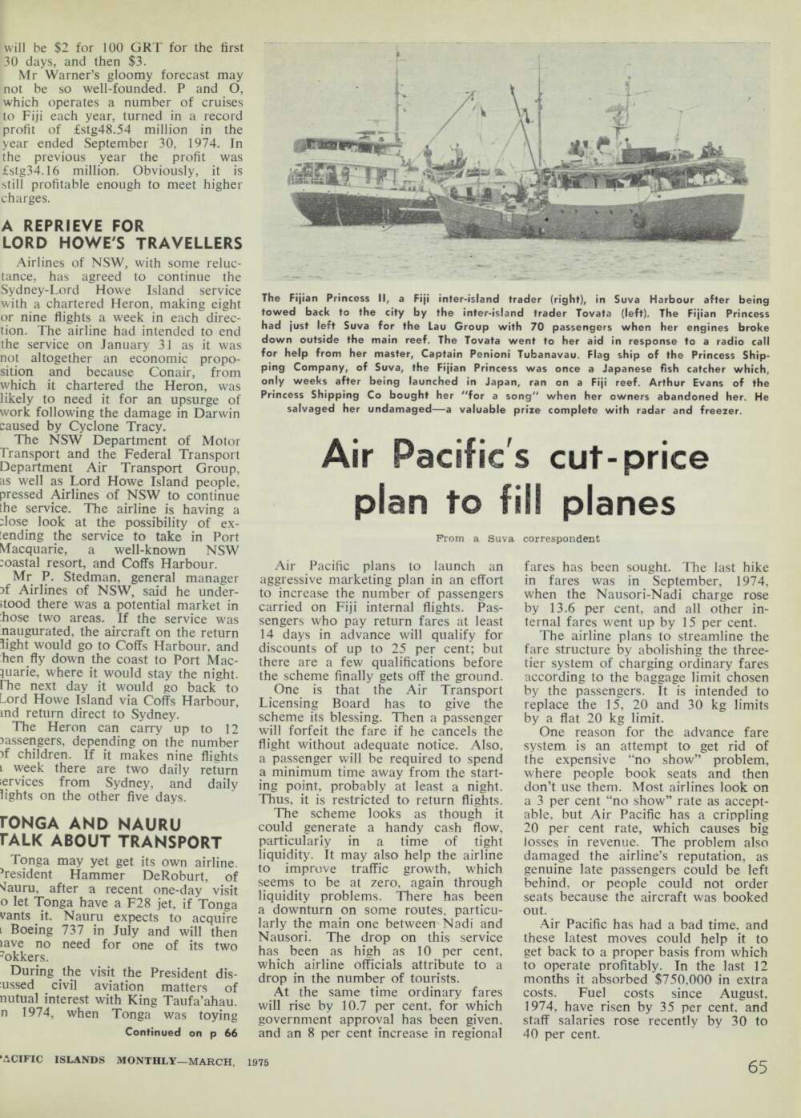
The Fijian Princess 11, a Fiji inter-island trader (right), in Suva Harbour after being towed back to the city by the inter-island trader Tovata (left). The Fijian Princess had just left Suva for the Lau Group with 70 passengers when her engines broke down outside the main reef. The Tovata went to her aid in response to a radio call for help from her master, Captain Penioni Tubanavau. Flag ship of the Princess Ship ping Company, of Suva, the Fijian Princess was once a Japanese fish catcher which, only weeks after being launched in Japan, ran on a Fiji reef. Arthur Evans of the Princess Shipping Co bought her "for a song" when her owners abandoned her. He salvaged her undamaged—a valuable prize complete with radar and freezer.