Pacific Transport
pp. 65-69 · Read in the full issue

Fiji Tourist Industry Shaken By
Massive Rise In Port Dues
A massive hike in port dues and docking fees is on the way in Fiji— from 100 per cent to 233 per cent.
The charges were to have applied from January 1, but shipowners were given a reprieve as there was a delay in Cabinet in setting up the Ports Authority of Fiji, which will control all port activity. Because of the delay the date of operation of the new charges was suspended.
The manager of the authority, Mr Lou Heng Kee, recommended the new charges. The authority’s opera tions will be financed by port charges.
Unless charges meet those costs, the authority will be a losing proposition, and will have to be subsidised by the government. It is clear, in these early days of the authority, that the government is determined that the cost of running the ports should be met by those who use them, and not by the taxpayers.
Predictably, there was an outcry.
The Fiji Visitors Bureau claimed the new charges could keep passenger ships away. The board chairman, Mr Dick Warner, said he believed some cruise ships would stop visiting Fiji if they had to pay the increases.
But a government representative on the board, Mr Raj Singh, quickly pointed out that Fiji’s port charges were among the cheapest in the world, and ships which called at Fiji should expect to pay the same as elsewhere if they wanted to use the port facilities and services. Some board members agreed that although port charges had to go up, the authority should look carefully at the amount of the increase.
The president of the Lautoka Chamber of Commerce, Mr Natwar lal Vagh, was another critic of the higher charges, saying Fiji’s ports would be among the dearest in the Pacific. The rises would cripple many merchants, who were already paying high overseas freight charges (just increased by another 17.75 per cent a ton to an average of about $56), plus bunker surcharges and overseas wharfage.
The docking fees for merchant ships or lighters which occupy berths will be on an hourly rate of 40c for each 100 gross registered tons.
Passenger-cruise ships and local inter island vessels or ferries will pay 20c an hour.
Some examples of the new charges, when they come into operation, are: Oriana (which is one of the biggest ships which calls at Fiji), $2,017 in port dues, plus $BO an hour for each hour it is docked or $1,920 a day; Orsova, $1,400 in port dues, plus docking fees; average cargo ships, $3OO in port dues, plus $24 an hour or $596 a day.
For trading vessels under 75 gross tons, there will be a separate charge.
Tugs will pay $lOO a year, and com mercial pleasure craft carrying up to
12 passengers will pay $5 a year.
The last time charges were raised in Fiji was in 1969. Since then Fiji has been badly hit by inflation, like most other countries, and naturally the cost of running ports would have risen steeply.
The base for the new charges is the gross registered tonnage of all foreign ships which enter Fiji ports, except warships. For every ship loading or discharging cargo, the charge will be $5 for each 100 GRT —an increase of 100 per cent.
For ships not loading or discharg ing cargo or handling passengers, but occupying a berth or an anchorage, the charge will be $3 for each 100 GRT. Ships berthed or anchored for bunkers, receiving stores, under re pair or changing crew, the charge
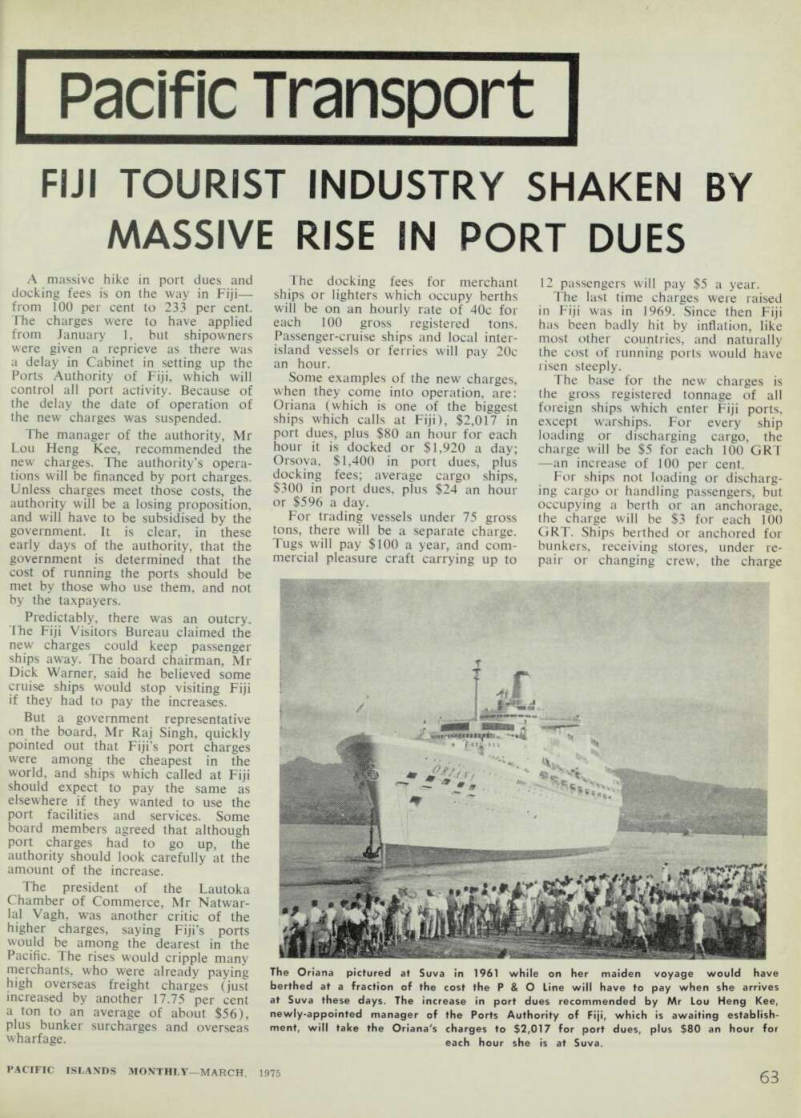
The Orlana pictured at Suva in 1961 while on her maiden voyage would have berthed at a fraction of the cost the P & O Line will have to pay when she arrives at Suva these days. The increase in port dues recommended by Mr Lou Heng Kee, newly-appointed manager of the Ports Authority of Fiji, which is awaiting establish ment, will take the Oriana's charges to $2,017 for port dues, plus $80 an hour for each hour she is at Suva.
will be $2 for 100 GRT for the first 30 days, and then $3.
Mr Warner’s gloomy forecast may not be so well-founded. P and O, which operates a number of cruises to Fiji each year, turned in a record profit of £stg4B.s4 million in the year ended September 30, 1974. In the previous year the profit was £stg34.l6 million. Obviously, it is still profitable enough to meet higher charges.
A Reprieve For
Lord Howe's Travellers
Airlines of NSW, with some reluc tance, has agreed to continue the Sydney-Lord Howe Island service with a chartered Heron, making eight or nine flights a week in each direc tion. The airline had intended to end the service on January 31 as it was not altogether an economic propo sition and because Conair, from which it chartered the Heron, was likely to need it for an upsurge of work following the damage in Darwin caused by Cyclone Tracy.
The NSW Department of Motor Transport and the Federal Transport Department Air Transport Group, as well as Lord Howe Island people, pressed Airlines of NSW to continue the service. The airline is having a close look at the possibility of ex tending the service to take in Port Macquarie, a well-known NSW coastal resort, and Coffs Harbour.
Mr P. Stedman, general manager >f Airlines of NSW, said he under stood there was a potential market in ;hose two areas. If the service was naugurated, the aircraft on the return light would go to Coffs Harbour, and hen fly down the coast to Port Mac quarie, where it would stay the night.
Phe next day it would go back to Lord Howe Island via Coffs Harbour, md return direct to Sydney.
The Heron can carry up to 12 3assengers, depending on the number )f children. If it makes nine flights i week there are two daily return services from Sydney, and daily lights on the other five days.
Fonga And Nauru
Falk About Transport
Tonga may yet get its own airline, ’resident Hammer Deßoburt, of after a recent one-day visit 0 let Tonga have a F2B jet, if Tonga vants it. Nauru expects to acquire 1 Boeing 737 in July and will then lave no need for one of its two 7 okkers.
During the visit the President dis ussed civil aviation matters of nutual interest with King Taufa’ahau. n 1974, when Tonga was toying
Continued on p 66
with the idea of operating a national airline, which would have been under Japanese control, the question of a joint Tonga-Nauru airline was discussed. One of the proposals was that the aircraft would have a double insignia.
President Deßoburt’s remark about being prepared to turn a Fokker over to Tonga rather suggests that the airline would be a Tongan venture.
The discussions were not confined to air transport. The king and the president also talked about the two countries operating a service similar Co of NZ 1 Ltd with the n Tofur some time ago. Nauru was prepared to offer the Enna G for such a service. hut opposition by New Zealand trade unions had not yet been resolved. ici e /vc i i/ut
Isle Of Light
On Noumea Run
A second French shipping company (after Sofrana) joined the Auckland-Noumea service in February as a new ship was introduced by a company formed by Caledonian importers, the Compagnie des Chargeurs Caledoniens (CCC).
The ship, ex-Magdalena, was renamed the He de Lumiere (Isle of
Light—a symbolic name used for New Caledonia).
Built at Rotterdam in 1962, the ship measures 87 metres and will have a turnaround of just under four weeks on the route Sydney-Lord Howe Is-Norfolk Is-Auckland-Noumea. The He de Lumiere backs up the service of the CCC’s Port de France which will now extend its schedule to Vila and Santo in the New Hebrides.
Png's Aerial
Aristocracy
Senior pilots employed by Air Niu . gini no *, earn more than a pHendshin 6 now s2° 000
“IL %°Ls $2 fly“g
, * hours £ ould receive much more .
The captain of an old warhorse, the DC3, now earns an average of 120,160. First officers earn between $11,480 and 513,750.
The airline employs 93 pilots, all of whom are expatriate, except for four PNG first officers. The new rates came into force after recent talks between the pilots, represented by the Australian Pilots’ Federation, and Air Niugini. The pilots were awarded one per cent less than Australian domestic airline pilots. How-
ever, rents and family allowances put them in front of their Australian counterparts in pay and fringe bene fits,
A Oakitas
R J*. Car El Ii
Oim Ruk Mji
The Prime Minister of Fiji, Ratu Sir Kamisese Mara, unwittingly put his foot in it in Sydney early in February when he criticised Qantas and Air New Zealand for over-flying Fiji a \ l east 50 times a week with an est i mate d 10,000 passengers. Two
beta's'"ofnew
schedules which meant an effective i ncrease of more than 800 seats a *** between Australia and Ftp.
The newspapers, in their wisdom, at least in Sydney, did not say any thing about these new schedules, and m a stopover on the way back Fiji f rom sugar talks with the EEC, Ratu Sir Kamisese was ap parently not briefed on the Qantas moves.
Ratu Sir Kamisese claimed that the overflying caused a significant downturn in Fiji tourism. The rea sons advanced by Qantas—fuel costs —were not very convincing, he said, The downturn had had a significant
effect on the Fiji economy.
The increases in Qantas seating, subject to approval by both the Fiji and Australian Governments, was to be more than half (more than 800 seats a week) and to operate from March. The increase in flights to Fiji was one of the features of the new schedule. Qantas planned to route all Australia-US services through Nadi, instead of operating some direct between Sydney and Honolulu. The frequency between Canada and Australia was to be doubled from one to two a week, with the aircraft calling at Nadi in both directions. To that would be added a weekly Sydney-Tahiti ser vice, via Nadi, and services to Fiji from Sydney and Brisbane.
A Qantas spokesman said the new schedules had nothing to do with what Ratu Sir Kamisese said. It was simply coincidence that the criticism was made about the time the new schedules were issued.
No Room To Move
\T Port Moresby
A mail strike in Australia and an nflux of shipping, led to congestion >n the Port Moresby wharf recently, fhe mail strike held up necessary )apers in Australia, and importers vere unable to take delivery of the :argo. It took them weeks, months in i few instances, to get goods from he wharf.
A new storage shed added to the ongestion as goods had to be moved nto it from the main wharf. This aused a continual flow of trucks and ront-end loaders, which held up •ther traffic. Record shipping enter ag the port made it impossible for he port authorities to keep up with he discharge of cargo.
>Ng Plane's
Mver Plunge
The pilot and 10 passengers scaped without injury late in Janu ry when a Cessna 402 aircraft failed a lift on takeoff and plunged into ie Ramu River in northern Papua lew Guinea.
The accident was at the isolated Jttlement of Annanberg in the wampy coastal plains area of the )wer Ramu west of Madang. The 02 —one of Cessna’s range of big ommuter twins—was operated by le PNG airline Talair.
The occupants scrambled to safety ith a wetting as the aircraft sank ito the muddy Ramu which crosses ie end of the airstrip. The tentative ieory of investigators is that the ircraft was unable to reach lift-off ?eed in the length of strip available
because of the height and dampness of the grass surface.
Making Allowance
For Wharf Thieves
Some importers in the South Pacific Islands expand their orders from New Zealand by 12 to 15 per cent to allow for complete orders after pillage and damage. According to Mr R. W. White, New Zealand general manager of Mogul Trans portation, this pillage and damage happens in local wharf areas, after ships discharge their cargoes.
Mr White was critical of facilities at many ports. There was much room to improve handling and storage facilities at the major ports in the South Pacific. Although container ships now service some of the Islands, the receiving ports did not have the facilities to handle them properly, which denied traders the benefit of containerisation.
Marine Mishap
Caused Suspicion
Palau District officials in Micro nesia had their doubts about a large wave inundating a Korean fishing ship recently, and made an investi gation. Two members of the crew of the Haeng Bok No 707 were admit ted to Koror hospital for treatment for injuries sustained in an accident at sea. One man was reported lost.
The ship, of 440 tons, was said to be fishing several miles off Yap when an unusually large wave struck it, “inundating everything from bow to stern”. Two of the three men fishing from the bows were thrown to the deck and a third was washed over
board. Attempts to find the missing man failed.
The official investigation was to discover if the alleged accident did happen, and that the story was not a cover-up for foul play.
Why Plane Crashed
Near Pago Pago
Probable cause of the Pan-Am 707 plane crash near Pago Pago on January 30 last year which killed 98 of the 91 passengers and 10 crew was the failure of the pilot to cor rect an excessive rate of descent while attempting a visual landing, reports the US National Transportation Safety Board after an inquiry.
Lack of crew co-ordination resulted in inadequate altitude callouts and inadequate instrument cross-monitor ing by other flight crew, the report said. Except for an officer, who died from leg and arm injuries, all deaths were from smoke inhalation and burns. The plane was on its way from Auckland to Honolulu.
Cooks Have
A New Ship
The Cook Islands have a new ship, the 690-ton dwt MV Florida, which has been acquired by Silk and Boyd Ltd, of Rarotonga. The Florida has a cargo capacity of 850 cubic tons and is designed for inter-regional Pacific Islands trade.
In late January, she was bound from Panama to Papeete and was expected in Rarotonga in mid- February. From Rarotonga she was expected to sail to Fiji and Niue, returning to Rarotonga in early March.