Robert Stanley
p. 61 · Read in the full issue
tells part of his story
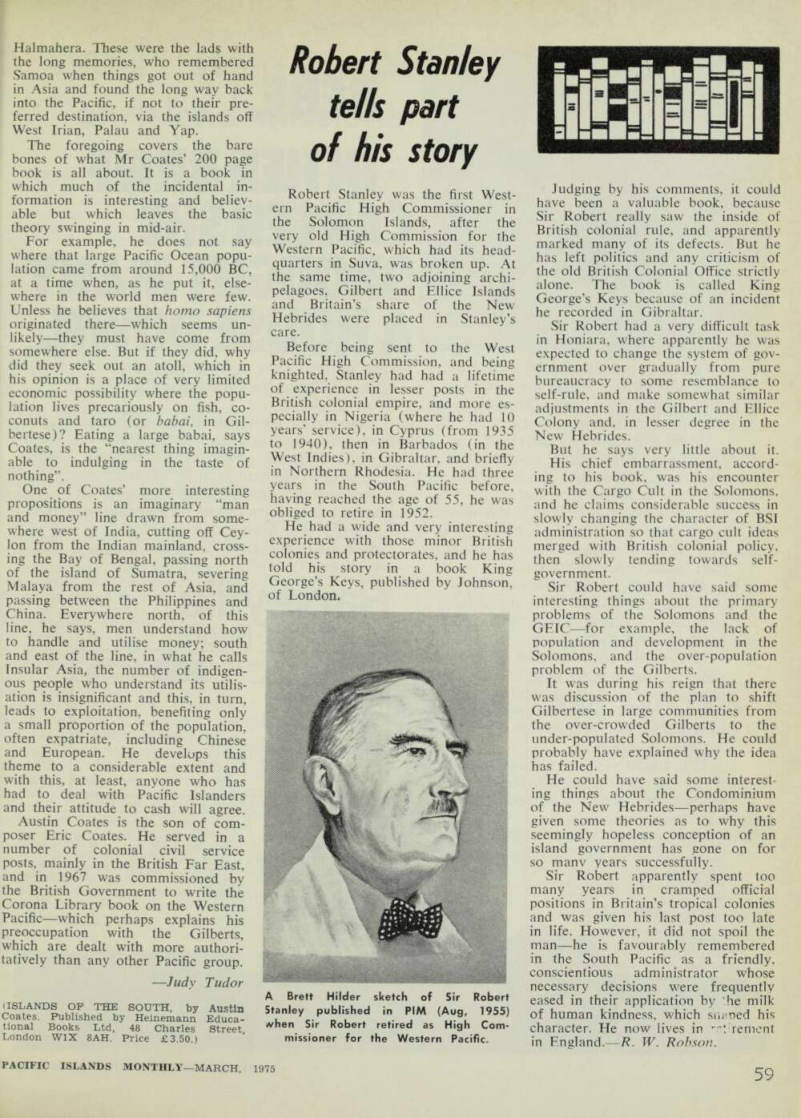
Robert Stanley was the first West ern Pacific High Commissioner in the Solomon Islands, after the very old High Commission for the Western Pacific, which had its head quarters in Suva, was broken up. At the same time, two adjoining archi pelagoes, Gilbert and Ellice Islands and Britain’s share of the New Hebrides were placed in Stanley’s care.
Before being sent to the West Pacific High Commission, and being knighted, Stanley had had a lifetime of experience in lesser posts in the British colonial empire, and more es pecially in Nigeria (where he had 10 years’ service), in Cyprus (from 1935 to 1940), then in Barbados (in the West Indies), in Gibraltar, and briefly in Northern Rhodesia. He had three years in the South Pacific before, having reached the age of 55, he was obliged to retire in 1952.
He had a wide and very interesting experience with those minor British colonies and protectorates, and he has told his story in a book King George’s Keys, published by Johnson, of London.
Judging by his comments, it could have been a valuable book, because Sir Robert really saw the inside of British colonial rule, and apparently marked many of its defects. But he has left politics and any criticism of the old British Colonial Office strictly alone. The book is called King George’s Keys because of an incident he recorded in Gibraltar.
Sir Robert had a very difficult task in Honiara, where apparently he was expected to change the system of gov ernment over gradually from pure bureaucracy to some resemblance to self-rule, and make somewhat similar adjustments in the Gilbert and Ellice Colony and, in lesser degree in the New Hebrides.
But he says very little about it.
His chief embarrassment, accord ing to his book, was his encounter with the Cargo Cult in the Solomons, and he claims considerable success in slowly changing the character of BSI administration so that cargo cult ideas merged with British colonial policy, then slowly tending towards self government.
Sir Robert could have said some interesting things about the primary problems of the Solomons and the GElC—for example, the lack of population and development in the Solomons, and the over-population problem of the Gilberts.
It was during his reign that there was discussion of the plan to shift Gilbertese in large communities from the over-crowded Gilberts to the under-populated Solomons. He could probably have explained why the idea has failed.
He could have said some interest ing things about the Condominium of the New Hebrides—perhaps have given some theories as to why this seemingly hopeless conception of an island government has gone on for so manv years successfully.
Sir Robert apparently spent too many years in cramped official positions in Britain’s tropical colonies and was given his last post too late in life. However, it did not spoil the man—he is favourably remembered in the South Pacific as a friendly, conscientious administrator whose necessary decisions were frequently eased in their application by ‘he milk of human kindness, which siiaoed his character. He now lives in •'F remont in England.—/?. W. Robson.
A Brett Milder sketch of Sir Robert Stanley published in PIM (Aug, 1955) when Sir Robert retired as High Com missioner for the Western Pacific.