Book Reviews
pp. 59-61 · Read in the full issue
So, Polynesians were in the Pacific all the time!
Theorising about the origin of the people of the Pacific has become so popular among academics and quasi academics that the average layman can be pardoned if he begins to feel that the whole subject is a great big bore. Even so, even the most blase might lift a languid eyebrow at the newest of the current crop, as pro pounded by Austin Coates in Islands of the South.
Mr Coates thinks that Polynesia and Micronesia were not populated from the Malaysian chain, hiving off from Indonesia as population pres sure built up behind, which was the conception of old-time anthropolo gists like Sir Peter Buck.
He thinks that the people of the Pacific atolls populated southern Asia, particularly the island chains off southern Asia. In this context he gives this area the blanket term of Austronesia, meaning islands of the
south, which generally embraces the area where the Malayo-Polynesian group of languages are spoken.
There is one safe bet about this, as in all such theories—there is no way of proving it wrong. The big thing is to propound an idea and get into business; positive proof of whether you are correct or not is lost in the effluxion of time, Islanders up to the advent of Europeans on the scene, having no written records and modern Islanders not giving a damn, being disposed to thinking that they have always been there, or there abouts.
A lot of what this author had to say about the similarities of life-style of the Pacific atoll dwellers and that of villagers in the Indonesian chain, Malaya, the Philippines, even Ceylon and Madagascar far over in the In dian Ocean, is interesting enough but some of his basic theory, which
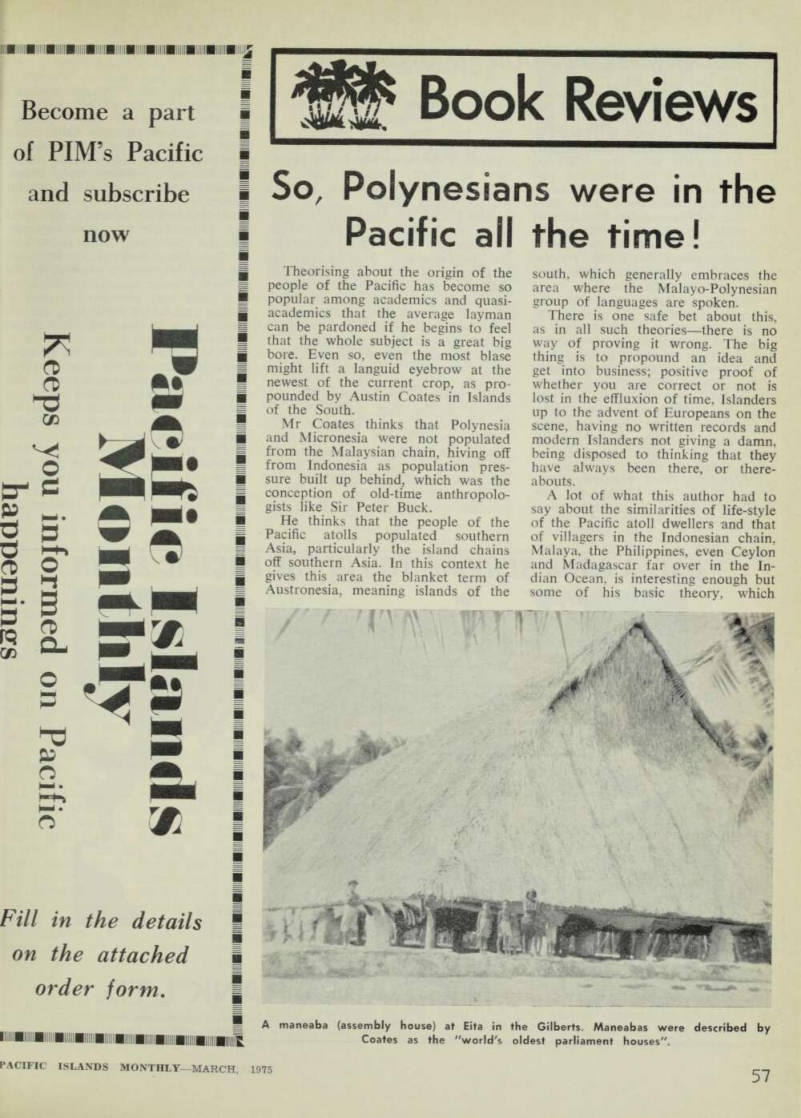
A maneaba (assembly house) at Eita in the Gilberts. Maneabas were described by Coates as the "world's oldest parliament houses".
Population Explosion In Oceania
seems to rest on supposition if not a fertile imagination, will be hard for most people to swallow.
According to Coates, in 15,000 BC two-thirds of Oceania was peopled by Melanesians who also inhabited Timor, parts of the Moluccas and Flores. At a time, he says, when elsewhere in the world men were few, the Pacific was the first part of the world to support a large human population. Pressure of population, therefore, caused the Pacific peoples to migrate, always in search of a better or untouched island.
This did not apply however to the Melanesians, whom the author obviously relegates to a lower order of society. They were already located on the bigger forested islands, such as Fiji or New Guinea, thus leaving the activity and enterprise to the Polynesians and Micronesias who were the originators of the Austronesians’ civilisation. The movement, he thinks, probably started in the atolls of the Tuamotu and spread from island to island, but became centralised on two relatively large islands, Tahiti and in Samoa.
Where islands and atolls were
already inhabited, the original inhabitants either became enslaved or pushed off themselves in canoes, if they had them, but generally he thinks Polynesian-Micronesian penetration of the area was fairly bloodless as they sensibly left the Melanesians entrenched on the big islands strictly alone.
About 3500 BC there was a population explosion in Oceania which increased the westward migrations of the Austronesians. Skirting the big Melanesian islands they “threaded their way through the intricacies of the Coral Sea”, along a route north of New Guinea until they reached Java where different but compatible people were at last encountered.
From there, because of favourable ocean currents, news went back to Oceania to the people remaining, telling them of the favourable conditions in the new land. This, in turn, produced new migrations.
“This point”, says Austin Coates, “marks the zenith of the Austronesian civilisation when for a period, which probably did not last more than two or three hundred years, there was communication back and forth be-
tween Asia and the Pacific, embracing a tropical region which came to ex tend from Madagascar to Tahiti”.
However, about three thousand years after the westward migration— ie about 450 BC—these Austro nesians evidently became disillusioned with their lot in their Asian home land and there arose among them, says Coates, a desire to make a des perate attempt to return to ancestral Samoa.
Although they evidently still could not write, their memories were ob viously very long—3,ooo years long in fact. They returned via what we now call Micronesia, particularly the Gilbert Islands, where many took the easy way out, gave up the idea of Samoa and settled for driving out the descendants of those who had stayed in the first place.
In the course of time, the invaders were also invaded by fresh arrivals from Asia and scattered over the Pacific, including Samoa and even New Zealand, but the Gilberts re mained the link between the Pacific and Southern Asia.
The ancestors of the present Gil bertese, says Coates, were part of a large group from Samoa who, during the Austronesian period, settled in the Moluccas. Amboina, Ceram and
Halmahera. These were the lads with the long memories, who remembered Samoa when things got out of hand in Asia and found the long way back into the Pacific, if not to their pre ferred destination, via the islands off West Irian, Palau and Yap.
The foregoing covers the bare bones of what Mr Coates’ 200 page book is all about. It is a book in which much of the incidental in formation is interesting and believ able but which leaves the basic theory swinging in mid-air.
For example, he does not say where that large Pacific Ocean popu lation came from around 15,000 BC, at a time when, as he put it, else where in the world men were few.
Unless he believes that homo sapiens originated there—which seems un likely—they must have come from somewhere else. But if they did, why did they seek out an atoll, which in his opinion is a place of very limited economic possibility where the popu lation lives precariously on fish, co conuts and taro (or babai, in Gil bertese)? Eating a large babai, says Coates, is the “nearest thing imagin able to indulging in the taste of nothing”.
One of Coates’ more interesting propositions is an imaginary “man and money” line drawn from some where west of India, cutting off Cey lon from the Indian mainland, cross ing the Bay of Bengal, passing north of the island of Sumatra, severing Malaya from the rest of Asia, and passing between the Philippines and China. Everywhere north, of this line, he says, men understand how to handle and utilise money; south and east of the line, in what he calls Insular Asia, the number of indigen ous people who understand its utilis ation is insignificant and this, in turn, leads to exploitation, benefiting only a small proportion of the population, often expatriate, including Chinese and European. He develops this theme to a considerable extent and with this, at least, anyone who has had to deal with Pacific Islanders and their attitude to cash will agree.
Austin Coates is the son of com poser Eric Coates. He served in a number of colonial civil service posts, mainly in the British Far East, and in 1967 was commissioned by the British Government to write the Corona Library book on the Western Pacific—which perhaps explains his preoccupation with the Gilberts, which are dealt with more authori tatively than any other Pacific group.
Judy Tudor
(ISLANDS op THE SOUTH, by Austin Coates. Published by Heinemann Educa tional Books Ltd, 48 Charles Street London WIX BAH. Price £3.50.)