Experts' plan
pp. 80-83 · Read in the full issue

to boost Fiji sugar
Fiji’s third report in 14 years on its sugar industry suggests that the country’s 16,000 cane growers should receive at least $14.50 a ton for their cane, and that sugar earn ings should be shared on the basis of two-thirds for growers and one third for millers. This report was made by a United Nations team.
The suggested price substantially
betters the minimum-guaranteed price of $7.75 a ton and 65 per cent of sugar sales proceeds, recommended by Britain’s Master of the Rolls, Lord Denning, after an inquiry in 1969. The UN report suggests a number of targets at which the in dustry should aim, not the least of which is production of 400,000 tons of raw sugar a year—from about 3.120.000 tons of cane from a mini mum of 130,000 acres.
Sugar production in Fiji has been declining in recent years for a variety of reasons. Production in 1974 of 270.000 tons, was well below the 1968 record of 393,000 tons. Fiji was in no position in 1974, after meeting quotas, to take advantage of record prices on the free market, which peaked in London at £stg6oo a ton.
The UN report suggested that the sugarcane stabilisation fund be re introduced. The first fund, set up in World War 11, gave the Fiji Govern ment and particularly the then- Financial Secretary, Mr Eric Beving ton, a real headache when it came to disbursing it about 15 years ago.
In setting up any new fund, care would need to be taken to avoid the pitfalls of the first fund.
The report revealed that the Fiji Sugar Corporation, which has con trolled the industry since the de parture of CSR Ltd, and growers, lose at least 4c every time a local shop sells lib of local sugar. It questioned whether this state of affairs should continue, as on current sales of about 20,800 tons a year, consumers were subsidised to the extent of $1,788,000.
Soon after the report was released, the Fiji Prime Minister, Ratu Sir Kamisese Mara, addressing a meeting of the Indian Alliance Party, said Fiji would market its own sugar, in stead of CSR Ltd. CSR Ltd con tinued to market Fiji sugar after it withdrew from milling a few years ago. Ratu Sir Kamisese has asked
the independent chairman of the in-r dustry, Mr lan Thomson, to report! on what organisation is needed too; set up a sugar marketing agency.
Ratu Sir Kamisese was critical ofk CSR Ltd’s dual role as selling agentr for both Fiji and Australia, saying) that recently Australia and Britaimi had concluded a sugar deal in cir-i cumstances which meant Fiji’s ownr agent was trying to outsell its sugar.!
Croc farms
for PNG
Crocodiles may soon be earning upi to $1 million a year for villagers ini the Gulf and Sepik regions of Papusr New Guinea, in areas where growingr cash crops is practically impossibles!
The PNG Department of Agricultures* Stock and Fisheries recently launcheos a crocodile farming project in therl Gulf District which is expected tot culminate in 200 small crocodileli farms by the middle of 1976.
There are plenty of young crocoo. diles about, according to wildlifdi officers. These will be collected anon taken into the farms. The skins arnj
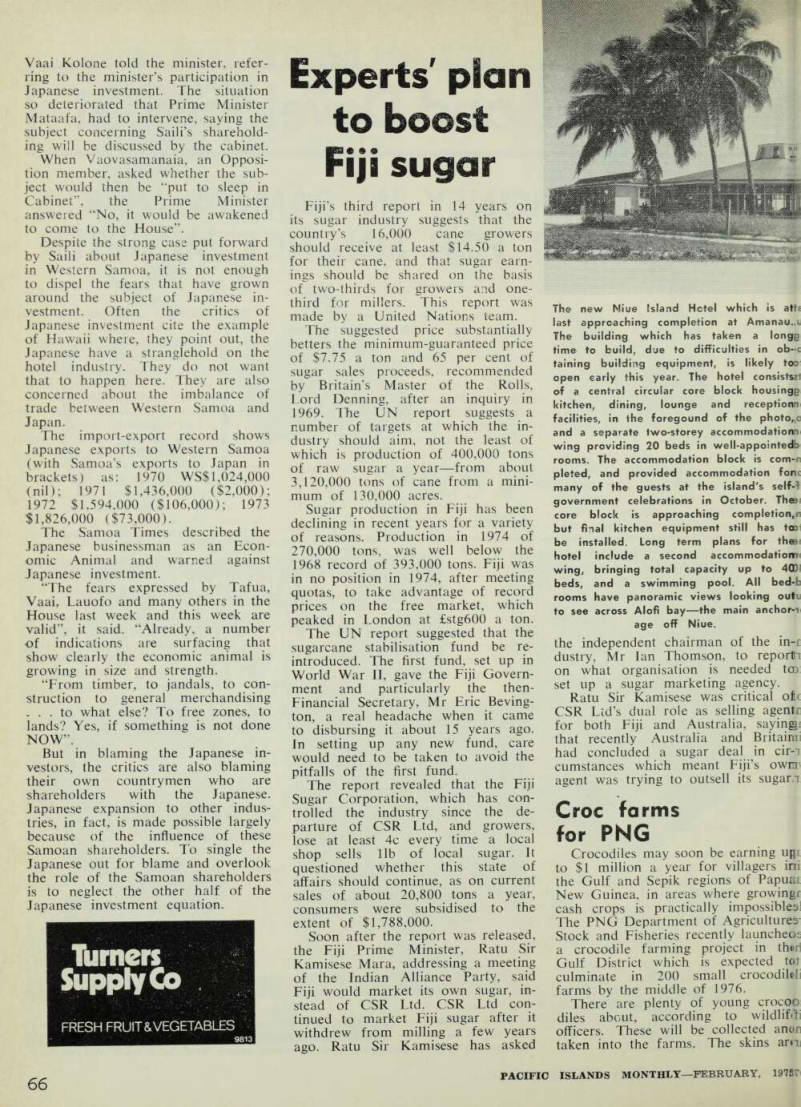
The new Niue island Hotel which is at last approaching completion at Amanau.
The building which has taken a long time to build, due to difficulties in ob taining building equipment, is likely to open early this year. The hotel consists of a central circular core block housing kitchen, dining, lounge and reception facilities, in the foregound of the photo, and a separate two-storey accommodation wing providing 20 beds in well-appointed rooms. The accommodation block is com pleted, and provided accommodation for many of the guests at the island's self government celebrations in October. The core block is approaching but final kitchen equipment still has to be installed. Long term plans for the hotel include a second accommodation wing, bringing total capacity up to 40 beds, and a swimming pool. All bed rooms have panoramic views looking out to see across Alofi bay—the main anchor age off Niue.
their most valuable when the rep es are two years old. The skins of )ung crocodiles are not worth much.
Wildlife officers are also confident e price of crocodile skins will rise there is a growing world shortage crocodiles. Papua New Guinea is le of a few countries where the ocodile population is rising.
oor year for
looks factory
According to the annual directors’ port of Island Foods Ltd, Raro nga, 1974 was a disappointing ar.
Island Foods has a processing fae ry on the island and the southern >oks supplies it with oranges, pine pies and pawpaw. These are con rted into canned juices and pulps, long which is the well-known Raro ange juice, for the New Zealand irket.
There was a big drop in the fac e’s 1974 receipts of citrus—over ,000 70 lb cases less than the pre ms year, which happened to be a :ord one for citrus. Other set-backs re the loss of a number of long ving staff who left for jobs in New aland, shortage of all types of raw iterials, and substantial increases costs, especially that of tin plate.
Although most of the company’s ported materials are re-exported NZ as finished products, Island ods had to pay Cook Islands’ im rt levies and other duties not pay le by similar industries in NZ. ese amounted to almost $29,000 ring the financial year, and sub ssions asking for relief have been de to the Cook Islands Govern nt.
Because of increased costs and re ;ed throughput, profits were seri »ly affected, and the net profit was le more than $3,000. No bonus growers could be paid for 1974.
Hie company expressed its great icern at the serious situation it I face unless cannery fruit sup ;s are substantially increased in future.
oiled shirts
I I the Rossi
Fhere will be an emphasis on din in style in the Hotel Rossi in the w Hebrides, management of which now in the hands of Pacific Re ts. Pacific Resorts, an Australian npany, manages several Pacific □rts. The hotel manager, Mr lan Intyre, said that all rooms were ng redecorated, and a new roof uld go over the old wing. There now formal dining nights each dnesday, special menus on Satur-
days, and Sunday dinner dances.
New amenities include cruises, in conjunction with Hideaway, and fish ing trips.
PNG Govt in
hotel trade
The PNG Government is consider ing buying a controlling interest in a $3.5 million hotel, just completed in Port Moresby. It would be the government’s first venture into hotel ownership.
The hotel. The Islander, was partly completed when its developers,
Cambridge Credit Corporation of Australia, collapsed last year. The project was saved by lAC through its PNG subsidiary lAC (NG) Pty Ltd.
With 96 suites, the hotel is PNG’s biggest and is built in a newly developing area not far from the university, and near a site for a state reception hall which the government hopes to build shortly.
Indications were that the govern ment would seek a 51 per cent in terest and possibly more.
The Minister for National Develop ment, Mr Gavera Rea, who has been involved in the talks with lAC, officially opened the new hotel on January 18.
Lord Howe's air
link to change
Lord Howe Island’s air link with Australia from January 31 is likely to be centred at Coffs Harbour, on the north coast of New South Wales.
Airlines of NSW, which has operated a service from Sydney to the island with a Riley Heron aircraft since September, 1974, was scheduled to withdraw its service on January 31.
Airlines of NSW, since taking its flying-boats off the service, have had the Riley Heron, chartered from Conair. It was not a viable service.
Matters reached a climax when Cyclone Tracy devastated Darwin on Christmas Day. There was such a demand for Conair services that it would have been impossible to arrange a renewal of the charter.
The major contender for the route
Bougainville Gets The Royalties
All royalties from the Bougain ville Copper mine after June 30, 1975, will be paid to the Bougain ville Provincial Government.
The Minister for Finance, Mr Julius Chan, announced this follow ing the signing in December of a memorandum of agreement between the central and provincial govern ments. Mr Chan was chairman of the government negotiating commit tee which met a Bougainville team.
Other signatories to the memoran dum were the Minister for Mines and Energy, Sir Paul Lapun; the Minister for Commerce, Mr Ebia Olewale; and for the Bougainville provincial government: the District Commissioner, Dr A. H. Sarei; Mr Aloysius Noga, executive officer; and Mr John Dakeni, executive member.
The agreement provides for: • all royalties on copper ex tracted after June 30, 1975, to be
paid to the Bougainville provincial government until the mine is ex hausted; • the central government to pass the money on within one month of receiving it, or pay interest at the current Treasury Bill rate. , The Bougainville Government to spend royalties at their own dis cretion- ’ • fature Payments from the non renewable resources fund to be made according to the new Bougainville copper agreement; • the provincial government to continue to negotiate its capital works programme annually with the central government; * the special grant of $2.4 mil fion ma( j e this year in recognition 0 f Bougainville’s contribution to national revenue to cease at the end of 1974-75.
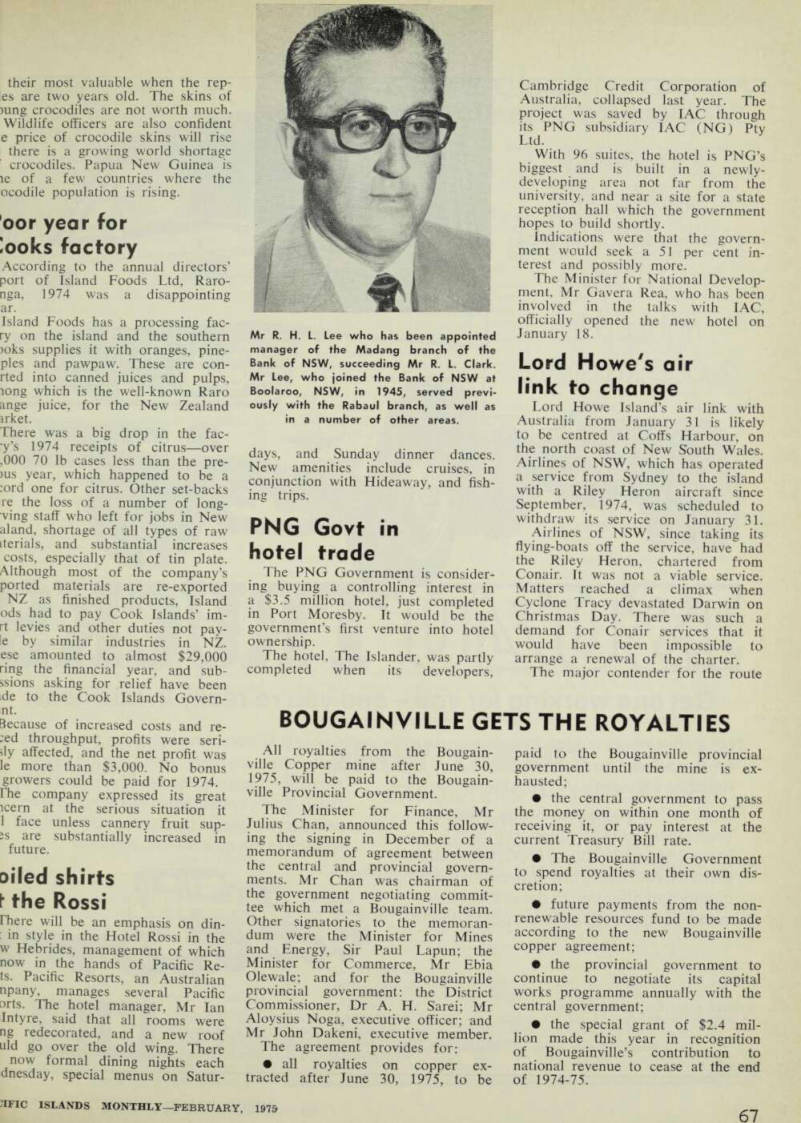
Mr R. H. L. Lee who has been appointed manager of the Madang branch of the Bank of NSW, succeeding Mr R. L. Clark.
Mr Lee, who joined the Bank of NSW at Boolaroo, NSW, in 1945, served previ ously with the Rabaul branch, as well as in a number of other areas.
licence from January 31 on was North Coast Airlines, based at Coffs Harbour. This airline, along with a number of others, sought the route when the flying-boats were about to be taken off. Now, it is the only air line operating a commuter service, which can meet all requirements for the service. It has aircraft, crews and experience on a Coffs Harbour-Lord Howe Island charter service.
North Coast Airlines seems cer tain to get the licence, at least on a temporary basis to provide an essen tial link between the island and the mainland, pending any further appli cations for the route coming in and being processed. Allocation of the licence is a joint matter, between the Federal Department of Transport (air transport group) and the NSW Department of Motor Transport.
North Coast Airlines will use Piper Navajo Chieftain aircraft, which can carry nine passengers. It is prepared to operate a daily ser vice.
Tonga's example
to the world
Tonga may be showing the rest of the world how to control inflation.
In the December quarter the cost of living index rose by only 1.7 per cent, compared with 3.1 per cent the previous quarter. The good result stemmed largely from the decision not to devalue the pa’anga when New Zealand and Australia devalued their currencies. This made imported food, most of which is from Aust ralia and New Zealand, slightly cheaper. Higher prices for locally produced food were the main cause of the slight rise in the index.
Fiji's champion
golf course
Fiji’s new golf course at Deuba, on the south coast of Viti Levu will be the venue for an international tournament, the Pacific Harbour Open, on August 7, 8 and 9. The course was officially opened recently by the Fiji Prime Minister, Ratu Sir Kamisese Mara, who is something of a golf enthusiast. The course is a fraction less than 7,000 yards from the championship tees, and the par is 72.
The course is part of the Pacific Harbour resort, which is about 35 miles west of Suva. The course was created from about half a million tons of sand dredged from surround ing lakes and waterways. It is fully sprinklered, irrigated and drained.
The tournament professional is 26year-old Peter Oosterhuis, who has made his name in world circles.