Business and Development
pp. 79-80 · Read in the full issue
Japanese Money In Samoa Makes
A Hot Seat For Finance Minister
From FELISE VA’A in Apia
The rapid expansion of Japanese investment in Western Samoa is worrying certain Members of Parlia nent and community leaders here. -\nd this is particularly odd since the :ountry started its third Five Year Economic Development Plan in Janu iry, and surely, the country’s leaders will back a general policy of inviting oreign investments!
This worry was obvious at the ?arliamentary debates over the 1975 Budget. The forthright chairman of he Public Accounts Committee, /aai Kolone, for instance, warned he government about the rapid, eemingly uncontrolled expansion of apanese industry in Western Samoa.
The Japanese were first allowed to et up business in the country in 1967 o cut and mill timber. New Samoa ndustry, which was formed as a re ult, continues to thrive today but hat is not the problem. Subsequently he Japanese expanded to other types )f industry, like building construction Trans-Pacific Development Corpo ation), and jandal-making. There lave also been unconfirmed reports hat they may go into general mer handising and vegetable growing.
It is this Japanese expansion into »ther fields which is causing the par iamentary disquiet and there are ome penetrating questions to be isked regarding, for instance, the hareholding in those so-called apanese companies.
According to a recent report in Apia’s leading weekly, the Samoa fimes, Japanese businessmen Oishi ind Orikane own 55 per cent Trans ’acific Development; the Samoa Minister of Finance Sam Saili and iavea loane own 1,500 shares each; vhile the balance of 15,000 shares re owned by others.
Shareholding in New Samoa In iustry, the Samoa Times says, is as ollows: Taniguchi (43,640), Savea pane (21,500), Sam Saili (11,460), uigamala Anetipa Lam Sam 6,700), Ana Kelemete (6,700). )thers hold 10,000 shares.
So the Japanese have a five per cent majority of the shares in Trans pacific Development, while Samoans have a clear majority in New Samoa Industry. Conclusion; The two com panies, therefore, are not wholly Japanese-owned companies and largely fulfil the established govern ment policy that locals must own a substantial amount of shares in any investment by “foreigners”. However, there is another problem attached to this.
Did the Japanese, for instance, get any preferential treatment from the government? Mr Saili is one of the principal shareholders in both com panies. Two of the shareholders in New Samoa Industry are a brother and sister of the minister.
Questions purporting to show a connection between Japanese invest ment and government favouritism were raised in parliament and the Minister of Finance devoted a major portion of his time to answer
ing them.
Saili said that originally he had objected to the coming of the Japanese milling company. Later he became associated with the company professionally and after a lot of per suasion from the Japanese had given some land to the company in ex change for shares in 1969. He, for his part, had urged the Japanese to give Samoans at least 50 per cent of the shareholding and in 1972, Samoans held 45 per cent of the shares. He kept pushing for more shares for Samoans and this year it was agreed that Samoans will have 75 per cent of the shares in New Samoa Industry and the Japanese 25 per cent.
He said he had given shares to his brother and sister because like any Samoan he loved his brothers and sisters.
Despite the minister’s eloquent de fence of the companies, members continued to bombard him with questions.
“I don’t believe your integrity”,
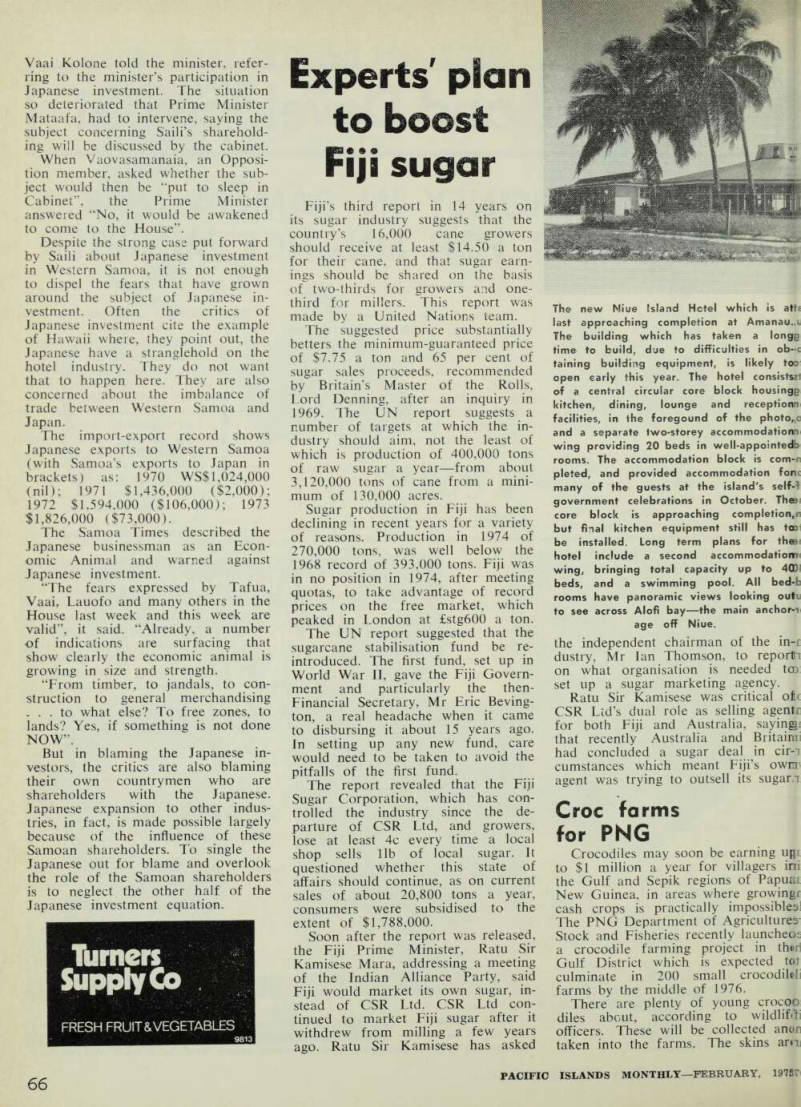
"I don't believe your integrity" says Vaai Kolcne, Public Accounts Committee chair man (right) to Western Samoa's Finance Minister, Mr Sam Saili (left), who was put on the hot seat in parliament over Japanese shares held by himself and relations.
Vaai Kolone told the minister, refer ring to the minister’s participation in Japanese investment. The situation so deteriorated that Prime Minister Mataafa, had to intervene, saying the subject concerning Saili’s sharehold ing will be discussed by the cabinet.
When Vaovasamanaia, an Opposi tion member, asked whether the sub ject would then be “put to sleep in Cabinet”, the Prime Minister answered “No, it would be awakened to come to the House”.
Despite the strong case put forward by Saili about Japanese investment in Western Samoa, it is not enough to dispel the fears that have grown around the subject of Japanese in vestment. Often the critics of Japanese investment cite the example of Hawaii where, they point out, the Japanese have a stranglehold on the hotel industry. They do not want that to happen here. They are also concerned about the imbalance of trade between Western Samoa and Japan.
The import-export record shows Japanese exports to Western Samoa (with Samoa’s exports to Japan in brackets) as: 1970 WS$ 1,024,000 (nil); 1971 $1,436,000 ($2,000); 1972 $1,594,000 ($106,000); 1973 $1,826,000 ($73,000).
The Samoa Times described the Japanese businessman as an Econ omic Animal and warned against Japanese investment.
“The fears expressed by Tafua, Vaai, Lauofo and many others in the House last week and this week are valid”, it said. “Already, a number of indications are surfacing that show clearly the economic animal is growing in size and strength.
“From timber, to jandals, to con struction to general merchandising , . . to what else? To free zones, to lands? Yes, if something is not done
Now”.
But in blaming the Japanese in vestors, the critics are also blaming their own countrymen who are shareholders with the Japanese.
Japanese expansion to other indus tries, in fact, is made possible largely because of the influence of these Samoan shareholders. To single the Japanese out for blame and overlook the role of the Samoan shareholders is to neglect the other half of the Japanese investment equation.