Png To Close Lucrative Loophole
pp. 83-84 · Read in the full issue
Against Currency Smugglers
Papua New Guinea, which uses Australian currency, is to close a loophole which for many years has allowed travellers to break Australian currency exchange regulations.
The situation could have allowed large sums of Australian currency to leak overseas illegally. The full extent to which the loophole may have been exploited is not known.
However, the PNG Finance Minister, Mr Julius Chan, confirmed in Port Moresby in December that it was known the Australian controls had been broken in PNG. The loophole has been caused by the fact that there have been no currency exchange or control restrictions between Australia and PNG.
This allowed large sums of money to be carried from Australia to PNG without question. But, at the same time. PNG has not made a practice of checking the amount of currency taken from its own ports to destina tions in Australia or anywhere else in the world.
This has allowed an effective, unchecked flow of money out of Australia to other parts of the world when it is staged through PNG, or is carried by Australian residents of
Png.
Questions on the situation were asked in the PNG Parliament early in December by the Member for Wewak, Mr T. O’Shannessy.
Mr Chan confirmed that the regulations had been broken and said that PNG would naturally watch the situation closely where its own cur-
rency was concerned after the cur rency change-over in 13 months time, Meanwhile an immediate scrutiny would be introduced of the amount of Australian currency being carried by travellers leaving PNG.
Mr Chan said travellers would be asked by customs officials to disclose how much currency they were carry ing. This question had not been asked in the past.
Under Australian currency regula tions, SIOO in cash and $4,000 in travellers cheques can be carried by departing passengers, This limit would now be applied j n PNG on Australia’s behalf while Australian currency continued to be in PNG. An equivalent limit would be applied when PNG began using its own currency, The legality of the controls had already been established in PNG banking legislation passed last year, • • , i
KlSllig COStS SJOW
k.iiNlnn uOWn nOtel DllllClSng The resort hotel at Ha’atafu Beach, on the west coast of Tongatapu, will not be ready in time for the next South Pacific Forum in July. Escalat ing costs have caught up with the owners, Pacific Resorts Pty Ltd, who are now having a close look at build ing the hotel progressively. Another plan to help meet costs is to charter a ship to take all materials for the hotel to Tonga. The owners will have a meeting with the architects in
January to discuss future plans in more detail.
Whatever happens, the hotel will still be built, a Sydney spokesman of Pacific Resorts said. It had been in tended to have the first stage of 58 rooms of the 96-room hotel ready for the forum meeting. Pacific Resorts owns the Port of Refuge Hotel in Vavau,
P & O Buys A
Cruise Liner
P and O recently bought a 20,000ton cruise liner, the Sea Venture, from Norwegian interests to operate on tourist cruises from Australia to Pacific Islands ports from November to May. The ship, which has been renamed Pacific Princess, will join the P and O fleet in April.
When not in the South Pacific she will cruise from the west coast of the United States. The Pacific Princess is the first passenger ship P and O has introduced to Australia since the Canberra made its maiden voyage in June, 1961.
How not to win
in PNG business
Unsound advice from “a new wave of foreigners” and a superstitious local attitude to cause and effect are plaguing many new businesses owned by New Guineans.
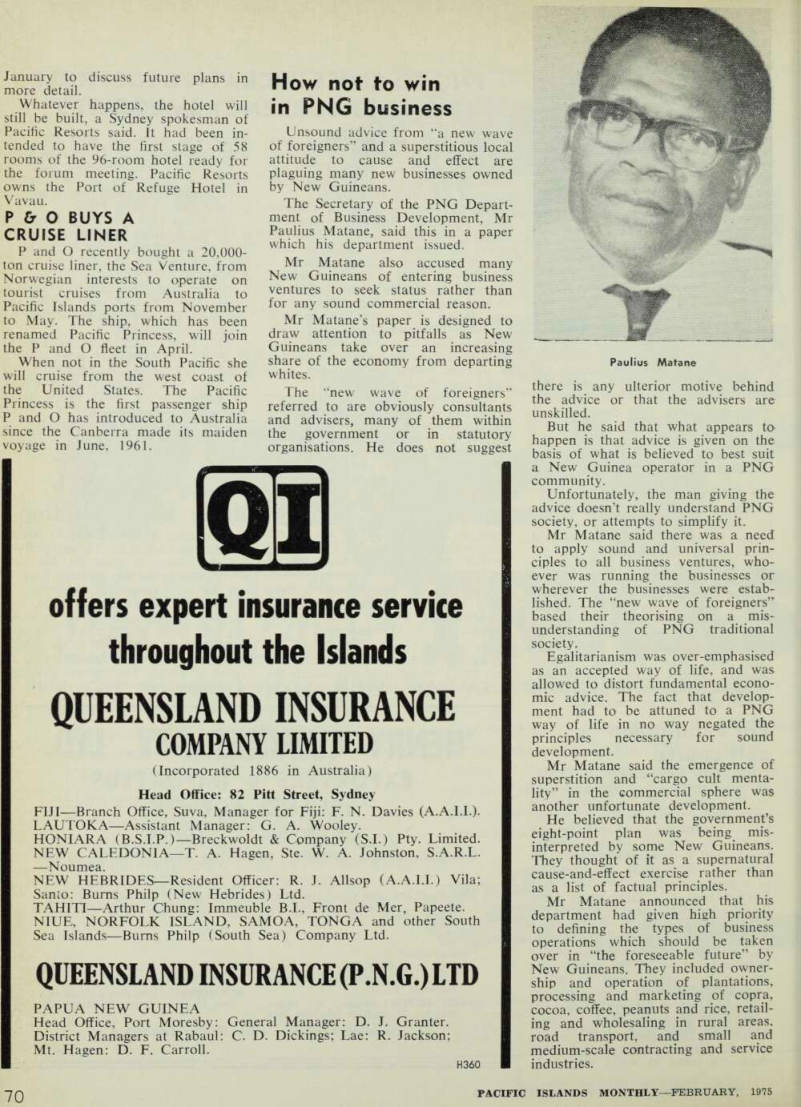
The Secretary of the PNG Depart ment of Business Development, Mr Paulius Matane, said this in a paper which his department issued.
Mr Matane also accused many New Guineans of entering business ventures to seek status rather than for any sound commercial reason.
Mr Matane’s paper is designed to draw attention to pitfalls as New Guineans take over an increasing share of the economy from departing whites.
The “new wave of foreigners” referred to are obviously consultants and advisers, many of them within the government or in statutory organisations. He does not suggest
there is any ulterior motive behind the advice or that the advisers are unskilled.
But he said that what appears to happen is that advice is given on the basis of what is believed to best suit a New Guinea operator in a PNG community.
Unfortunately, the man giving the advice doesn’t really understand PNG society, or attempts to simplify it, Mr Matane said there was a need to apply sound and universal prin ciples to all business ventures, who ever was running the businesses or wherever the businesses were estab lished. The “new wave of foreigners” based their theorising on a mis understanding of PNG traditional society.
Egalitarianism was over-emphasised as an accepted way of life, and was allowed to distort fundamental econo mic advice. The fact that develop ment had to be attuned to a PNG way of life in no way negated the principles necessary for sound development.
Mr Matane said the emergence of superstition and “cargo cult menta lity” in the commercial sphere was another unfortunate development.
He believed that the government’s eight-point plan was being_ mis interpreted by some New Guineans.
They thought of it as a supernatural cause-and-effect exercise rather than as a list of factual principles.
Mr Matane announced that his department had given high priority to defining the types of business operations which should be taken over in “the foreseeable future” by New Guineans. They included owner ship and operation of plantations, processing and marketing of copra, cocoa, coffee, peanuts and rice, retail ing and wholesaling in rural areas, road transport, and small and medium-scale contracting and service industries.
Paulius Matane