Yesterday
p. 57 · Read in the full issue
Suva Chamber of Commerce 20 rs ago was almost unanimous in its losition to a proposal to introduce -as-you-earn taxation in Fiji. Ten rs later PAYE became law in Fiji, ctically without opposition. first 15 days of the Western 10a constitutional convention, which ted in Apia on November 10, 1954, e taken up with social functions, ters of procedure and a six days' ate on the proposed transfer of public service from New land to Western Samoan control, my petrel of the early proceedings Mr P. L. M. Morgan, who raised actions to a few matters. Twice was ruled out of order, and the jnd time refused to sit down till ir delegates supported the chairman's ng that he remain silent.
'k was scheduled to start on a new ort for Lae, New Guinea, metime after July, 1955". The ort was to be at Malahang, ards the Busu River from Lae, and ut three miles from the airport i used. The plan for the new ort was approved by the imonwealth Government in 1948.
When Sir Robert Stanley, British High Commissioner for the Western Pacific and the man with the toughest administrative job in the South Seas, passed through Sydney on a quick trip to London, he firmly declined to tell radio or press reporters anything about his mission. PIM said it was not difficult to draw certain conclusions: London was being asked to take some decisions which would affect directly the future of the "Sorrowful Solomons". He was an administrator of rare conscientiousness. His three-year term was to expire about mid-1955 when he was due for retirement.
It would be consistent with his record and temperament if he tried, as his last big job, to introduce some plan which could at least provide the Solomons with an impulse towards development.
The Methodist Mission press at East Cape, Milne Bay, PNG, printed a school edition of a new English-Dobuan dictionary, the first dictionary for nearly 60 years, when a dictionary combining other languages was turned out. The dictionary contained a vocabulary of 2,500 words, which were compiled by the Methodist chairman in the district, the Rev R. Grant. He considered that number the minimum required by the native.
The Fiji Battalion sent to Malaya in 1952 for two years to fight against communist terrorists looked liked staying for "quite a long time", PIM, December, 1954, quoted Mr Malcolm MacDonald as saying. Mr MacDonald was then Commissioner General for the UK in SE Asia. The "long time" ended in June, 1956, when the battalion returned to Fiji. A large number of Fiji residents were opposed to the Fijians serving in Malaya. They believed they had a job to do in their own country, but not fighting communist terrorists.
The latest Cook Islands report showed that 243 Cook Islanders were employed
on the French phosphate workings at Ma katea—a fact which did not placate non-Maori critics of the scheme.
They took the view that the men should be employed developing their own islands, and that it was a disgrace that NZ should provide cheap labour for a French company. The phosphate was worked out in 1966.
Nickel and chrome mining, the two industries which were the basis of the economy of New Caledonia, were in violent contrast to each other 20 years ago. Nickel mining was booming and faced a bright future. But the chrome industry was reeling under the burden of high production costs and few foreign buyers. The United States, which took most of the chrome production, was out of the market.
And local politicians protested, unsuccessfully, against French industrialists buying chrome from foreign sources.
The net profit of Bulolo Gold Dredging Ltd dropped by nearly 50 per cent to $C992,600 for the year ended May 20, 1954. Shareholders were told that a steady decline could be expected in the company's activities as more dredges worked out their reserves.
A new £60,000 "ranch house" palace has been designed for Queen Salote of Tonga by an architect employed by the NZ Ministry of Works. Foundations for the new palace will be laid about four miles from Nukualofa within the next few years. The palace will have only a dozen bedrooms.
It will consist of several buildings joined by cloisters and arcades. It will replace the old timber palace in Nukualofa. The buildings will have asbestos roofs, parquet floors, louvre windows and screen doors. Avocado trees and coconut palms will surround it. RIM recorded all that in December, 1954. The old palace is still there, the new one has not gone up.
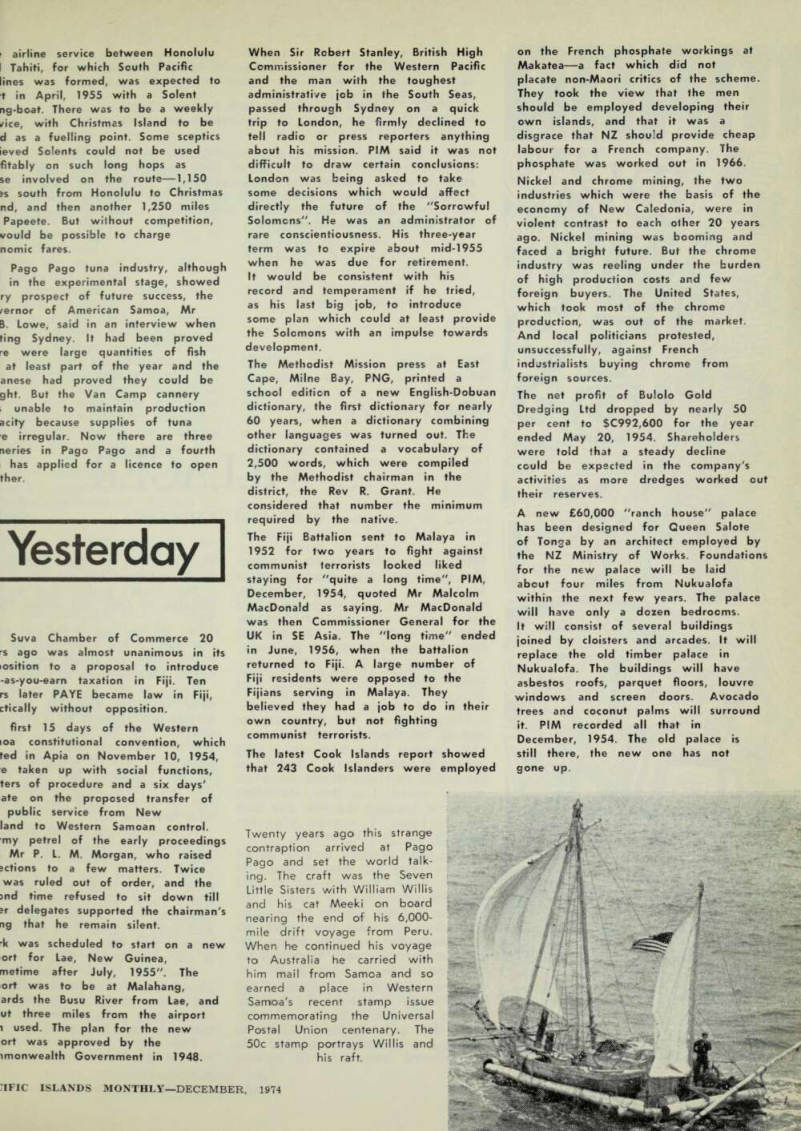
Twenty years ago this strange contraption arrived at Pago Pago and set the world talk ing. The craft was the Seven Little Sisters with William Willis and his cat Meeki on board nearing the end of his 6,000mile drift voyage from Peru.
When he continued his voyage to Australia he carried with him mail from Samoa and so earned a place in Western Samoa's recent stamp issue commemorating the Universal Postal Union centenary. The 50c stamp portrays Willis and his raft.