Magazine Section
pp. 55-57 · Read in the full issue
When The Pen Helped The Sword
To Win The War In Png
Tie outbreak of hostilities in ma New Guinea in 1942 soon used attention upon the need for zient means of disseminating in mation and news to servicemen ;d with the most difficult of con ons.
'olonel Scanlan on New Year’s /, 1942, ordered his men to fight the last and concluded his mess , “There shall be no withdrawal”, nours, some emanating from ;yo, were rampant among the >ps and Lieutenant Selby felt that egular news service might dispel misgivings which Colonel Scan s message had increased. Scan s headquarters considered that i an information service was im :ticable and a few days later ers were issued forbidding the i to listen to broadcasts from :yo. Selby persisted, however, and Juced a daily AA News Bulletin headquarters requested that they uld be placed upon the distri on list. lajor William C. Groves, a for anthropologist and teacher in toria and Nauru, was the editor the Moresby Army Newsheet, the t effort to bring mass information he fighting men. The troops were auraged to be contributors and ty submitted verses, which re ted upon the rigours of life in One such contributor adied “Wrap me up in my stock p and blanket”: Tear my innards apart and stew me— ut still it remains my belief "hat I’ll come back at night to haunt you md I’m still the same bully beef”.
IM praised the quality of this sheet and suggested that its type : was reminiscent of that of the met Papuan Courier, iuinea Gold was the outstanding ied forces newspaper produced the territory and is reputed to e emerged from an interview veen General Blarney, Com-
By W. G. Coppell
In this article, fourth of an occasional series on newspapers in the Islands, Dr W. G. Coppell tells the story of the four-year career of Guinea Gold, one of the most successful of the forces newspapers which catered for the Allied armies in almost every theatre of World War 11.
Guinea Gold, of which 35,630,000 copies were printed between November 19, 1942, and June 30, 1946, circulated throughout Papua New Guinea with Australian and American editions. Dr Coppell, a lecturer in education at Macquarie Uni versity, has made a special study of Island newspapers.
mander-in-Chief of Australian Forces and Reginald Leonard, a war correspondent of the Melbourne Herald. It is reported that Blarney asked of Leonard; “You think we should produce a newspaper? How often?”
“Daily, Sir”.
“Well if you think you can, you’d better do the bloody thing”.
Leonard, who had entered the tent as a war correspondent, emerged as a major in the Australian Army.
The men who worked on Guinea Gold meet annually in reunion and in their memorial booklet is the story of how their paper acquired its masthead.
“The unofficial news going the rounds was known in the slang of the times as the ‘G.G.’ or ‘good guts’.
The Commander-in-Chief was not so isolated from his troops that he did not know. He played with the letters ‘G.G.’ and he produced the title for the paper—Guinea Gold”.
The paper first appeared on No vember 19, 1942 and ceased on June 30, 1946 after 1,320 days of con tinuous publication. Its policies were largely influenced by Blarney’s re solve that the army newspapers should contain no editorial comment.
The strength of this resolve was shown in a letter Blarney wrote to General Morshead on November 16, 1943. Blarney was referring to a re cent Guinea Gold article on pilfer ing when he said, “It was excellent, and, I believe, timely but it is con trary to my policy to use an army newspaper for propaganda of any kind.
“In the first place troops readily become suspicious of a paper if it contains ‘pills’; secondly, this paper is sent to many American soldiers; thirdly, 1 do not believe in allowing editions of army newspapers to do anything that fashions the outlook of the troops. I do not believe they are the proper people to do it”.
Blarney, however, did not always abide by his own precepts. In an anonymous article he told the truth about malaria.
“Some fifth columnist has circu lated a story that taking quinine makes a man impotent. Nothing could be more false. But it is certain that repeated attacks of malaria will do so. A man becomes so weakened by repeated attacks that he loses all his energy and doesn’t find much of interest in life anyway. Only one per son can safeguard you against this, and this is yourself”.
Reginald Leonard has recounted some of his trials and tribulations in producing Guinea Gold.
“The real credit belongs to the junior officers and to all the other ranks who did not spare themselves when things went wrong. It was they who patched up the old machinery to keep it going and who fed the machines by hand even when circu lation was at its peak of 64,000 daily.
There were others who intercepted radio news by matchlight during bombing raids, others who set type by hand when mechanical equipment failed, others whose brawny arms provided power for the presses when the electrical power failed.
“The hand-set type was badly worn and it was necessary to pack the undersides with gummed paper
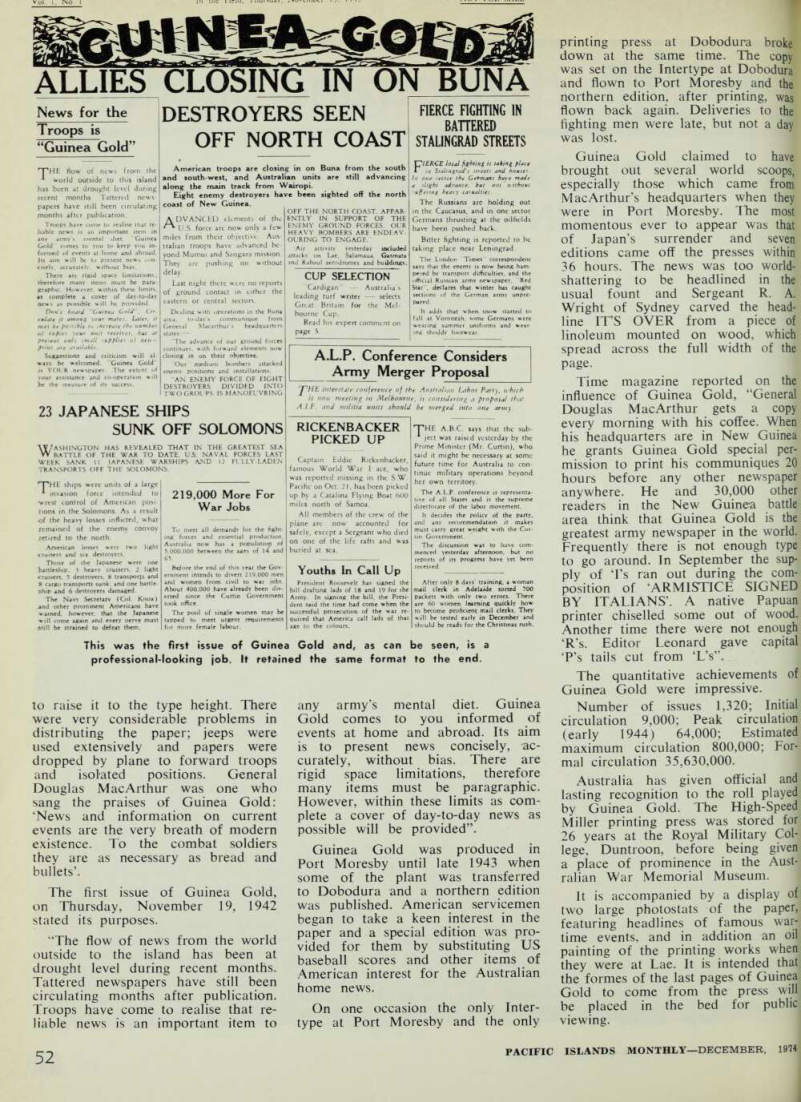
to raise it to the type height. There were very considerable problems in distributing the paper; jeeps were used extensively and papers were dropped by plane to forward troops and isolated positions. General Douglas MacArthur was one who sang the praises of Guinea Gold: ‘News and information on current events are the very breath of modern existence. To the combat soldiers they are as necessary as bread and bullets • The first issue of Guinea Gold, on Thursday, November 19, 1942 stated its purposes. - r , u The flow of news from the world outside to the island has been at drought level during recent months.
Tattered newspapers have still been
circulating months after publication.
Troops have come to realise that reliable news is an important item to
any army’s mental diet. Guinea Gold comes to you informed of events at home and abroad. Its aim is to present news concisely, ac curately, without bias. There are rigid space limitations, therefore many items must be paragraphic, However, within these limits as com plete a cover of day-to-day news as possible will be provided”, Guinea Go|d was produced in port Moresby until late 1943 whe n some of the plant was transferred to Dobodura and a northern edition was published. American servicemen began to take a keen interest in the paper and a special edition was pro {or by substituting US baseba n scores and other items of American interest for the Australian .
On one occasion the only Inter type at Port Moresby and the only
printing press at Dobodura broke down at the same time. The copy was set on the Intertype at Dobodura and flown to Port Moresby and the northern edition, after printing, was flown back again. Deliveries to the fighting men were late, but not a day was lost.
Guinea Gold claimed to have brought out several world scoops, especially those which came from Mac Arthur's headquarters when they were in Port Moresby. The most momentous ever to appear was that of Japan’s surrender and seven editions came off the presses within 36 hours. The news was too world shattering to be headlined in the usual fount and Sergeant R. A.
Wright of Sydney carved the head line IT’S OVER from a piece of linoleum mounted on wood, which spread across the full width of the page.
Time magazine reported on the influence of Guinea Gold, “General Douglas MacArthur gets a copy every morning with his coffee. When his headquarters are in New Guinea he grants Guinea Gold special per mission to print his communiques 20 hours before any other newspaper anywhere. He and 30,000 other readers in the New Guinea battle area think that Guinea Gold is the greatest army newspaper in the world.
Frequently there is not enough type to go around. In September the sup ply of T’s ran out during the com position of ARMISTICE SIGNED BY ITALIANS’. A native Papuan printer chiselled some out of wood.
Another time there were not enough ‘R's. Editor Leonard gave capital ‘P’s tails cut from ‘L’s”.
The quantitative achievements of Guinea Gold were impressive.
Number of issues 1,320; Initial circulation 9,000; Peak circulation (early 1944) 64,000; Estimated maximum circulation 800,000; For mal circulation 35,630,000.
Australia has given official and lasting recognition to the roll played by Guinea Gold. The High-Speed Miller printing press was stored for 26 years at the Royal Military Col lege, Duntroon, before being given a place of prominence in the Aust ralian War Memorial Museum.
It is accompanied by a display of two large photostats of the paper, featuring headlines of famous war time events, and in addition an oil painting of the printing works when they were at Lae. It is intended that the formes of the last pages of Guinea Gold to come from the press will be placed in the bed for public viewing.
airline service between Honolulu I Tahiti, for which South Pacific lines was formed, was expected to ■t in April, 1955 with a Solent ng-boat. There was to be a weekly /ice, with Christmas Island to be d as a fuelling point. Some sceptics ieved Solents could not be used fitably on such long hops as se involved on the route—l,lso >s south from Honolulu to Christmas nd, and then another 1,250 miles Papeete. But without competition, vould be possible to charge nomic fares.
Pago Pago tuna industry, although in the experimental stage, showed ry prospect of future success, the rernor of American Samoa, Mr B. Lowe, said in an interview when ting Sydney. It had been proved re were large quantities of fish at least part of the year and the anese had proved they could be ght. But the Van Camp cannery . unable to maintain production acity because supplies of tuna e irregular. Now there are three neries in Pago Pago and a fourth has applied for a licence to open ther.