Justice-a
pp. 37-39 · Read in the full issue
job for God or Caesar?
This is the second article by the REV JOHN GARRETT, of Fiji, on the Church’s modern role in the Islands.
“I don't want to hear that young an preach in this church again.”
The speaker was an expatriate ivernment officer in the New ebrides, who had just been hearing sermon based on the Bible about e need for every people to find its vn identity in its own land, like the ws under Moses.
“Why not?” asked the local inister who was standing alongside m at the church door and had also en in the congregation. “Because is raising the race question,” said s expatriate.
“I don’t think you understand him,”
“ local answered gently. “He’s not king about race; he’s talking about dice.”
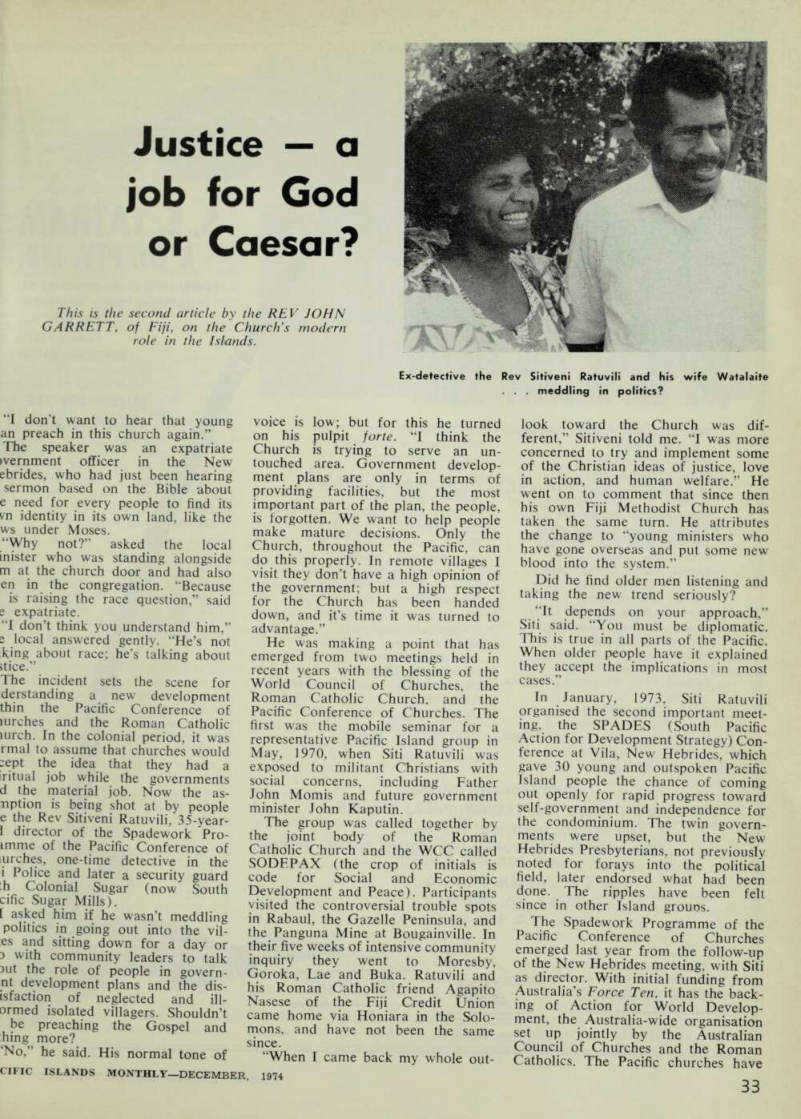
The incident sets the scene for derstanding a new development thin the Pacific Conference of lurches and the Roman Catholic lurch. In the colonial period, it was rmal to assume that churches would :ept the idea that they had a iritual job while the governments d the material job. Now the as nption is being shot at by people e the Rev Sitiveni Ratuvili, 35-year- I director of the Spadework Pro imme of the Pacific Conference of lurches, one-time detective in the i Police and later a security guard -h Colonial Sugar (now South cific Sugar Mills). 1 asked him if he wasn’t meddling politics in going out into the vil es and sitting down for a day or 3 with community leaders to talk 3ut the role of people in govern nt development plans and the dis isfaction of neglected and ill ormed isolated villagers. Shouldn’t be preaching the Gospel and hing more? ‘No,” he said. His normal tone of
voice is low; but for this he turned on his pulpit forte. “I think the Church is trying to serve an un touched area. Government develop ment plans are only in terms of providing facilities, but the most important part of the plan, the people, is forgotten. We want to help people make mature decisions. Only the Church, throughout the Pacific, can do this properly. In remote villages I visit they don’t have a high opinion of the government; but a high respect for the Church has been handed down, and it’s time it was turned to advantage.”
He was making a point that has emerged from two meetings held in recent years with the blessing of the World Council of Churches, the Roman Catholic Church, and the Pacific Conference of Churches. The first was the mobile seminar for a representative Pacific Island group in May, 1970, when Siti Ratuvili was exposed to militant Christians with social concerns, including Father John Momis and future government minister John Kaputin.
The group was called together by the joint body of the Roman Catholic Church and the WCC called SODEPAX (the crop of initials is code for Social and Economic Envelopment and Peace). Participants visited the controversial trouble spots in Rabaul, the Gazelle Peninsula, and the Panguna Mine at Bougainville. In their five weeks of intensive community inquiry they went to Moresby, Goroka, Lae and Buka. Ratuvili and his Roman Catholic friend Agapito Nasese of the Fiji Credit Union came home via Honiara in the Solo mons, and have not been the same since.
“When I came back my whole out
look toward the Church was dif ferent,” Sitiveni told me. “I was more concerned to try and implement some of the Christian ideas of justice, love in action, and human welfare.” He went on to comment that since then his own Fiji Methodist Church has taken the same turn. He attributes the change to “young ministers who have gone overseas and put some new blood into the system.”
Did he find older men listening and taking the new trend seriously?
“It depends on your approach,”
Siti said. “You must be diplomatic.
This is true in all parts of the Pacific.
When older people have it explained they accept the implications in most cases.”
In January, 1973, Siti Ratuvili organised the second important meet ing, the SPADES (South Pacific Action for Development Strategy) Con ference at Vila, New Hebrides, which gave 30 young and outspoken Pacific Island people the chance of coming out openly for rapid progress toward self-government and independence for the condominium. The twin govern ments were upset, but the New Hebrides Presbyterians, not previously noted for forays into the political field, later endorsed what had been done. The ripples have been felt since in other Island grouos.
The Spadework Programme of the Pacific Conference of Churches emerged last year from the follow-up of the New Hebrides meeting, with Siti as director. With initial funding from Australia’s Force Ten, it has the back ing of Action for World Develop ment, the Australia-wide organisation set up jointly by the Australian Council of Churches and the Roman Catholics. The Pacific churches have
Ex-detective the Rev Sitiveni Ratuvili and his wife Watalaite ... meddling in politics?
nit it into their Education and Com nunications work, with instructions o make it a grass-roots effort, con :entrating on the numerous neglected ural poor and using videotape and ound equipment to put across vivid deas for non-literates.
“We are beginning in Fiji this year, ;oing to one or two other Pacific erritories, then hoping for a further hree years of the same kind of work ilsewhere in the region,” Sitiveni xplained. “From what I see I riticise our government and the oluntary and technical aid people for lot being co-ordinated and not talking language villagers understand.” He peaks as a member of Fiji’s National xonomic and Social Council, where ther church people who were at chool with him sit as civil servants r planners.
How did he find race relations at jcal level? He smiled. “At the top wel and in the middle class, Indians nd Fijians quarrel,” he said. “At the ottom level, in the poor villages r here they live together, they speak ach other’s languages and help each ther all the time.” He cites ex eriments like the Vunikavikaloa lultiracial Society, set up by the ev Eloni Goneyali of the YMCA iral work staff, a fellow-product of □va’s Pacific Theological College.
How is his Hindi? He learned )me as a policeman and talks it at ame with his pretty wife Watalaite, sparkling, fully-trained Methodist jaconess, who has fluent vernacular id high Hindi and reads the script, -lis Hindi is improving,” says Wa. le grins at him. “Hers is better,” ; grins back.
Watalaite can be seen visiting house -house in the many Indian families r Suva’s mixed and colourful Toorak ea. She works under Daniel astapha, the busy Methodist minister the Dudley Circuit, who points out at “Wati can go during the day to sit people in the homes, where I, a man, would not be welcome.” ic shares her husband’s social con rns. Asked about his job she admits like it, all except the travelling rt; I don’t like that!”
The Spadework Programme of the icific Conference of Churches, aded by this kind of husband-wife im, sees itself, obviously, as part of 2 increasing Christian concern for cial justice in the Third World.
The churches are beginning to ess human development within the :ial and economic settine, on the sumption that even deprived and t)-literate churchgoers and com mity leaders in half-forgotten vil ;es can find dignity if they are saved »m the threat of being treated as litical idiots.