Repair Ravages Of Civilisation?
pp. 33-35 · Read in the full issue

Cultural Conservation-Can We
As independence comes to the Island territories, a movement is growing up among them to return d the best of their own customs and culture. In this they are being helped by some of the metropolitan ountries from whence in the past came those whose rule and own customs helped to destroy much that fas good in Island life. Now there are moves to “cultural conservation’’ and the South Pacific Com lission is expected to play a part. Below Mr George Kalkoa, senior executive officer in the British administration of the New Hebrides and a member of the New Hebrides Advisory Council, and the Australian Government give their views of the need for cultural conservation in papers submitted at ie 14th South Pacific Conference at Rarotonga.
Mr Kalkoa wrote: To study this topic properly coverg the Pacific Islands, one would ive to write a book. It is wide beuse it reaches out to the very tap ots of the many indigenous treared customs and cultural rites; it deep because it holds a rich and unified system of authentic and imc culture, which is often closely mtified with the Pacific.
Some of these customs and culres are bad and some are good but us not judge the bad and the good th prejudice, perhaps this is the nking of the modern man, but to ; old and to those who have up- Id traditions, reasoning and judg- ;nt of custom and culture in deion making are not preconceived tions but genuine and automatic :is ‘° ns - Whether in serious crimes or ty offences customary punishments ; often harsh and although leni- :y may be shown, it is only done ely by t he chief or the head of : tribe, but in most cases the parned man or woman will always /e a guilty conscience; unless cusnary compensation of some sort ione to amend and be accepted by community, one is rejected and mded an outcast for life.
Despite the richness, treasured and 0
■ Si Mat
are waging a battle to preserve these traditional treasures, because the European way of life tends to obliterate in one way or another the identity of a Pacific Islander.
Traditional dances, dresses, and customs don’t just disappear into thin air or die in a day, but are gradually replaced by alien ideologies and philosophical doctrines; therefore one finds that today artificial or bastardised rituals have replaced the authentic customs and practices of our fathers.
The grass skirt or the Nambas (penis-wrapping) disappears and is replaced by a dress or shorts, and modern cooking utensils, weapons, transport, communication methods, medicines etc, replace the customary types.
The village-type girl lives a happy and plain village life, but soon is led astray by her sophisticated and better-educated colleague. The humble home life is left behind Ignoring the plea of her parents about the strange westernised life in town, she ventures out seeking the bright lights and way of life totally new to her, in a new and sophisticated society. She wears a mini skirt, uses make-up, rides on the back of a motor-cycle with a stranger with
long hair, who wears clothes very different from her brothers. She smokes and wears dark glasses, drinks the white man’s fire-water and alas before the year ends, a baby is
born -
The young man no longer takes notice of the wise instructions from the old. He is proud, selfish and like the girl, enjoys the new life, but soon ends in gaol.
Perhaps it is significant to mention that the disappearance of customs and culture was largely due to the influence of the early missionaries, They opposed the valued indigenous culture and today most islands in the Pacific have lost their true traditions.
The Pacific shores were and will be invaded by hundreds of anthropolo gists seeking to verify or prove cer- ! ain . histor , ical occurrences and °n l ° l Cek neW r 8 5° unds °j ? d - „ on f tt he ? rs . .°t t ? e . wo £ d J? at . lve and , P nmitl . ve • Jt 1? the man s I ? vent j on to sult his 86 fish means and ends * Tourists have caused a lot of anxieties among the humble villages, The unspoiled shores are polluted and treasured cultures are soon ex posed, carvings and handicraft etc, some of the latter of rare species, are taken away for a very small sum °f money, and lost forever.
socklfy iTy 8
« foTofa
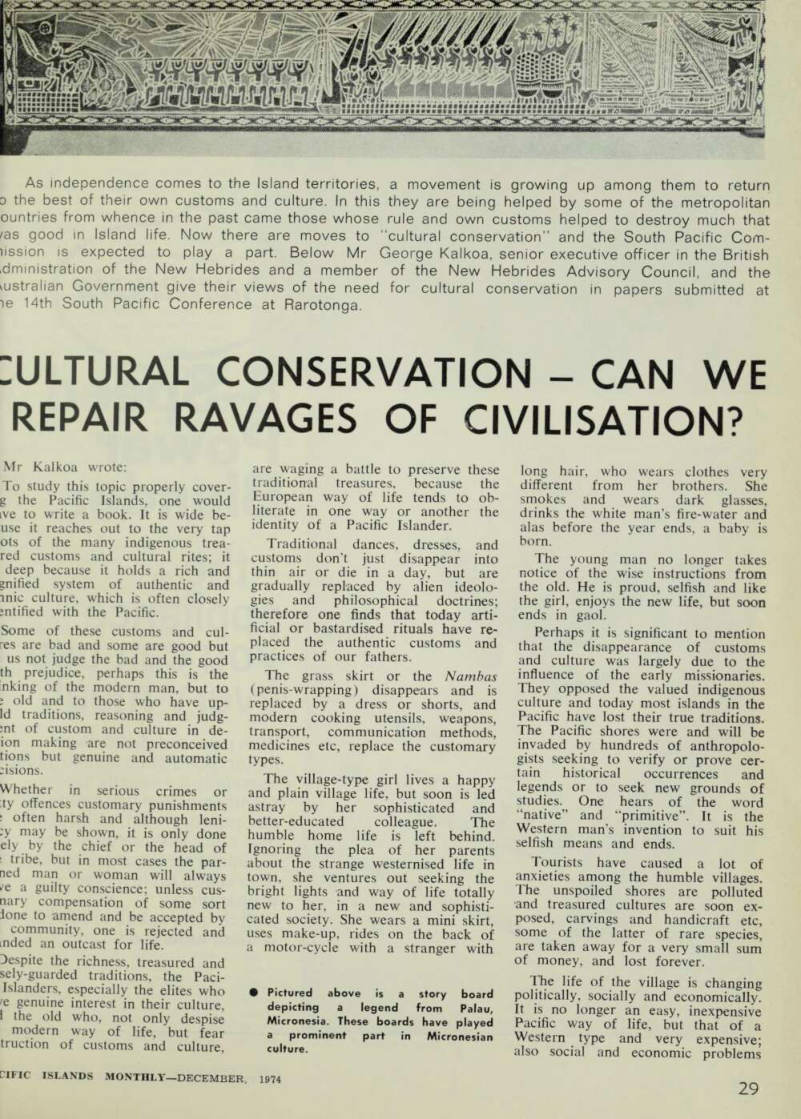
Pictured above is a story board depicting a legend from Palau, Micronesia. These boards have played a prominent part in Micronesian culture.
cur, and the village chief finds mself being confronted by the •ung who have despised and re ded the old man’s advice.
Should these changes be accepted irely because of modern civilisation should they be rejected? If a neu il position is to be maintained then is important that the New Heb lean follows his own traditions and )se of the European which will t harm him nor hurt his colleagues the community as a whole. It must remembered that the indigenous aple in the Pacific region have ed in civilisation before the Euro in discovered them.
Cultural conservation embraces : varieties of custom and culture it exist in Melanesia, Polynesia I Micronesia. To find solutions to >blems raised is no easy task but haps more damaging would be its idual disappearance in society.
Fhe initiative taken by the South :ific Commission’s Fourteenth nference in the Cook Islands to k into this problem is a worth ile step to uphold, revive and to ch the coming young generations, value of customs and cultures sting in their own environment oi ieties.
Ae are seeking to maintain our ntity, not because of our colour, e- or creed, but because we are cerned with an important aspect, 1 perhaps the core, of our exis :e. he Australian Government is a leading part in the move cultural conservation and has ;n $250,000 as an “initial contri on” towards the cost of a five r programme to help “conserve develop South Pacific cultures”, wo-man mission from the Aust in Department of Foreign urs was touring the Islands in 3ber for talks with governments .he best way to spend the money, lethods of achieving cultural con ation were outlined by the Aust in Government in a paper at atonga. he paper explained that different s of approaching cultural con ation were needed in the differ areas of the South Pacific. A d division existed between the inesian world, where outside act had, on the whole, been less ise and prolonged, and the islands
of Polynesia and Micronesia, many of which had experienced long asso ciation with outside cultures.
“In the Melanesian world”, the paper pointed out, “there is a great need for further recording and in vestigation of the local cultures which, for the most part, are still largely traditional. There is scope here too for future anthropological investigation to be carried out by the local people themselves.
“In Polynesia and Micronesia many islands have suffered a near total loss of aspects of their cultures.
In many cases remaining vestiges of their culture have been removed to museums outside the Pacific”.
One method of cultural conserva tion, it was stressed, was to encour age the retention of artifacts. Un fortunately, many artifacts had been taken from their rightful place.
The United Nations Educational, Scientific and Cultural Organisation (UNESCO) was striving towards an international agreement to help gain the return of artifacts to their coun try of origin. In the meantime, South Pacific Islanders were in the position of having to try, often unassisted, to bring back those valuable objects to their homeland.
Even if artifacts were returned, many island areas did not have suit able buildings in which to put them so that they did not decay or suf fer damage. Cultural centres should be established to combine the functions of museum, library and school. They could also have a book shop, an arena for the performing arts or a garden in which to display plants on which Islanders used to de
pend and how they used them. Such centres could become the basis for broader cultural development and creative activity—a living museum.
The paper also underlined the im portance of preserving historical sites, documentation of the various collections of artifacts and their lo cations, making photographic records of artifacts, the recording of the per forming arts and oral traditions of the region, and training courses for Islanders in the recording on tape or film of their own traditions.
“One must not only preserve the past but also develop and encourage the contemporary Oceanic culture as seen in the works of writers, poets, painters, carvers, performing artists and musicians”, the paper continued.
Hopefully, more use will be made of available avenues of expression such as the section called Mana in the Pacific Islands Monthly allocated to the South Pacific Creative Arts Society.
“More workshops, such as that held on creative writing at the Uni versity of the South Pacific this year, could be held to encourage people in the visual arts, oral tradition, music and dance”.
Commenting on its contribution of 5250,000, the Australian Government said it was additional to that already being spent. It was not seen as an alternative source of funds for pro jects so that governments or organis ations could re-allocate their money to other projects. Australia did not want other organisations and govern ments to stop spending money on cultural projects in the South Pacific m the belief that Australia would do it for them.
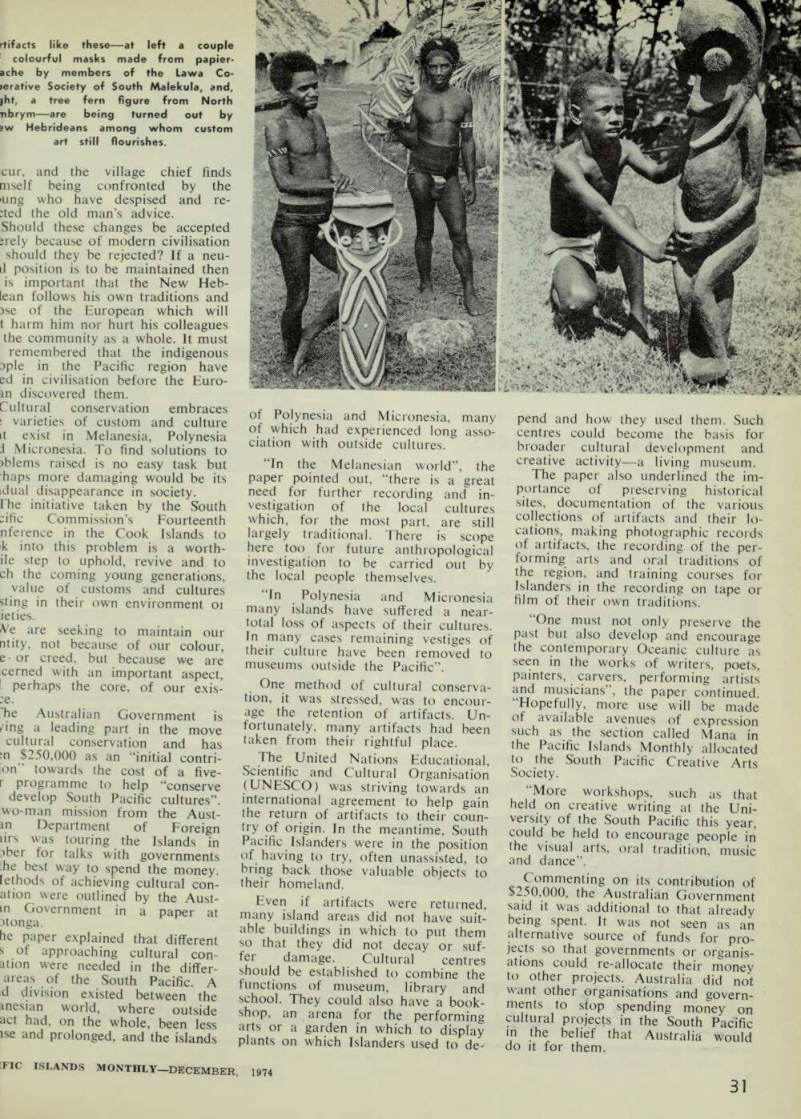
[?]tifacts like these—at left a couple colourful masks made from papier [?]ache by members of the Lawa Co [?]erative Society of South Malekula, and, [?]ght, a tree fern figure from North [?]mbrym —are being turned out by [?]ew Hebrideans among whom custom art still flourishes.