[?]o Polynesia's past
p. 23 · Read in the full issue
Samoa find—a clue [?]o Polynesia's past
From FELISE VA’A in Apia The discovery of fragments of an ent pottery off the coast of Upolu, >out 20 miles from Apia, Western imoa’s capital, may upset all the eories about Polynesian settlement the Pacific.
The pottery, which was discovered st year by Mr T. T. Hassall, pro :t engineer involved in the dredg g of a wharf site at Mulifanua, has :en examined by Professor Jesse D. nnings, of the University of Utah the United States, who arrived in estern Samoa in August with his ife and a team of university shi fts.
Professor Jennings believes that the id could establish Samoa as the Jest Polynesian settlement, and the iging area for the mass Polynesian igrations to the rest of the Pacific lands.
His theory contradicts others held anthropologists which place the
oldest settlement in the Cook Islands, or Hawaii or Tonga.
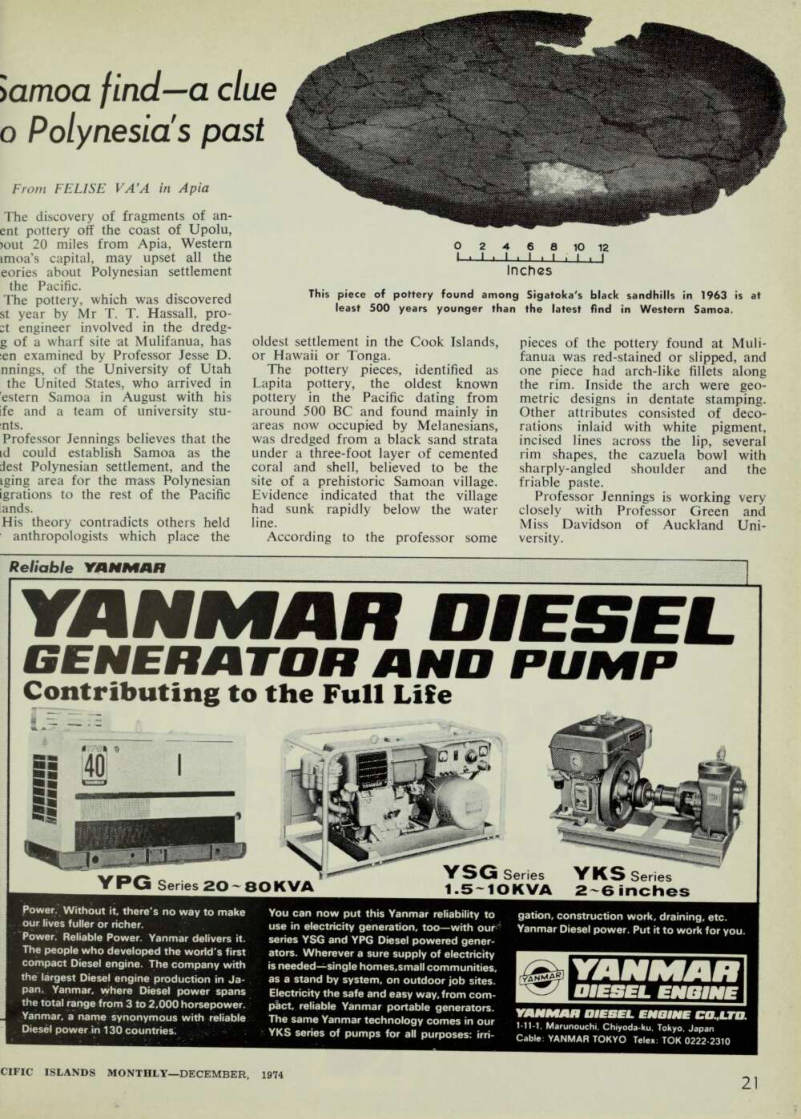
The pottery pieces, identified as Lapita pottery, the oldest known pottery in the Pacific dating from around 500 BC and found mainly in areas now occupied by Melanesians, was dredged from a black sand strata under a three-foot layer of cemented coral and shell, believed to be the site of a prehistoric Samoan village.
Evidence indicated that the village had sunk rapidly below the water line.
According to the professor some
pieces of the pottery found at Muli fanua was red-stained or slipped, and one piece had arch-like fillets along the rim. Inside the arch were geo metric designs in dentate stamping.
Other attributes consisted of deco rations inlaid with white pigment, incised lines across the lip, several rim shapes, the cazuela bowl with sharply-angled shoulder and the friable paste.
Professor Jennings is working very closely with Professor Green and Miss Davidson of Auckland Uni versity.
This piece of pottery found among Sigatoka's black sandhills in 1963 is at least 500 years younger than the latest find in Western Samoa.