you have for breakfast?
p. 21 · Read in the full issue
Tell us Ratu Mara, what do you have for breakfast?
From Vijen Dr A Kumar
in Lautoka THERE is that yarn about Fiji’s elder statesman, the late Ratu Sir Lala Sukuna, about the time he gave a lift in his car to a Fijian villager. Ratu Sir Lala was being driven to a village near Sigatoka for an official welcome meeting when he came upon the elderly man trudging along the dusty road with a large bundle of tapioca on his back.
The ratu (chief) and the com moner struck up a lively con versation. The man, it transpired, was going to the meeting to see the big ratu and make an offering of tapioca to him. No, he had never seen him before but from what he had heard of him, he was “the great one”.
Ratu Sir Lala never let on that he was the subject of the com moner’s adulation. The man, of course, found out when the car stopped at the village.
Such snippets are the very life of an autobiography or biography.
Although Fiji has produced a crop of brilliant and gifted leaders, not one has left behind a book of memoirs—except with the probable exception of the late
Mr Ayodhya Prasad, the founder of the Fiji Kisan Sangh (cane farmers’ union). He wrote a very illuminating history of the Kisan Sangh in Hindi which remains largely unread and untranslated into English. The book reveals the author’s prejudices with some very frank opinions on leaders living and dead.
Pandit Vishnu Deo, one of the longest serving members of the old Legislative Council, died without putting pen to paper.
Ratu Sir Edward Cakobau, the colourful and gentlemanly soldier and politician, similarly left no thoughts on paper. Mr A. D.
Patel, the founder of the opposi tion National Federation Party, was all his life a controversial political figure but never as sembled his ideas into a book.
I recently met his widow, Mrs Lila Patel, who gave a rare in sight into the man who was largely not understood or was mis understood. She has a whole col lection of priceless letters and documents which would make en
thralling reading.
How many people, for example, know of the close personal friend ship between Mr Patel and his political adversary, Ratu Sir Kamisese Mara, who is now Fiji’s Prime Minister? Mrs Patel had never given a thought to getting these published until 1 planted the idea in her mind. But, her next question took me by sur prise: “Who will write it?”
Indeed, that is a big question because Fiji has not so far pro duced any writers of note. Per haps, the University of the South Pacific may give us scholars and writers to do research and pub lish biographies of our national heroes who are gone. Perhaps the government or some trust found ation could allocate funds for such a worthwhile project.
Fiji boasts a rich cultural heri tage further enhanced through the mixing of diverse cultures and traditions. But it is a literary desert. Apart from two daily newspapers (the second, the Fiji Sun, was launched in October
this year) and a smattering of thin weeklies or monthlies pub lished in English, Fijian and Hindi, it has nothing else to show.
There is no book publishing house, although a few document ary-type pictorial books have gone down well.
While children and students in Fiji do not need their own little Red Book, there is an urgent need for them to know what Fiji is all about. And lives of great men—Fiji’s own great men— should be part of their learning.
I do not know whether Ratu Sir Kamisese Mara is secretly working on his memoirs or has even given it a thought. It would be a great pity if he did not leave behind a book or two (not that he is retiring yet). The Prime Minister, who ranks with the world’s statesmen, is the architect of Fiji’s independence. No doubt, he received help and co-operation from the present leader of the Opposition, Mr Siddiq Koya, to ensure an orderly transfer of power from the British to the people of Fiji. But it is Ratu Sir Kamisese who has been at the centre of things.
Ratu Sir Kamisese the leader is well known by the people. But what about Ratu Sir Kamisese the man? Few in Fiji know what he has for breakfast, what he reads, what films he likes, which world leaders he admires—and abhors.
While these are not important things, they help to bring the leader and the people closer.
Apart from that, Ratu Sir Kamisese is a part of our evolving history. It would be an experience to look at Fiji through his eyes.
The late Mr A. D. Patel ... he never assembled his ideas into a book.
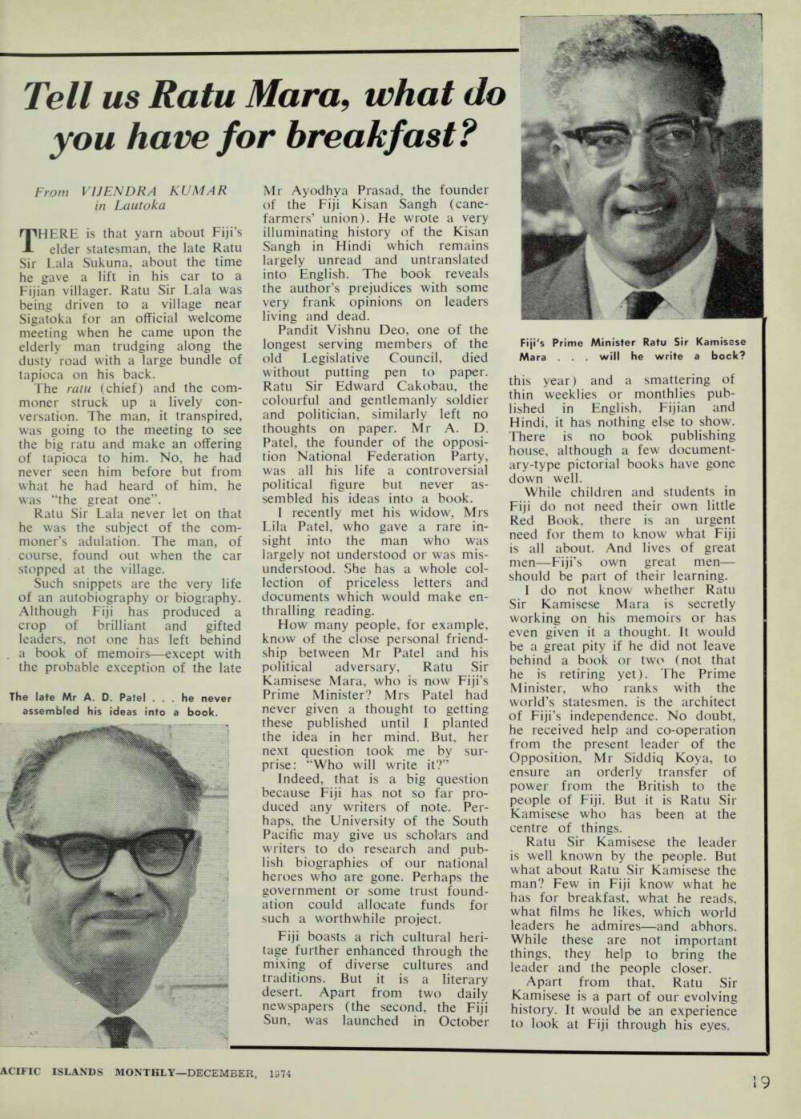
Fiji's Prime Minister Ratu Sir Kamisese Mara ... will he write a book?