Writing on
the wall for Caledonians?
From a Noumea correspondent
The French flag trampled on and burned, anti-colonialist slogans painted on public buildings in Nou mea, the word “traitor” splashed across the tomb of the late Senator Henri Lafleur: these are some of the recent anti-French incidents in New Caledonia surrounding the court ap peal of 12 persons originally sen tenced for up to six months of prison over political incidents.
Two lawyers were flown in from Paris to defend the 12 Caledonians in their court appeal on October 29.
Shortly beforehand, it was announced that Mr Olivier Stirn, new French Minister for Overseas Territories, would not be making his scheduled November visit to Noumea, a visit which had been expected to bring some good news for the economy on the nickel front. Instead, it be came clear that the much-publicised SOMMENI smelter project for the north, around Poum-Koumac, was shelved, in view of mounting costs.
Caledonian exasperation has been stretched a long way since de Gaulle’s promises of new nickel pro jects back in 1966. Still, inflation gallops ahead, unemployment con tinues and young Melanesians parti cularly are agitating more aggress ively for greater local political control.
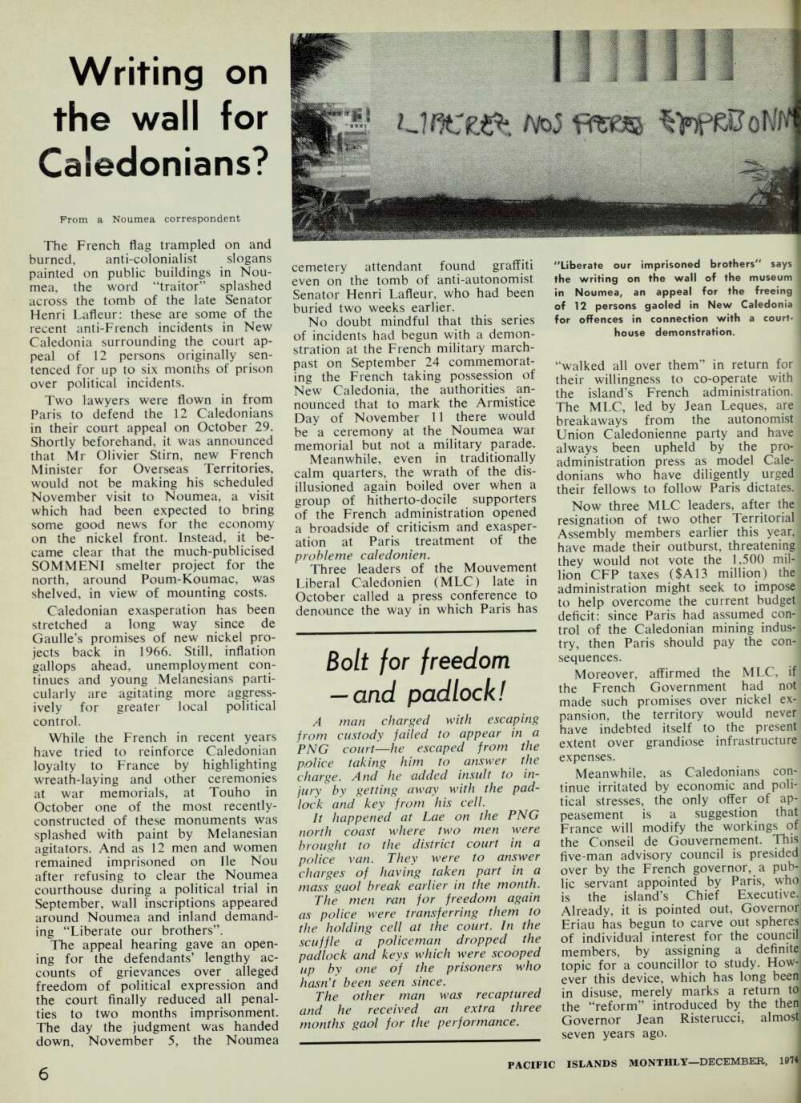
While the French in recent years have tried to reinforce Caledonian loyalty to France by highlighting wreath-laying and other ceremonies at war memorials, at Touho in October one of the most recently constructed of these monuments was splashed with paint by Melanesian agitators. And as 12 men and women remained imprisoned on He Nou after refusing to clear the Noumea courthouse during a political trial in September, wall inscriptions appeared around Noumea and inland demand ing “Liberate our brothers”.
The appeal hearing gave an open ing for the defendants’ lengthy ac counts of grievances over alleged freedom of political expression and the court finally reduced all penal ties to two months imprisonment.
The day the judgment was handed down, November 5, the Noumea
cemetery attendant found graffiti even on the tomb of anti-autonomist Senator Henri Lafleur, who had been buried two weeks earlier.
No doubt mindful that this series of incidents had begun with a demon stration at the French military march past on September 24 commemorat ing the French taking possession of New Caledonia, the authorities an nounced that to mark the Armistice Day of November 11 there would be a ceremony at the Noumea war memorial but not a military parade.
Meanwhile, even in traditionally calm quarters, the wrath of the dis illusioned again boiled over when a group of hitherto-docile supporters of the French administration opened a broadside of criticism and exasper ation at Paris treatment of the probleme caledonien.
Three leaders of the Mouvement Liberal Caledonien (MLC) late in October called a press conference to denounce the way in which Paris has
“walked all over them” in return for their willingness to co-operate with the island’s French administration.
The MLC, led by Jean Leques, are breakaways from the autonomist Union Caledonienne party and have always been upheld by the pro administration press as model Cale donians who have diligently urged i their fellows to follow Paris dictates. I Now three MLC leaders, after the resignation of two other Territorial Assembly members earlier this year,! have made their outburst, threatening they would not vote the 1,500 mil lion CFP taxes (SAI3 million) the administration might seek to impose to help overcome the current budget deficit: since Paris had assumed con trol of the Caledonian mining indus try, then Paris should pay the con sequences.
Moreover, affirmed the MLC, if the French Government had not made such promises over nickel ex pansion, the territory would never have indebted itself to the present extent over grandiose infrastructure expenses.
Meanwhile, as Caledonians con tinue irritated by economic and poli tical stresses, the only offer of ap peasement is a suggestion that France will modify the workings of the Conseil de Gouvemement. TTiis five-man advisory council is presided over by the French governor, a pub lic servant appointed by Paris, who is the island’s Chief Executive.
Already, it is pointed out, Governor Eriau has begun to carve out spheres! of individual interest for the council members, by assigning a definite! topic for a councillor to study. How ever this device, which has long been: in disuse, merely marks a return to the “reform” introduced by the them Governor Jean Risterucci, almost seven years ago.
"Liberate our imprisoned brothers" says the writing on the wall of the museum in Noumea, an appeal for the freeing of 12 persons gaoled in New Caledonia for offences in connection with a court house demonstration.