Pacific Islands Monthly
pp. 6-7 · Read in the full issue
At Last! Down In The New
Hebrides Something Stirs
From a Vila correspondent
Britain and France announced on November 5 new measures, agreed in talks in London, to “encourage the further political and economic development” of the New Hebrides and then, in a Press conference, through their representatives at the talks. Miss Joan Lestor, Under secretary of State at the British Foreign Office, and Mr Olivier Stirn, French Secretary of State in the Department of Overseas Terri tories, dashed hopes of any moves towards early independence.
There was no indication of the New Hebrides becoming independent in the foreseeable future, they said.
It wasn’t even discussed.
The main points of the agreement were: • A representative assembly, with new powers, to replace the present Advisory Council elected by uni versal suffrage before the end of 1975 and be so constituted as to ensure fair representation of all sectors of
the population.
• The first urban and rural zones will be set up at the beginning of next year and the first local councils elected by universal suffrage. • The two governments agreed on the principle of unification of jurisdiction and penal laws to be drawn from the British penal pro cedure and the French penal code. • The two governments will study the possibility of granting a status of double nationality to citizens of the New Hebrides who are not either French or British. • A new code of land tenure will be established and applied to all in habitants without distinction of origin.
In the interim period before elec tions to the new council are held, the Advisory Council will be improved with the addition of two further no minated New Hebridean members and the abolition of the right of official members to vote.
The new elected Territorial As sembly, which is what the New Hebrideans have asked for over the
years, will have 24 New Hebridean members and seven each British and French members.
According to an exchange of notes between the condominium partners before the London talks, the Protocol of 1914 would be modified to allow New Hebrideans found guilty of an offence by the Indigenous Tribunals to appeal to the Joint Tribunal.
This chance to appeal could be used for prison penalties of over 30 days and fines over £2O (about 4,000 NHF). The appeal would be against the finding or the penalty, or both.
The appeal procedure is defined in a ruling which has been established by the Judges of the Joint Tribunal.
The modification of the Protocol would also carry changes in the jurisdiction of the Joint Tribunal and the Indigenous Tribunals. From now on, each type of Indigenous Tribunal would have jurisdiction over all in fractions to the Indigenous Penal Code committed by New Hebrideans.
Until now, infractions committed in the Central Islands 1 and at Paa ma districts and carrying a penalty of over one year in prison fell under the jurisdiction of the Joint Tribunal.
In a comment on these modifica tions to the Protocol, spokesmen for the two residencies declared that it was a question of important legal reforms insofar as they put an end to the unsatisfactory situation where by people condemned by the In digenous Tribunals were put in a less favourable position than those con demned by the National Tribunals and the Tribunals of the Ist Degree, who always had the right of appeal to a higher Tribunal.
The discontinuance of the old Joint Tribunal jurisdictions in the Central Islands 1 and Paama districts meant that the Indigenous Tribunals in different districts would have the same powers.
The spokesmen explained that the reason the right of appeal had been limited to sentences of over 30 days prison and fines of over £2O sterling was they wanted to avoid seeing the Joint Tribunal being inundated by
appeals on minor cases, which would, in effect, slow down the Joint Tribunal’s work and have a good chance of slowing down the hearing of appeals of more serious cases coming from the Indigenous Tribunals and Tribunals of the Isl Degree.
Mr Stirn reported to the French Cabinet that the French legal code will define crimes, but the British legal procedure will be used to judge them.
This, officials conceded, woulc create problems. For instance, the French code continues to impose the death penalty for certain crimes. A New Hebridean could, therefore, be condemned to death, but, as Britah has abolished capital punishment, hi would be certain of escapin] execution.
In the economic sector, it wa agreed in principle that the Nev Hebridean currency would be peggei to the French franc, and curren links with the Australian dolla would be dropped. Plans will alsi be made to improve social and econ
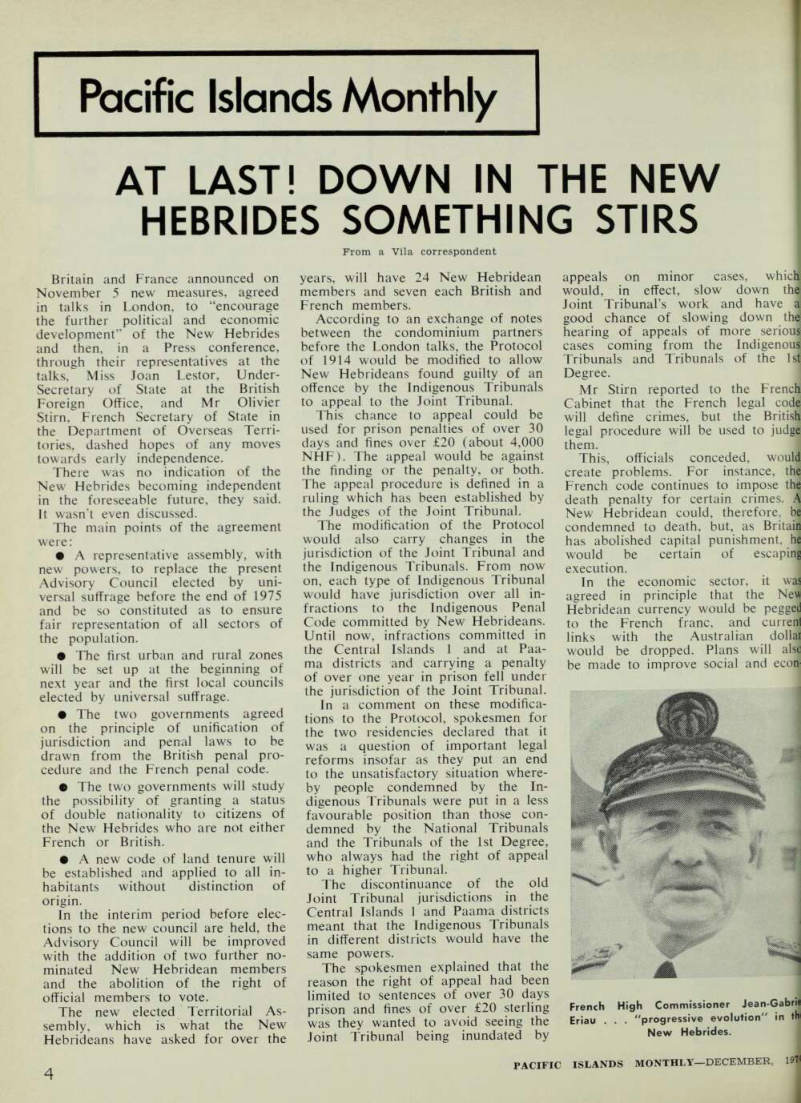
French High Commissioner Jean-Gabrie Eriau ... "progressive evolution" in the New Hebrides.
lie standards, particularly in the ral areas.
This is not the whole story, bow er. Miss Lestor and Mr Stirn will it the condominium in January ■ further talks.
The French High Commissioner, r Jean-Gabriel Eriau, was inter wed over Radio Noumea before : talks.
T don’t know what the results of ; conference will be”, he said, “but issure you that the French side I be taking initiatives, which are tied at satisfying the aspirations the diverse ethnic groups of the w Hebrides, in organising certain inges in proper order and with i regard for each individual. ‘I personally predict favourable 'elopment for agriculture and tie breeding. The desirable mges to the Protocol which will possible after this London con ence will lead to, I hope, peace certain quarters, which will prove t the two governments have the ire to lead the archipelago to a igressive evolution. Anyway, that the desire of the French Govern nt”, iefore the London meeting, the w Hebrides National Party sent a r-point petition to the Resident nmissioners. he points were; The formation a Legislative Council; involvement New Hebrideans in all constitu lal discussions; opposition to the nation of municipal councils and abolition of the Protocol, Vhile British and French officials ged themselves with delight over Anglo-French reforms for the v Hebrides, and congratulated another on what some liked to “the enormous step forward for anesians ’, the immediate reac of New Hebrideans appeared to a kind of puzzled and restrained
welcome.
“There’s a terrible lack of detail about the major proposals”, said one official of the New Hebrides National Party, two weeks after the results of the London ministerial talks were announced.
“But on the basis of anything is better than nothing, we must wel come the reforms as far as they go”.
Generally, New Hebridean reac tion was like a Roman crowd being faced with the rare sight of a Chris tian actually twisting the tail of a lion . . . there was a scattering of polite applause ... but it wasn’t what they came to see!
A Representative Assembly with wider powers and responsibilities?
What did it mean? Power to frame legislation which would tackle some of the urgent problems of the New Hebrides? Real fiscal responsibility for raising revenue and deciding how it should be spent?
A lot of questions were left un answered in the first bald statement covering the results of the talks. And though thousands of excited listeners waited for illumination from Radio Vila, the government-run broadcast ing service, its coverage dried up after the initial burst of publicity for the official communique.
There was one shaft of explanat ory light cast on the phrase double resortissant. That, said Radio Vila announcers, simply meant that in future New Hebrideans would be issued with a proper passport identi fying them as citizens of the New Hebrides, and guaranteeing the pro tection of British or French em bassies when they travel abroad.
Yet it was all so unsatisfactory.
Land has been, and remains, a major issue of strife in the New Hebrides.
The London communique, however, merely mentioned “a new system of land tenure” and did nothing to m
dicate, even briefly, the premise upon which the new system would be based.
One sentence in the communique which led to a great deal of specu lation, much of it cynically humor ous, was the mention of “rationalis ing the Residencies”.
That had to mean, surely, that at last the French and British govern ments would get around to pruning their top-heavy departments and weeding out some of the regiments of administrative officers who sprout faster than papaws in the New Hebrides.
“Maybe it means we’ll only have to deal with one blundering bureau crat, instead of two and sometimes three”, commented one soured businessman in Vila.
Meanwhile, in the Residencies, senior officials were muttering mutin ously about the task they face in organising elections for local authori ties early in 1975” and immediately afterwards organising the elections for the Representative Assembly.
One French admin officer growled C est impossible when the news came through from London, and his British colleagues seemed to agree.
Especially since one source revealed that there would be no extra money forthcoming from London or Paris to put all the new proposals into effect.
Considered reaction to the reforms will come this month when the Ad visory Council meets to look at next year’s Condominium Budget. There will be no stopping the New Heb ridean members raising the subject of the Anglo-French proposals.
And if the Resident Commissioners —who are joint Chairmen of Adco —can’t reveal more than they have already done, they had better look out for the first cyclone of the season.
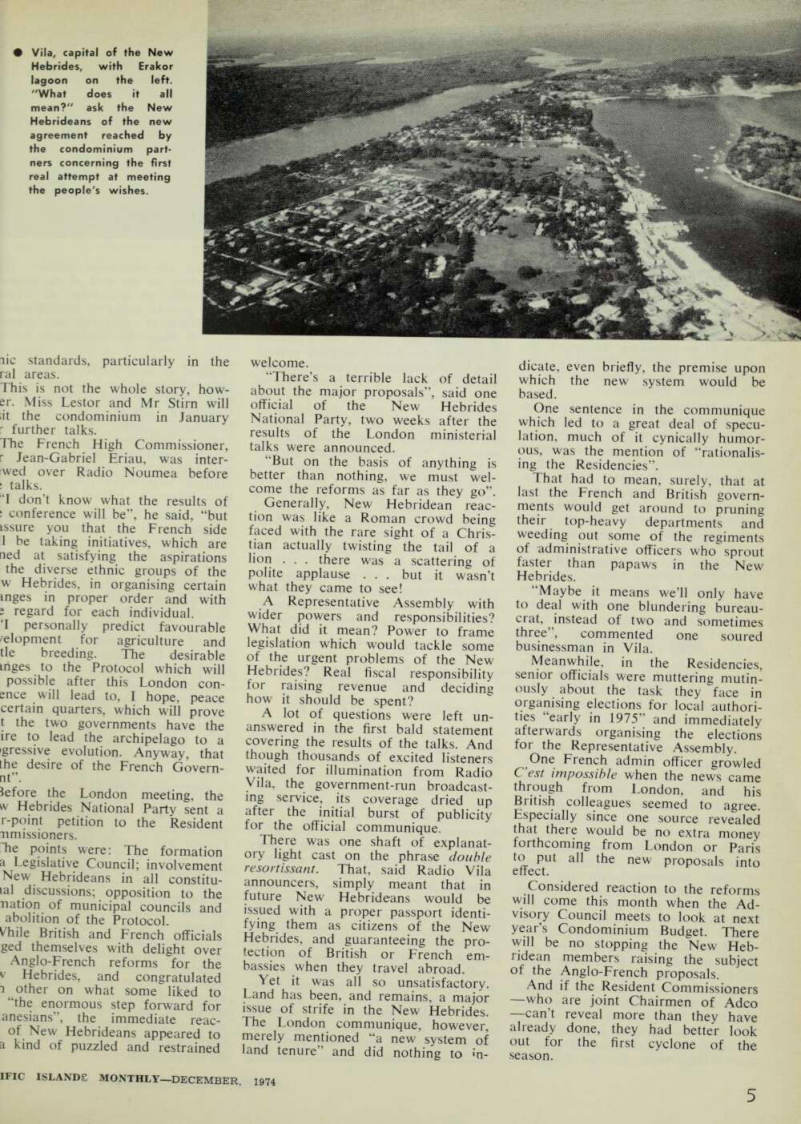
Vila, capital of the New Hebrides, with Erakor lagoon on the left.
"What does it all mean?" ask the New Hebrideans of the new agreement reached by the condominium part ners concerning the first real attempt at meeting the people's wishes.