Some second thoughts on public service exodus
p. 45 · Read in the full issue
public service exodus
From Gus Smales,
in Port Moresby
In just under two years the lumber of whites in the Papua Sew Guinea public service has
Iropped by one-third—from
3,500 in November, 1972, to
: ewer than 4,500 today.
And as the trend continues, phas ng New Guineans into the jobs left r acant, concern is beginning to grow n some areas of national opinion hat the pace may be too fast.
Most of the concern about the [uickness of the pace represents the ears of conservative and lesser leveloped rural areas, where change s frequently resisted purely for its iwn sake. But some of PNG’s dedi ated nationalists are now joining he expressions of concern, not be ause they want to slow down the •ace towards nationhood but because hey fear their country could be los ng too many skills too rapidly.
What has really happened is that he move to “localise” employment— he government’s euphemism for re lacing white workers with black— » no longer seen in itself as an ssential ingredient of political in ependence.
Localisation and independence are till seen as closely interwoven, yet here is a new realisation that no recise formula links one with the ther.
Papua New Guinea would like othing better than to reserve all its ibs for its own nationals, but the egree to which it is able to do this as no real connection with the bility and desire to become politic lly independent.
For too many years PNG was hasing the wrong target, looking for le development of a fully-skilled ommunity as a prerequisite for in ependence. Australia all too fre uently didn’t—or wouldn’t—make lis point clear, either. pie present concerted move for olitical disengagement from Aust ria began shortly before the Labor jovernment came to power in Can erra. Despite the strength of the
move, the old idea that a community of all skills must emerge before independence, continued to linger in some political areas. The lingering of this idea had several effects.
One was that the conservative element in PNG politics opposed political change without real reason, and using an argument which was not soundly based. It was an argu ment of fear based on a belief that independence would require total reliance on home-grown skills.
Another effect was within the government itself which went to elaborate and sometimes risky ex tremes to force the pace of localis ation. An annual 15 per cent blanket reduction was imposed on the num ber of whites in the Public Service, putting more emphasis on an arbi trary target than on the country’s year-to-year needs. (The 15 per cent target has since been removed, and the availability of local skills governs the pace at which whites are displaced.) The situation now exists where self-government has slipped in with hardly a ripple and where indepen dence is generally accepted as being only a matter of months away. Even whites who until a few years ago saw
independence as a generation in the future are saying, “get it over with as quickly as you can so we all know where we stand”.
With nationhood accepted as not far away there is now a more realis tic acceptance of the employment situation. There is a strengthening ambition among rank and file New Guineans to take over jobs at present held by whites, but the situation is no longer tied up with independence and political change.
It’s a personal ambition, and represents a far more rational situ ation than what existed before.
It can also mean that a politician can attack (or praise) the rate of localisation without being accused of meddling with the date for political independence.
Against this background there is a growing feeling that some of the employment changes have been ex cessively traumatic. Many whites in the Public Service got out much faster than anticipated because of in securities they felt, and this was one of the factors which caused the removal of the 15 per cent reduction target.
In the western highlands in Sep tember a meeting of 6,000 villagers expressed fears that the country was losing too many whites with skills which were still needed.
Meanwhile the Public Service Board has begun a detailed review to find out exactly what manpower it requires, and to give some indica tion to whites still in the Public Service of the:.-, likely tenure of each job.
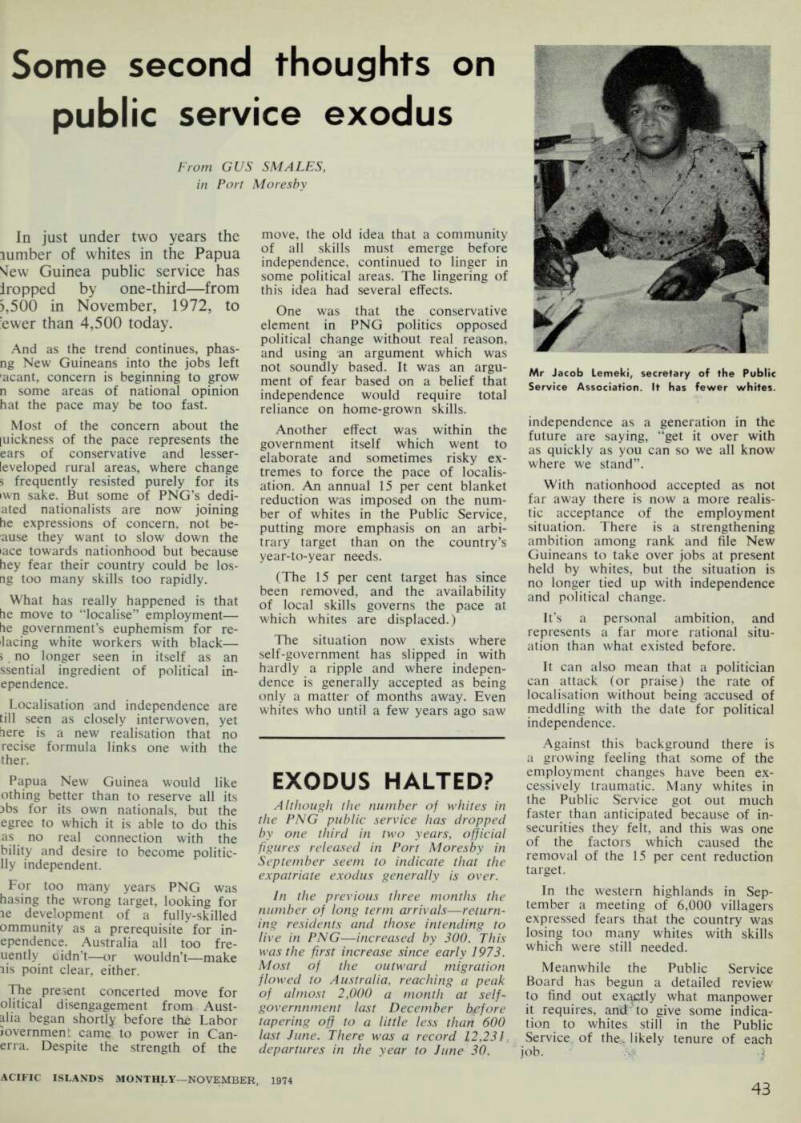
Mr Jacob Lemeki, secretary of the Public Service Association. It has fewer whites.