Islanders get
pp. 41-43 · Read in the full issue
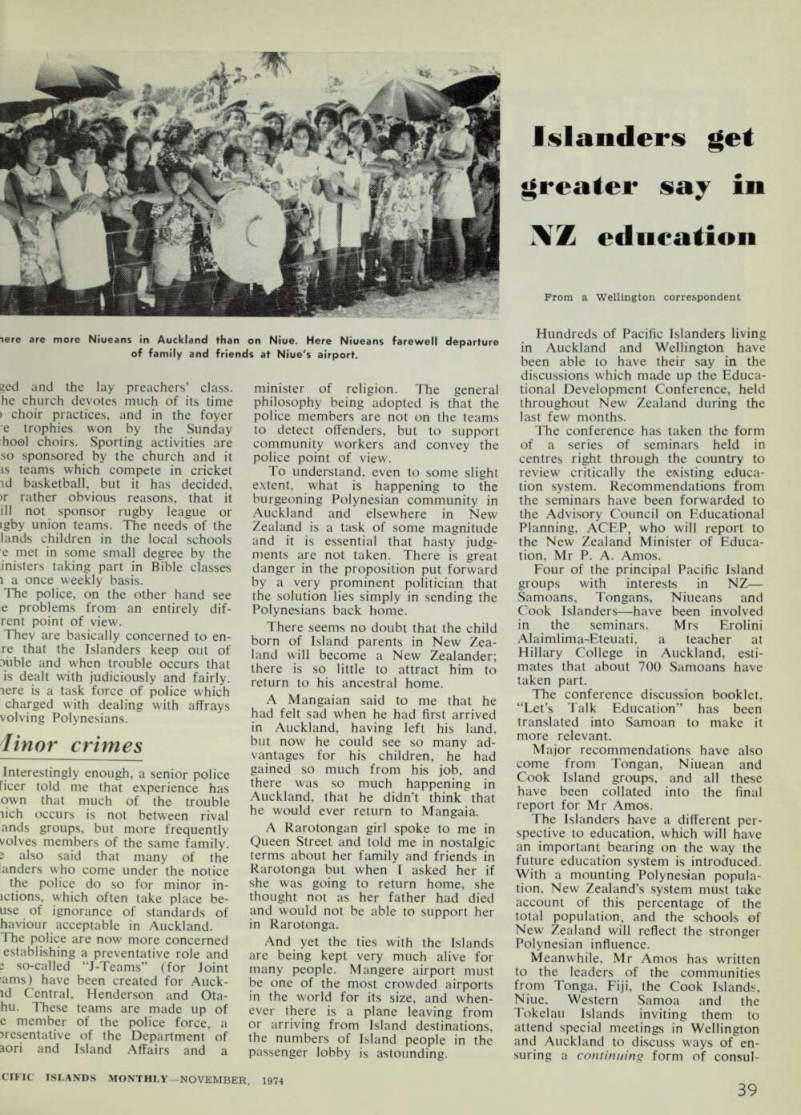

greater say in XZ education
From a Wellington correspondent
Hundreds of Pacific Islanders living in Auckland and Wellington have been able to have their say in the discussions which made up the Educa tional Development Conference, held throughout New Zealand during the last few months.
The conference has taken the form of a series of seminars held in centres right through the country to review critically the existing educa tion system. Recommendations from the seminars have been forwarded to the Advisory Council on Educational Planning, ACEP, who will report to the New Zealand Minister of Educa tion, Mr P. A. Amos.
Four of the principal Pacific Island groups with interests in NZ Samoans, Tongans, Niueans and Cook Islanders—have been involved in the seminars. Mrs Erolini Alaimlima-Eteuati, a teacher at Hillary College in Auckland, esti mates that about 700 Samoans have taken part.
The conference discussion booklet, “Let’s Talk Education” has been translated into Samoan to make it more relevant.
Major recommendations have also come from Tongan, Niuean and Cook Island groups, and all these have been collated into the final report for Mr Amos.
The Islanders have a different per spective to education, which will have an important bearing on the way the future education system is introduced.
With a mounting Polynesian popula tion, New Zealand’s system must take account of this percentage of the total population, and the schools of New Zealand will reflect the stronger Polynesian influence.
Meanwhile, Mr Amos has written to the leaders of the communities from Tonga, Fiji, the Cook Islands, Niue, Western Samoa and the Tokelau Islands inviting them to attend special meetings in Wellington and Auckland to discuss ways of en suring a continuing form of consul
tation between the Island groups and the government.
“It may well prove that an advisory council of some sort could be estab lished to offer this avenue of consul tation,” Mr Amos said.
Such an organisation could con sider a broad range of activities associated with Island people, includ ng resettlement programmes, the de velopment of a truly multi-cultural ;ociety, and educational opportunity.
“I am anxious to get Pacific Is anders thinking and discussing this ype of development. In Auckland, am aware a local group has been stablished involving all Island Kopies, and it may be that a similar Wellington group, and then in turn i similar national group may be ;stablished.
“This would then provide a work ible structure for consultation, and eaction, to and from the government md the broader community,” Mr \mos concluded.
Mr Phil Amos has also made mother announcement of particular ignificance to Pacific Islands children, vho form a large proportion of many lasses in some New Zealand schools, t is planned that refresher courses vill be commenced in Teacher Train ng Colleges for Island teachers, who, ►ecause they do not possess New Zealand teaching qualifications, are at ►resent unable to use their talents in 4ew Zealand schools.
Mr Amos said Polynesian children n NZ would benefit from contact rom teachers of their own race, and vith the enhanced teacher-pupil re ationships a better teaching climate vould result.
An article by lain McDonald in the 4ew Zealand Herald emphasises the ducational plight of Pacific Islands hildren in New Zealand schools. He aid it was “not clear to what extent tie use of another language was a landicap to learning English . . . slanders were less successful than heir European contemporaries in ■nglish and reading. But Islanders id just as well as the Europeans in pelling and arithmetic. The difficulty ►f educating Polynesian children is ncreased by the unwillingness of eachers —mostly Europeans—to work i schools in inner-city suburbs of Auckland where most Polynesians ive. Teacher - pupil relationships ould be marred by a lack of under tanding of cultural differences”. • The population of Niue Island t December 31, 1973, was estimated t 4,142. The figure has declined teadily since 1966, when it was ,194, with emigration to New Zea md as the major cause. The popu ition of the island in 1884 was esti lated at 5,070.
Islanders In Trouble
Tongan and Samoans were involved in two separate assault cases in Auck land recently, and in each case the Samoan was charged. Pai Amituanai, 24, admitted he had struck Tarita Tali with a pocket-knife in the lower abdomen. The court was told a dis agreement developed between the two at a party, and they agreed to fight.
Amituanai stood up to go out and Tali struck him in the face. Ami tuanai then retaliated with the pocket knife. Mr M. L. Morgan, SM, sen
tenced Amituanai to six months’ periodic detention and ordered him to pay $19.50 costs.
In the second case Joseph Bentley, 30, was remanded for a probation report and sentence, after pleading guilty to having assaulted a Tongan with a bottle. It was stated that Bentley and two friends passed a Tongan and insults were exchanged.
Bentley asked the Tongan to explain the insults, and was pushed to the ground. They started fighting, and Bentley smashed a beer bottle over the Tongan’s head.