Hooker—alive and doing
pp. 97-100 · Read in the full issue
well in the Pacific
The collapse of the big Australian eveloper, Mainline, in September Lit the spotlight on the position of ther developers, including the ooker Corporation, which like fainline has interests in the Islands, ut Hooker is in no difficulty, though like most other industries in ustralia it had recently been feeling ie effects of the downturn in the onomy. Hooker is liquid, and i conservative financial policy of cent years with overseas’ borrow gs arranged well ahead has paid off.
Two divisions of the Hooker Cor >ration have Islands interests—L. J. ooker, as agents (it has recently :en offering for sale land in the ew Hebrides) and Hooker Inter itional—which operates overseas fairs. Vice-president of the Pacific jgion for Hooker International— e region includes all the Pacific lands, including the Philippines and awaii —is W. A. (Bill) McGrath, :11 known in Papua New Guinea as former officer with the Department Lands; in Micronesia, where for any years he was Director of Land anagement for the Trust Territory avernment; and in Hawaii, where was Land Department manager til last September with the big aperty owner, developer and sugar mtation owner C. Brewer & Co d.
Bill McGrath, now based in dney, has been extremely active recent months, with frequent visits Papua New Guinea and Fiji.
In PNG, Hooker’s biggest current erests (operating as Hooker Panua w Guinea Developments Pty Ltd), on Bougainville, where in 1972 company bought Toberoi Planta n, outside Kieta. Original reason the purchase was probably to ike use of the land for new town /elopment in an area which was sanding greatly because of the /ent of Bougainville Copper Ltd. t the situation changed and ex ision stopped. There is enough id at Arawa, the newest town area sest to Panguna, and at Kieta and niva to accommodate all land ;ds for the foreseeable future. There also land for industrial activities Loloho, where the port is, and at :ara, on the road to Panguna.
Hooker is now operating Toberoi as plantation, producing about 230 is of copra and 100 tons of cocoa /ear. But it’s looking at the feasi
bility of a ship-repair facility on Toberoi land, before submitting such a proposal for approval to the Bougainville District Government.
Meanwhile, the company is search ing for opportunities for resort and commercial activity in Port Moresby and Lae and is particularly interested in office and commercial development at Waigani, Port Moresby, where a new city and government centre is going up, with several high-rise build ings already erected.
It’s also interested in joint ventures with the PNG Government, and pos sibly with Japanese interests.
In Fiji, Hooker Fiji Ltd (formerly Hooker Fijian Developments Ltd) has three residential sub-divisions in Suva—Kula Street, Tamavua Heights and Namadi, but is looking at other types of development and commercial blocks in Suva.
It has currently been looking closely at Fiji’s north-west, around the Nadi and Lautoka areas, where it feels there are very good developmen: opportunities in an expanding area.
Hooker International has recently completed a survey of investment possibilities in the New Hebrides, New Caledonia and Hawaii. Its non- Pacific overseas interests include Hooker-Bernes, a joint venture with an American company engaging in condominium and land development in Atlanta, Georgia, and recently opened offices in Indonesia, Singa pore and Malaysia to engage in joint venture project developments.
Fiji gets tough
with inflation
Fiji’s Finance Minister, Mr Charles Stinson, could not fairly be described as a “tragic treasurer”, but it has fallen to his lot to announce a num ber of tough measures designed to offset the effects of inflation. Much of Fiji’s inflation is of the imported variety and it becomes necessary to conserve overseas funds.
Late in August, Mr Stinson said Fiji had to borrow about SFI2 mil lion a year to offset losses in foreign reserves. This was only a few weeks after the government introduced several controls in an effort to con serve SF2 million a year in overseas funds.
The Prime Minister, Ratu Sir Kamisese Mara, early in September said Fiji would ask the International
Monetary Fund for a $6 million de velopment loan as there would be no surplus from the operating budget to transfer to the work budget.
Mr Stinson spoke of “frightening” increases in the cost of food and other imports. “Astronomical” in creases for imported food and fuel were draining overseas reserves, which were at SFS2 million. The im port bill for 1974 would be about SF2B million higher than in 1973, without any increase in the volume of exports. One bright spot though, was a drop of five per cent in the volume of fuel imports, which sug gested that people were having diffi culty in meeting the high costs of fuel and electricity.
Fiji has launched an emergency borrowing programme designed to keep the drain on overseas funds to a minimum till the money crisis sorts itself out —Mr Stinson hopes by the middle of 1975. The borrowing would enable the 1975 capital works pro gramme to be at not less than the 1974 level.
Mr Stinson quoted two food items which rose sharply in 1973, compared with 1972—rice from $757,000 to $3,281,000 and flour from $1,419,000 to $5,914,000. The flour import bill will now be lower as Fiji has its own mill, but there will be a substantial bill for wheat imports.
Mr Stinson is not one for pessi mism—in fact, he can be something of a gambler financially. In 1959, when he first became Mayor of Suva he induced the council to use profits from its electricity undertaking to finance municipal projects. This move caused a number of raised eyebrows
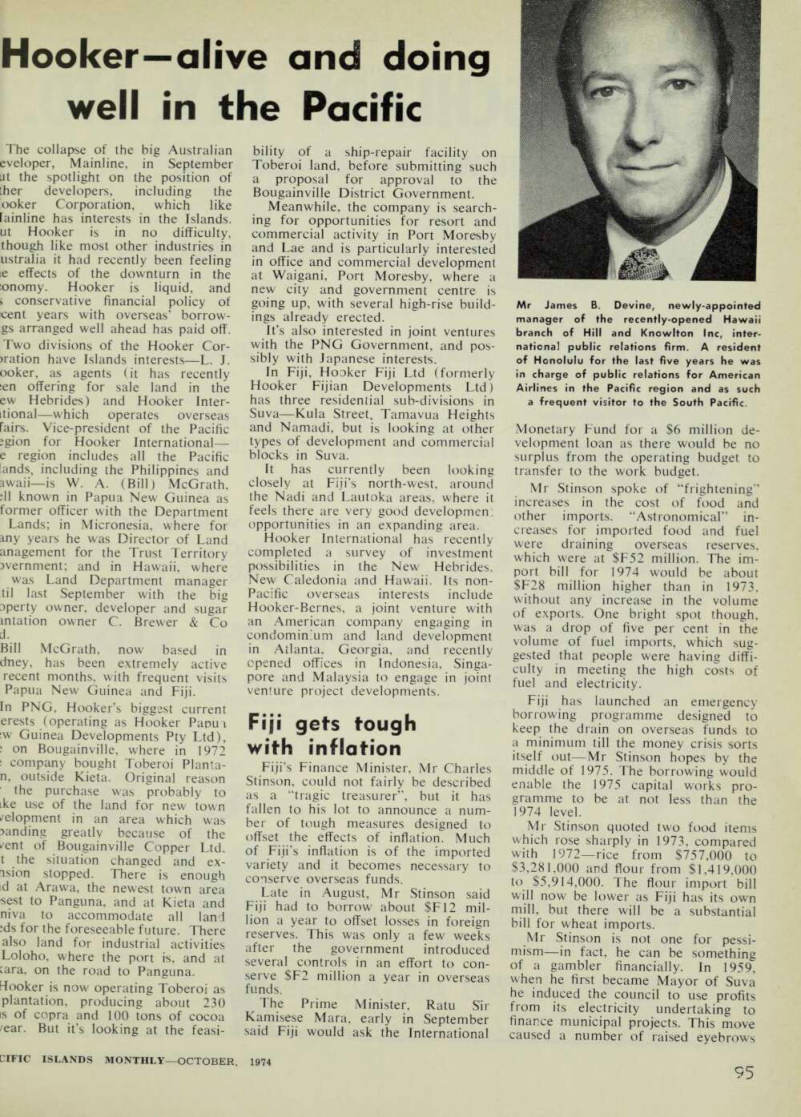
Mr James B. Devine, newly-appointed manager of the recently-opened Hawaii branch of Hill and Knowlton Inc, inter national public relations firm. A resident of Honolulu for the last five years he was in charge of public relations for American Airlines in the Pacific region and as such a frequent visitor to the South Pacific.
long the financial pundits of the en colonial administration, but any iticism was in hushed, off-the-record ties. It may be that 1975 will see tn steering Fiji through smoother ancial waters.
World sugar prices are at almost precedented levels, and copra, hough not as high as three or four >nths ago, is bringing good prices, ith some doubts about the current > soy bean crop, copra growers ve little to fear about future prices.
And Fiji is looking to increased »ar sales, limited only by produc n, to the United States in 1975. e US is studying the possibility of ling sugar quotas before they ex e on December 31, 1974. This uld give any country with diplo itic relations with the US the right send sugar without restriction.
Fhe Fiji quota at present is about 000 tons a year; the country be /es it can supply the US with ),000 tons a year, which would e the economy a tremendous lift, 1 help to build up those overseas erves. i The Mitsui Mining and Smelt- Co, of Japan, unable to build a mina plant in Japan because of lution-control problems, is looking the possibility of setting up on inel Island in the Solomons.
BSIP aims of
self-sufficiency
The Solomon Islands should aim at becoming self-sufficient in basic foods, where such a policy made economic and political sense, and sup plying other basic foods at the lowest cost to the country. This was sug gested by a committee which investi gated the demand and supply of local and imported food as part of the government’s plan to combat rising prices.
The committee limited itself to the study of foods which were the basis of family diet for most people in the Solomons—root crops, mainly sweet potato, rice, flour, bread, biscuits, fresh, frozen and tinned fish and sugar.
Recent studies suggested that at least 60 per cent of Solomon Islander cash income in the lower brackets was spent on food. Insufficient atten tion had been given in the past to the role of supply and price of food in deciding real income.
Food production had been under valued and cash incomes had been given too much prominence as a measure of development. Cash in comes were usually earned where im ported food was advertised and readily available, and local foods
were not promoted or were in short supply. TTie result was an ever increasing use of imports, and crea tion of long-term problems of foreign exchange and dependence on basic foods from overseas.
The committee, referring to root crops, recommended that generous provision be made in all urban plans for garden land, up to one acre for each household, if possible, and im proved planning and extension work to help food gardening, especially the cultivation of the sweet potato. A marketing agency, with the full back ing of the government, should be set up in Honiara, and possibly other towns, to market root crops. Small markets should be set up in all hous ing areas.
Guadalcanal Plains Ltd should de velop and market a standard low-cost rice for the home market. The government should give more help to local fishermen to market their catches.
The government should also ap point an authority to co-ordinate the transport, slaughter and marketing of local beef. The tariff should be re moved from Fiji sugar, tinned meat and fish. An import trade committee should be set up to take advantage of favourable trading opportunities in other countries.
As an immediate follow-up to the
report, the government should make a feasibility study, with commercial banks and import traders, of an im port credit guarantee scheme for the bulk ordering of basic foods.
The chairman of the committee was the Governing Council member for South Guadalcanal, Rennell and Bellona, Mr Stephen Cheka, sitting with Messrs Samuel Saki, Stephen Yee. Roy Kershaw, Anthony Grif fiths, Charles Johnson and Tony Hughes (executive secretary).
Meanwhile, the tourist industry is lamenting the shortage of US dollars, caused by a sharp drop-off in the number of American tourists. Against that, more tourists from Australia, New Zealand and Europe are visiting the Solomons.
Mr Ollie Torling, managing direc tor of Tambea Village Tourist Re sort Ltd, said his company was not making money this year, because few Americans were visiting the Solo mons. Mr Bruce Saunders, a director of Laulasi Adventure Tours Co, Malaita, said his business had also been affected.
Devaluation of American currency is given as the reason for the drop in American tourists. They visited other areas which were cheaper to get to.
Another resort
hotel tor Tonga
Work has begun on the 96-room Ha’atafu Beach Resort Hotel on the west coast of Tongatapu, 13 miles from Nukualofa. The owners, Pacific Resorts Pty Ltd, operating through their Tongan company,
Tonga Tourist and Development Co, plan to complete the first stage of 58 rooms by next July in time for the next meeting of the South Pacific Forum —the annual summit meeting of Pacific leaders.
Pacific Resorts already owns the magnificent Port of Refuge Hotel in Vavau, Tonga’s northern group, which is the only international stan dard hotel in the group besides the government-owned Tonga Inter national Dateline, in Nukualofa.
The Dateline has dropped its stan dards of accommodation and service in recent years, and if the new Ha’atafu Beach Resort provides the same standard provided in Vavau then the Dateline will lose customers.
The beach at Ha’atafu is a magnifi cent white sand beach, and the com pany is also providing a nine-hole golf course.
Tonga can expect an influx of Japanese businessmen on holidays through word-of-mouth advertising by the president of a Japanese in dustrial company, Mr Seitaro Iwai.
Mr Iwai, during a recent holiday, said Tonga was fortunate as nature had not been interfered with. He intended to return and would also tell his Japanese friends that Tonga was the place to visit for holidays.
Mr Iwai met King Taufa’ahau and government leaders. He was the guest of the king at a feast, during which he presented him with a samurai sword in recognition of the king’s interest in Japan’s traditional sport. He also presented the king with a traditional Sumo costume decorated with traditional Japanese designs.
Coral Gardens
in doubt?
The immediate future of the luxurious, yet uncompleted Corali Gardens Hotel, Korolevu, Fiji, is in doubt now that Mainline Corporation! in Australia is in receivership. Main-1 line owned about 76 per cent of Coral Gardens. Work is still pro ceeding on the hotel, but for howl long is the question.
Mainline was overdrawn with the First National City Bank and had in tended to put money into the project to finish it, when it went into receiver ship. There are now two options:] (1) First National City Bank elects to complete the project; (2) someone else buys it and completes it.
Noahs Ltd, which was to managd the hotel, is concerned. Originally it had been intended to open the hotel in October, and bookings were ac-l cepted for October, November and December. A strike by building workers set the opening date back to December. Now the Mainline troubles make it impossible to fore-| cast an opening date.
A spokesman for Noahs said Noahs had conducted a “very success ful promotion” for the Coral Gardens Hotel, and the company held “fan tastic” bookings for October, Novem ber and December.
“We hope that people will under stand,” he added.
Mainline Construction (Fiji) Ltc did not get caught up in the receiver ship of the Mainline Corp Ltd ir Australia. The Carpenter group ii Fiji owns 50 per cent of Mainlim Construction, which has erectec several big buildings.
“They are still carrying on as fa as we are concerned,” a Carpente spokesman said in Sydney. “The] are still earning money and makinj money. It is a viable proposition ii
every way.”
PNG to start
a pension scheme
The Papua New Guinea Govern ment will set up a compulsor national provident fund scheme t( apply, initially, to all urban worker and later to rural workers. Payment will be made when the participant reach 55.
The scheme will be based on : contribution equal to 12 per cent o salary—seven per cent paid by th employer, and five per cent by th employee. One of the chief aims o the scheme is to help people wh( have moved from traditional villag life into the cash economy.