PNG planters fear legal
pp. 94-95 · Read in the full issue
Business and Development
PNG planters fear legal hijack with land bill
From a Port Moresby correspondent
When Papua New Guinea’s House of Assembly passed the new Land Acquisition Bill under which the government can acquire land by com pulsory purchase, Chief Minister Michael Somare assured expatriate planters that they would be com pensated for land the government took over. The planters, however, were not impressed nor were their fears quieted. Many still think they will lose on the deal for several state ments have emanated from the government indicating that the yard stick for the purchase price will not be the current market value but a figure arbitrarily fixed by a govern ment valuer.
One cause for disquiet was a government refusal to incorporate in the bill a provision concerning human rights and guaranteeing “just” pay ment to planters for the sale of their land.
The planters’ unease was reflected in Opposition members’ allegations that the government had prepared a blacklist of 169 white-owned plant ations to be taken over by New Guineans under the new compulsory acquisition powers.
This was denied by Mr Somare in a statement released at the beginning of September. However, he admitted that the government was preparing a scheme for the “localisation” of ex patriate plantations. “But, no pro perty will be purchased without full discussion with the owner”, the Chief Minister stressed.
“It is not true, as some people have suggested, that the government intends to use the Land Acquisition Act as a vehicle for the mass ex propriation of expatriate plantations.
“The Minister for Lands has said on a number of occasions that the government is seeking a gradual transfer of expatriate plantation in terests to New Guineans in order to deal with land shortage problems and to develop a truly Papua New Guinea plantation economy”.
With regard to the price, however, the Chief Minister held out no hope
of expatriate owners being able to sell for handsome profits, or even for the going price.
Underlining the fact that compen sation negotiations would not be based on a “free market” price, Mr Somare said, “My position is clear.
My government will pay reasonable compensation but this involves assessing what is fair for New Guineans to pay and just what is fair for plantation owners to receive.
I urge plantation owners to have trust in my government to carry out the plantation repurchase programme in a reasonable manner”.
Basing an analysis of Mr Somare’s intentions on his honest record to date as Chief Minister, planters might be mollified but many prefer to base their doubts on the “official position paper” which was accidentally circu lated in the House during the debate.
This paper, issued by the Lands De partment, was claimed as part of his speech by Minister for Lands Mr Thomas Kavali.
However, Opposition Member for Sumkar, Mr J. Middleton, refused to accept this. Naming it as an official position paper, he said that the paper clearly said the Lands Department could see no reason why full com pensation should be paid.
“It also clouds the issue”, he said, “by mentioning the original price paid for land without pointing out that the compensation referred to applies only to the assets on the land. These obviously were not there when the land was acquired”.
Referring to the government’s re fusal to accept an Opposition amend ment on human rights, Mr Middle ton said the Opposition wanted to ensure the human right of appeal where a price was not considered fair.
There was a variable factor in the compensation formala which could be used to discriminate against land owners.
Despite statements by the Chief Minister and government ministers that a fair price would be paid, in defeating the human rights clause the
jvcrnment was refusing to accept e Opposition amendment which lught to consolidate the minister’s atements.
“We deplore the attitude of the mgu Party who were, after all, res msible for the introduction of the uman Rights Bill into the last ouse, and also the People’s Pro ess Party, who made a great cam ign issue out of protection of pro rty”, said Mr Middleton.
“Both parties have compromised smselves completely in this issue”.
Non-acceptance of the amendment, r Middleton said earlier, would be ae first step in the destruction of r democratic process”.
Mr Somare’s reply was that it was Ticult to incorporate the concept human rights into legislation.
Government speakers complained it too much concern was being Dwn for expatriate planters and not augh for New Guineans. The com lints were crystallised by Father in Momis (Bougainville) who said : government had been worried aut what the Australians would r about land acquisition rather than aut the people’s problems. ‘lf we look carefully at the his y of this case”, he said, “we will i that in the past certain Western fitalists have come into the coun and fought for these properties, ese people were concerned only h their self-interest. Today, no w Guinean could regard himself a king in his own country”, fhe bill was passed at the end of gust since when warnings have n sounded by various parliament ms against original tribal owners ing the law into their own hands I occupying land which they imed they had been swindled out when the white man colonised the ntry.
Tie new bill did not give auto tic right to New Guineans to take k any lands they claimed to be ive-owned, the Member for Ko -10 Open, Mr Oscar Tammur said Rabaul. le confessed himself worried that ai land owners might not under id the system of the new land law y. Land was the main cause of problems of the Tolai people on Gazelle and deep understanding he problem was needed.
Ir Tammur said settlement of 1 problems on the Gazelle should mutual compromises between the srnment, present land owners and igers claiming ownership. The law ild not allow squatters to invade itations and land currently under ute to develop it for their own sh needs.
W. Samoa's
Development
Bank opens . . .
The newly-created Development Bank of Western Samoa is expected to be a major force in the develop ment of the country, both as a pro moter of enterprises and as a financier. The bank had its genesis in 1965 in the development depart ment of the Bank of Western Samoa.
This was set up to extend term finance to any productive activity of importance to the economic develop ment of Western Samoa. Several changes followed in the functions of this department. At the August sitting of Parliament legislation was passed creating the bank under its present name, operating under a separate board of directors. October 1 was fixed as the date for the bank to open its doors.
Initially, $20,000 was available.
Major changes in 1970 saw a new committee take charge of the fund, and a further SWS2OO,OOO advanced by the government. In 1972, the Asian Development Bank made a re port on the fund. The bank saw there was scope for a development finance institution involved in pro motion, as well as in finance, to serve the expanding investment needs of the country.
Acting on a recommendation from the ADB a working team of two arrived in Western Samoa in Septem ber, 1973, to upgrade the operations,
procedures, policies and strategies of the fund. This technical assistance was provided as an ADB grant.
So far the Western Samoa Govern ment has funded the operation to the extent of $W5550,000. This amount, in loan balances, has been taken over by the new bank. The government has asked New Zealand and the ADB for loans so that the bank can expand its activities.
With its limited resources the fund has only been able to make loans for agriculture. Its small loans for the development of traditionally-owned land have become a potent force in lifting village farmers from sub sistence outlooks to a cash economy.
Next year the bank will move into industrial lending.
Loan approvals so far are: 1972, 236 loans, $W575,895; 1973, 800 loans, $W5286,265; 1974 (first six months), 634 loans, $W5214,602.
. . . and PNG's does
record business
The Papua New Guinea Develop ment Bank has announced a record year of lending for projects boosting total approvals to $39 million in seven years of operations.
Managing director Mr R. V. Cole said loan approvals for the year ended June 30 totalled $8,547,250, an increase of 48 per cent on the previ ous year.
Of the 1,654 loans approved in the last 12 months, 92 per cent were for New Guinean ventures and of that figure 64 per cent went to rural enter prises.
The average loan size for New Guineans in the last seven years was $1,719, while practically all rural loans were made without formal security being required.
The bank is keen to lend more money for agricultural and business projects. Two successful ventures were a pastoral supply centre at Popondetta, where the vocational centre provided farming requirements for local farmers, and at Badili, where cane and other furniture mak ing is one of the main activities, the bank lent money for a vocational centre truck.
Plans are now under way to de velop commercial projects with bank loans at other centres—flower and vegetables at Wiotape, rice-growing at Bereina, and soya beans at Agarabi. Assistance is not just a mat ter of lending money. The bank helps to train students in business matters to prepare them for running their own businesses later, or when they take up positions.
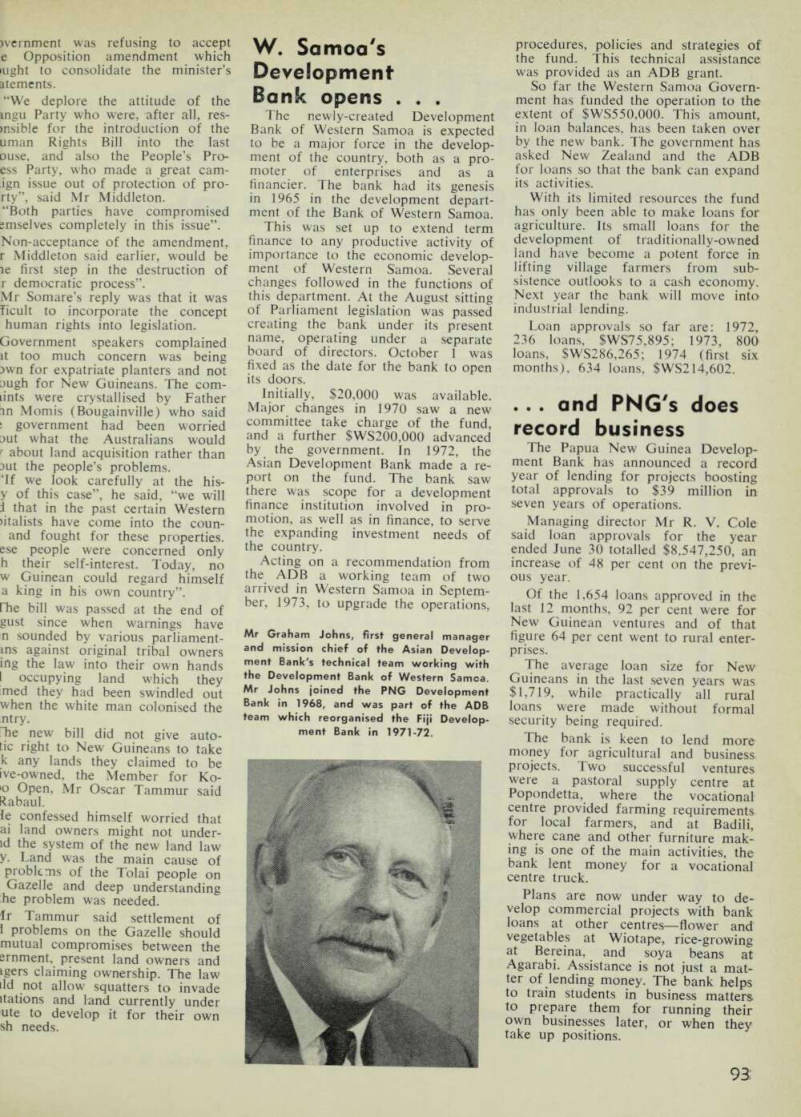
Mr Graham Johns, first general manager and mission chief of the Asian Develop ment Bank's technical team working with the Development Bank of Western Samoa.
Mr Johns joined the PNG Development Bank in 1968, and was part of the ADB team which reorganised the Fiji Develop ment Bank in 1971-72.