Pacific Transport
pp. 81-85 · Read in the full issue


With The Japanese Flirtation
Over, Tonga Woos Air Nauru
The kingdom of Tonga doesn’t lan to go ahead with its own inter ational airline supported by Japanese iterests, using Boeing 7375. Present lans are for a link with Air Nauru, sing an F2B Fokker of the type Iready being operated by Air Nauru.
The new Fokker, which will be dr Nauru’s third, may have Air lauru’s insignia on one side of the aselage, and the insignia of Friendly ilands Air on the other. Friendly ilands Air is the name chosen by dng Taufa’ahau for Tonga’s inter ational airline.
The king has recently been flirting ith All Nippon Airways and has ane so far as to state that the ipanese will be allowed to bring air ews and ground staff to Tonga by ic end of the year to operate an temational air service from Tonga i behalf of the Tongans.
Views have been expressed in the dustry that the king was putting mself in the position of being taken ftr by the Japanese, but it now ems likely that the king has been ell aware of the dangers and has assibly been using his Japanese imance to achieve his objective of inging Air Pacific into line. In any ise he is now reported convinced at the Boeing 737 s are not the air aft capable of operating services and out of Tonga.
President Deßoburt of Nauru has sen a frequent recent visitor to ?nga, and a new plan of a dual rline has resulted from these visits, ir Nauru has recently begun a eekly F2B service from Nauru to pia and plans soon to make it twice jekly. Air Nauru is tapping into e Japanese tourist market, and it reported to have organised 30 □ck seats carrying Japanese tourist irties from Nauru to Apia from □vember. An extension to Tonga Duld be logical, and thus Tonga rough Air Nauru would be linked rectly to Japan through Nauru, uam and Kagoshima, which Air auru at present services.
The Nauru-Tonga link would pre sumably be the one in which Tonga and Nauru would collaborate using the one aircraft with a double insignia.
Air Nauru, in addition to its pre sent two Fokkers, is acquiring a Boeing 737 for delivery next July.
This is a luxury version of the air craft, with all sorts of optional extras.
Air Nauru is planning big expansion of its services.
It is a sore point with Tonga that its aerial links with the outside world, except for Air Polynesia in recent months, have been through Fiji. Most
Tongans who go overseas go to New Zealand, which has meant putting down at Suva and Nadi after leaving Nukualofa.
That problem seems to have been overcome rather fortuituously, through Tongans overstaying their permits in New Zealand. In an effort to get them home quickly, Tonga allowed Air Pacific temporary rights through Fuamotu airport to Auck land, and back. These temporary rights were recently extended for a further eight months—to May, 1975. and could become permanent, as they have given Tonga a direct link with the world outside.
Air Pacific’s fortunes took a turn for the better in August. President Ford, of the United States, signed an order giving Fiji rights at Pago Pago and Majuro, while neighbouring countries showed themselves more in agreement with the concept of a single regional airline, meaning Air Pacific.
The Pago Pago rights make Air Pacific the sole regional carrier be tween Nadi and Pago Pago, and vice versa. Originally, the US blocked Fiji’s application for these rights, but was prepared to allow Air Pacific to operate the route, provided the US could name another regional carrier to also fly the route. Fiji retaliated by cutting PAA services through Nadi to one a week.
The Nadi-Pago Pago monopoly should prove profitable for Air Pacific. When the service will be started is not yet known, as the Air Pacific board has not met since rights were granted. Similarly, it is not known when the rights at Majuro will be taken up.
But the new services will not mean the recall of the Air Pacific BAG One-Eleven which is on charter to Air Malawi. Captain P. W. Howson, chairman of Air Pacific, said in Sydney early in September that the aircraft, which was chartered to Air
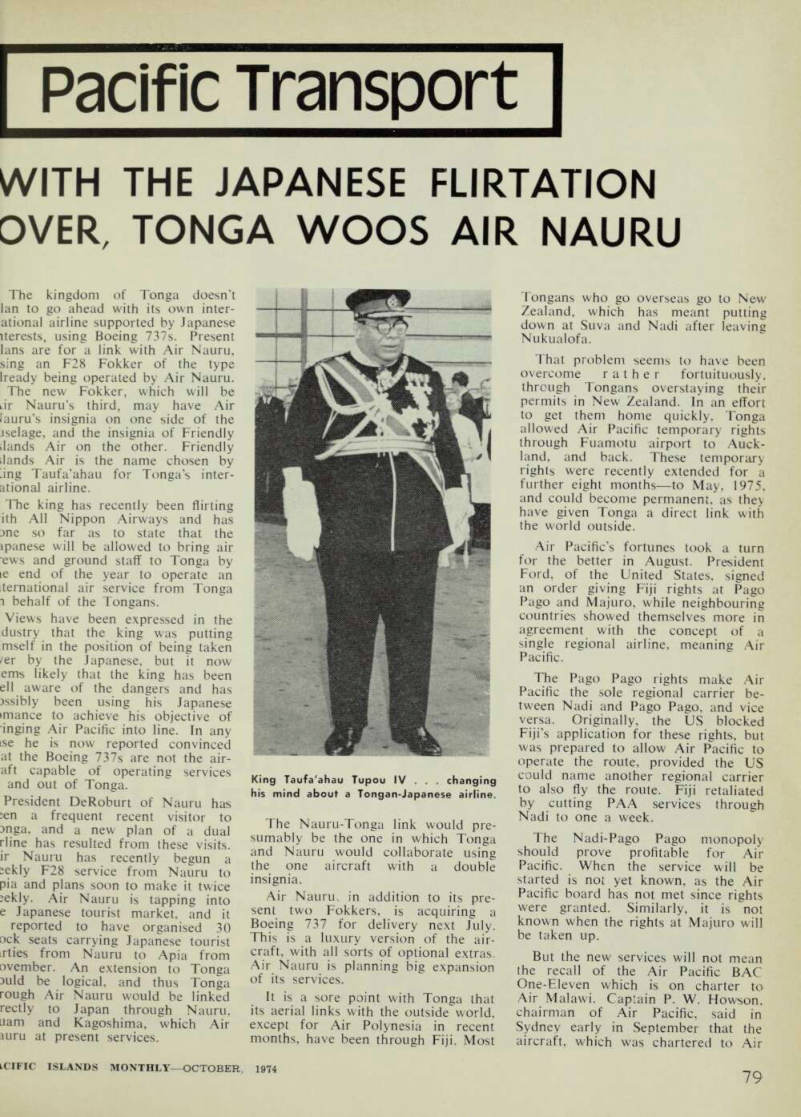
King Taufa'ahau Tupou IV . . . changing his mind about a Tongan-Japanese airline.
lalawi for five months, would not 5 required for at least two years.
“We are trying to negotiate an ex nsion of that charter,” he said.
Air Pacific’s main need today is to ;t back into the black through >erational efficiency. Complaints ive been many in recent months >out late arrivals, and even non rivals, without telling anybody. This is infuriated a number of would-be avellers in Tonga.
The problem basically, has been aintenance. The airline does not ive a big enough maintenance staff keep its growing fleet in the air. nd the ageing Herons, which were ed for Royal flights in New Zealand te in 1953, need much more atten >n to keep them airworthy.
Air Pacific expects to be on the ay to overcoming that problem by placing the Herons with Trislanders, e first two of which are expected be in service by the end of 1974.
Dnga Extending
S Tourist Airline
Tonga’s internal airline, operated the Tonga Tourist and Develop ait Co and known locally and in rrectly as Air Vavau, will shortly extending its service to Haapai, 2 central group of the three main oups of Tonga.
The 2,500 ft strip in Haapai, on main island of Lifuka, has been mpleted although it still needs a ished coral surface. The Britten Drman Islanders will begin a once veek service in October, Tongatapu lapai-Tongatapu and, additionally, ce a week, Tongatapu-Haapai ivau and return. The Haapai group s probably the most beautiful island mery in Tonga, and with great irist potential once accommodation d facilities are provided. But with air service, and an overnight ferry vice from Nukualofa the only :ans of contact, it has never seen my visitors.
Lifuka is the island which Captain >ok named “Friendly Island”, and >m which all of Tonga now gets name of the Friendly Islands. It's ly about 4\ sq miles in area with >erb beaches.
The local airline last year began a vice from Nukualofa to Eua, ich has continued profitable, and h the opening of the Haapai strip the main groups are now con ned by air.
The local airline has lately been hit serious fuel shortages, and three les in a month recently had to up fuel from Fiji in its own aircraft keep itself operational.
Pan-Am And Twa
May Join Forces
The possibility that Pan American World Airways may eventually merge with Trans World Airlines is being publicly embraced by both inter national carriers following talks with the US Government.
Chief executives of both airlines met privately with Transportation Secretary Mr Claude S. Brinegar, in separate sessions to discuss their plight.
Both airlines face millions of dollars in losses this year, due to higher fuel costs and a drop in pas senger traffic between the United States and Europe.
“We believe that a Pan Am merger with TWA could provide one logical and positive step toward the long term viability of our nation’s inter national air services,” the TWA chair man, Mr Charles C. Tillinghast, said after the meeting, A Pan Am spokesman said his air line agreed with the TWA statement, but he emphasised that Pan Am is not engaged in merger talks with any one. Such a union between the two carriers would require approval by the Civil Aeronautics Board (CAB).
Mr Tillinghast’s statement, in which Pan Am concurred, said a merger is not the answer to the air lines’ problems for the short-term.
“So long as current economic dis
>cations persist, and until the :onomic benefits of such a merger dually begin to be realised, a period f temporary subsidy would in any be of critical importance.”
Last Spring, both Pan Am and WA asked the CAB for a perma ;nt mail subsidy rate involving ore than SUSIOO million annually i help ease their financial losses.
Pan Am has estimated its 1974 ss at SUS 76 million (SASI million), WA’s loss is expected to be around JS6S million (SA43 million).
A CAB decision on the request is onths away, and Pan Am urgently ipealed to the board in August to ant it a “temporary” subsidy of :arly SUSIO.2 million (SA6.B illion) a month to get the airline ist hungry creditors pending a final ling. —A A P-Reuter.
\N-Am Wants
\Res Raised
Pan American World Airways has ked the US Civil Aeronautics >ard to lift fares between Pago go and Honolulu, and Honolulu d the US west coast. The American moa Government is likely to pro t against the suggested increases.
The new fares sought by PAA on ; Pago Pago-Honolulu route are 76 tourist class, a rise of $7B, and 88 first class, up $146. The ex rsion fare will be based on 85 per it of the tourist fare. PAA says es on the route have not been ad ted since 1959. The suggested new es are equal to US domestic fares.
>Rd Howe
;eps air link Lhe people of Lord Howe Island icted favourably on August 22 en the manager of Airlines of W, Mr P. Steadman, told m that his company would intain the air link with the main d, using a Riley Heron aircraft, e airline has a wet charter of the :raft from Conair for four months, ile it assesses the market reaction. \irlines of NSW will run four ser es a week from Mascot to Lord we Island on Sundays, Wednes 's, Fridays, and Saturdays and will jrn the same day. The first service 5 scheduled for September 15. The ey Heron, in normal conditions, I do the trip in two hours and 20 mtes. Its capacity on the outward ht will be nine passengers and 12 the return. It will carry a limited ount of mail.
At Steadman explained that on ward flights the aircraft would e to have enough fuel to allow it circle over the island for half-an ir and then return if the weather
precluded a landing on the new air strip, The single fare is $65, com pared with the subsidised $54.80 in the flying-boat.
However, capacity is much lower.
The most passengers the airline will be able to take to Lord Howe Island in a week will be 36, compared with 200 during the height of the season carried in the flying-boats.
Conair, the chartering company, under the wet charter, supplies the aircraft, pilots, fuel, and engineering services. It has been operating for many years from Alice Springs to various parts of the Northern Terri tory. It has five Riley Herons, which differ considerably from the original Herons which are used by Air Pacific, The Riley Herons have different engines, and retractable under carriages.
Night Fliers
At Nausori Again
Night-flying restrictions at Nausori Airport in Fiji were expected to end about the middle of September, pro vided two local air traffic controllers qualified for Fiji government permits.
The men trained in New Zealand for two and a half years, and only needed to pass the local examination.
International/Aeradio Ltd, which manages the airport, cut out night landings when the government refused to allow an expatriate air traffic con troller to work at Nausori for three months. During the period of restric tion the airport closed each night at 8.30, although that time was occasion ally extended on special request for local and regional flights by Air Pacific.
Bad Luck Dogs
Fiji's New Ship
The Tabu Soro, the replacement for the Uluilakeba which sank in Lau during Hurricane Lottie in December, 1973, is having a long delivery voyage to Fiji. Engine trouble dogged the ship since it left Norway in May.
It broke down in Port of Spain, Trinidad, and then had further trouble which made it necessary for her to put into Panama for further repairs.
The ship, which was originally ex pected to arrive in Fiji in June, is unlikely to arrive before the middle of October.
Better Nz Service
For The Islands
Fiji, Western Samoa and Tonga can look forward to a better ship ping service from New Zealand early in 1975, when the Union Steam Ship Co of NZ Ltd puts on another con tainer ship. According to the com pany’s foreign trades department manager, Mr Stuart Caspari, the new
container ships will carry 200 to 300 containers, more than twice as many as the Union South Pacific.
The USS Co launched its container service to the three groups with the Tarros class container ship, the Union South Pacific. The ship recently returned to service after repair work in Sydney. Mr Caspari said containers were the coming thing for the South Pacific. Their advantages over loose cargo included faster handling in port, less damage and less pillaging. • The New Zealand Shipping Corporation has added a new ship, the Toa Moana, 1,190 tons, to the Auckland-Cook Islands service. With the Lorena it maintains a fortnightly schedule, with calls at Niue every four weeks. The Toa Moana was delivered recently from Denmark. • Freight rates on Pacific Naviga tion Co vessels operating between New Zealand and Tonga have been lifted by 12 per cent. The two ships the company operates in this trade are the Aoniu and the Frysna. Sharply rising fuel prices are blamed. Bunkers which cost ST23 a ton in New Zea land in 1972, now cost STBO a ton. • Mr Robert Dods, the Fiji Secre tary for Transport and Tourism, has been appointed chairman of the ad visory board which will serve the proposed South Pacific regional ship ping council. Ministers from nine Pacific countries, meeting in Nuku alofa late in August, recommended that the board and council be set up. • New Zealand-Japan is a likely extension of Air New Zealand’s net work of services. The airline has been looking at ramifications of such a service for some time. At present an inhibiting factor is Tokyo airport, which is so busy that it would be difficult to fit in a new service. The service, when it eventuates, is likely to be from Auckland to Nadi, and then direct to Japan. • The airport at Rarotonga has cost almost $lO million to the end of July. The NZ Civil Aviation Minister, Dr Finlay said in the NZ Parliament that about $400,000 for building construction claims had yet to be charged, and another $500,000 would be required for airport main tenance facilities and for accom modating airport staff. • The people of Naisisili village in Fiji, are the proud owners of a launch, 42 ft long with a 12 ft beam.
The boat, which cost $F 1,400, was built for them by Mr Varayame Ratu, of Yaqete Island in the Yasawas. The people will use the launch for fishing and travelling.