From 'Easy' Street At 43 To A New
pp. 75-79 · Read in the full issue

Tatham man's odyssey
FROM 'EASY' STREET AT 43 TO A NEW JOB ON THE ROAD TO THE ISLES
By John Carter
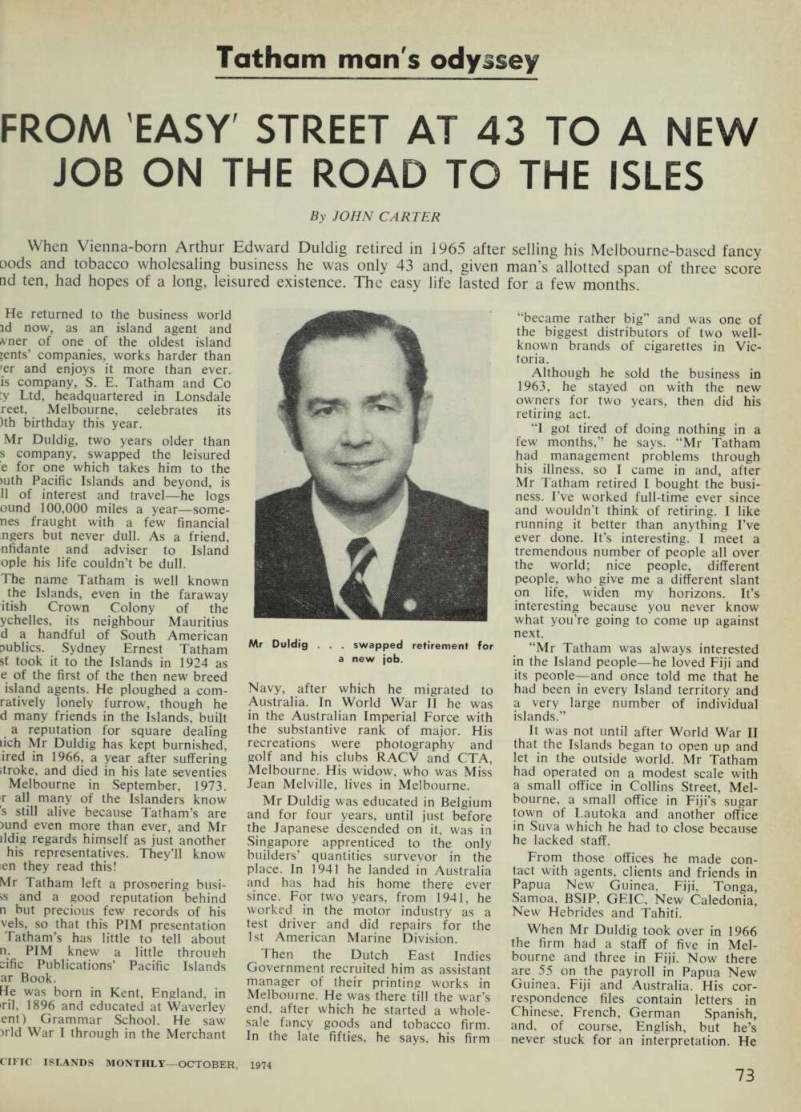
When Vienna-born Arthur Edward Duldig retired in 1965 after selling his Melbourne-based fancy oods and tobacco wholesaling business he was only 43 and, given man’s allotted span of three score ad ten, had hopes of a long, leisured existence. The easy life lasted for a few months.
He returned to the business world id now, as an island agent and vner of one of the oldest island >ents’ companies, works harder than r er and enjoys it more than ever, is company, S. E. Tatham and Co :y Ltd, headquartered in Lonsdale reet, Melbourne, celebrates its )th birthday this year.
Mr Duldig, two years older than s company, swapped the leisured e for one which takes him to the >uth Pacific Islands and beyond, is 11 of interest and travel—he logs ound 100,000 miles a year—some nes fraught with a few financial ngers but never dull. As a friend, nfidante and adviser to Island ople his life couldn’t be dull.
The name Tatham is well known the Islands, even in the faraway itish Crown Colony of the ychelles, its neighbour Mauritius d a handful of South American publics. Sydney Ernest Tatham sf took it to the Islands in 1924 as e of the first of the then new breed island agents. He ploughed a com ratively lonely furrow, though he d many friends in the Islands, built a reputation for square dealing uch Mr Duldig has kept burnished, ired in 1966, a year after suffering itroke, and died in his late seventies Melbourne in September, 1973. r all many of the Islanders know s still alive because Tatham’s are )und even more than ever, and Mr ildig regards himself as just another his representatives. They’ll know en they read this!
Mr Tatham left a prosnering busi es and a good reputation behind n but precious few records of his vels, so that this PIM presentation Tatham’s has little to tell about n. PIM knew a little throueh cific Publications’ Pacific Islands ar Book.
He was born in Kent, England, in 'ril, 1896 and educated at Waverley ent) Grammar School. He saw )rld War I through in the Merchant
“became rather big” and was one of the biggest distributors of two well known brands of cigarettes in Vic toria.
Although he sold the business in 1963, he stayed on with the new owners for two years, then did his retiring act.
“I got tired of doing nothing in a few months,” he says. “Mr Tatham had management problems through his illness, so I came in and, after Mr Tatham retired I bought the busi ness. I’ve worked full-time ever since and wouldn’t think of retiring, I like running it better than anything I’ve ever done. It’s interesting. I meet a tremendous number of people all over the world; nice people, different people, who give me a different slant on life, widen my horizons. It’s interesting because you never know what you’re going to come up against next.
“Mr Tatham was always interested in the Island people—he loved Fiji and its peonle—and once told me that he had been in every Island territory and a very large number of individual islands.”
It was not until after World War II that the Islands began to open up and let in the outside world. Mr Tatham had operated on a modest scale with a small office in Collins Street, Mel bourne, a small office in Fiji’s sugar town of Lautoka and another office in Suva which he had to close because he lacked staff.
From those offices he made con tact with agents, clients and friends in Papua New Guinea, Fiji, Tonga, Samoa, BSIP, GEIC, New Caledonia, New Hebrides and Tahiti.
When Mr Duldig took over in 1966 the firm had a staff of five in Mel bourne and three in Fiji. Now there are 55 on the payroll in Papua New Guinea, Fiji and Australia. His cor respondence files contain letters in Chinese, French, German Spanish, and, of course, English, but he’s never stuck for an interpretation. He
Navy, after which he migrated to Australia. In World War II he was in the Australian Imperial Force with the substantive rank of major. His recreations were photography and golf and his clubs RACY and CTA, Melbourne. His widow, who was Miss Jean Melville, lives in Melbourne.
Mr Duldig was educated in Belgium and for four years, until just before the Japanese descended on it, was in Singapore apprenticed to the only builders’ quantities surveyor in the place. In 1941 he landed in Australia and has had his home there ever since. For two years, from 1941, he worked in the motor industry as a test driver and did repairs for the Ist American Marine Division.
Then the Dutch East Indies Government recruited him as assistant manager of their printing works in Melbourne. He was there till the war’s end, after which he started a whole sale fancy goods and tobacco firm.
In the late fifties, he says, his firm
Mr Duldig . . . swapped retirement for a new job.
and his staff, which includes Chinese, can do it all.
His Fiji staff, headed by Mr Kantilal Jiwan, general manager, who is at Lautoka, and Mr Mohammed Janif at the Suva office, is completely localised. With the exception of Australian David Marburg, general manager and manager at the Lae branch, the PNG staff is local. Papuan Albert Karo is the Port Moresby manager The warehouse in Lae was opened in 1972 and the warehouse in Port Moresby a year later. But Mr Duldig had begun to spread his wings in 1969. He went further than most island agents and entered the Indian
Ocean, trading with the Seychelles and Mauritius. He must have done a good job there because the colony government appointed him their representative in Australia in 1970.
One of the firm’s representatives, a Chinese, looks after things in the Western Pacific while Mr Duldig makes the central and eastern Pacific his parish, doing at least three tours a year as well as numerous visits to Papua New Guinea and annual calls on clients in SE Asia, the Seychelles, Mauritius and East Africa. South America sees him less frequently.
“From a pin to a ship” is the usual gamut of the island agent’s trading activities but Mr Duldig concentrates
as much as nossible on Australian. ; products with a bias towards food products “because that is the strength of Australia” he says although secondary Australian pro ducts are coming more to the fore.
I wrote in an article on island i agents (PIM, Dec, 1971, p 44), “The island agent is all things to all his clients, even Father Christmas to their children,” Mr Duldig is no exception.
One of his favourite chores is to look after the welfare of three island children in school in Melbourne—two from Noumea and one from the New Hebrides. They look to him for everything they need in Australia* even pocket money. There’s no charge for the service. It’s one of the many things done for clients who are more friends than clients.
He’d never make a living as Father Christmas, and as the major part of an agent’s income stems from brokerage fees, which like everything else in these inflationary days have gone up slightly from the 2i per cent charged a few years ago, it’s puzzling ; to the outsider to understand how he makes a living at all.
He does and, if he’s a good agent it’s a good living.
“But overheads have risen to such an extent in the last 18 months that an island agent can’t possibly make ends meet on the old brokerage allowed by the manufacturers, so the buying commission has had to be in creased,” says Mr Duldig. “We work on volume and very small profits.
Even the finance-generating power of the big manufacturers and others, even the banks, are finding it difficult to keep un with inflation, so the com mission had to go up.
“This brings problems because
inflation is growing in the Islands where they have to depend so much on overseas suppliers. Then the cost of goods has risen substantially, some more than 50 per cent. As we finance every project and stand to lose if anything goes wrong, our problems increase.
“The manufacturer is the safest of the lot. He exports the goods, gets the benefit of the sale and hasn't to foot the bill if anything goes wrong.
The island agent deals with all classes and kinds of people in the Islands. Some are well educated, well established. Others, starting from scratch have difficulty in keeping their financial records. If financial records go awry, the agent catches
the draught.
“Basically, the problem encounter
ed in the Islands is the lack of pro fessionalism,” Mr Duldig says.
“Qualified accountants are hard to find and it is hard for the Islander to keep his records straight if he hasnt good professional advice. That’s where
: come in. We sometimes have to vise our clients on how to control nr businesses but, by and large, the ijority of Island businesses are well a.
“More than that, it’s our experience it, so far as honesty is concerned, ;re is no one better than the Islander sinessman.”
To be a successful island agent u’ve got to be resourceful and r Duldig is that. He was once at uncion in Paraguay, having arrived plane, and was waiting for his bag
gage. Everybody’s but his came out.
He was stranded without his bags. The airline representative explained that it must have been stored with the bag gage to be offlifted at the next port of call, hundreds of miles away. No, he couldn’t look for it. It would take too long and would hold up the flight.
Senor Duldig would get it within a week. But Senor Duldig wasn’t going to wait a week.
He remembered a very impressive looking document he carried, a parchment with red seals attached which he had got from the South Australian Government, a kind of trading gimmick, impressive, yes, but not worth the paper or the sealing wax. He flourished this under the airline man’s nose together with dire threats of what his government would do if the aircraft flew away with diplomatic baggage.
The aircraft left more than two hours late. Mr Duldig had got his baggage.
There was the time when an air line manager in one of the islands told him his flight had been cancel led. He discovered that it hadn’t; that the plane had taken off without him but with a friend of the airline’s local manager occupying his seat.
Mr Duldig saw the airline manager
and left him in no doubt about the future of his job if a plane wasn’t found. It was but it was going slightly off route. Mr Duldig took the plane and finished up in Honolulu as a guest of the airline for five days until the plane arrived to take him home.
So, if, as a bemused traveller, you want to take it out of an airline or some local tinpot would-be dictator, seek out Mr Duldig. After all, he should know. Among Tatham’s many activities is that of travel agents!
Mr Jiwan (Fiji).
Mr Marburg (PNG).