It Was Bloody Buna
pp. 71-73 · Read in the full issue
Major-General Edwin F. Harding’s 32nd US Infantry Division arrived in Papua during October, 1942. The men were poorly trained, some of their weapons and much of their clothing and equipment was unsatisfactory, and many details of the divisions organisation had to be modified.
Hearing that the Japanese were heavily engaged on Guadalcanal, Harding wanted to advance on Gona without delay. Had he done so, the division would have been annihilated.
As it happened a combined Austra lian-American assault on the Japanese defences along the Buna-Gona coast was mounted in November. It developed into three virtually separate fronts, with the Americans attacking Buna.
By the end of the month it was clear that the enemy was much stronger than expected and that the terrain was most difficult. The Japan ese had dug themselves in and were using tactics learnt in the Owen Stanleys. Swamps, flooded rivers and heavy secondary growth hampered the attackers while large, thickly foliaged trees made air strikes almost impossible.
During the first two weeks the 32nd Division lost 492 men in battle with out gaining any ground; elsewhere, the Australians were not making any progress, either. In his Our Jungle Road to Tokyo, Lieutenant-General Eichelberger tells how General MacArthur commanded him to take over: “. . . relieve all officers who won’t fight ... if necessary, put sergeants in charge of battalions and corporals in charge of companies . . . take Buna, or do not come back alive,”
When Eichelberger reached Buna on December 2 he found the Ameri cans reluctant to patrol, poorly dis ciplined, hungry and dirty. Harding and several other senior officers were
sent out, but, as Lida Mayo suggests in Bloody Buna, the Americans may have done better had MacArthur not pressed for quick results. Moreover, as events were soon to show, they did much better later on. It was the old story of untrained militia men sent into battle under poor leaders. There is some parallel, too, with Blarney’s dismissal of Rowell and the earlier substitution of Dougherty for Potts.
And at least some of the blame rests with Canberra and the Australian Press, too avid for a victory.
After consulting the Australian Lieutenant-General Herring to whom he was responsible, Eichelberger organised a new attack on December 5, supported by Australian artillery and Bren carriers, with RAAF and USAAF providing air cover. The Americans now showed their mettle, one of them winning the Congres sional Medal of Honour. They paid a high price: by December 10, 113 had been killed, 490 wounded, 64 were missing, 1,260 had been evacuated to hospital, and 169 officers and 3,017 men were left to carry on.
The enemy still did not look like giving up and Buna would have held out much longer had not Australia’s 18th Brigade and supporting troops, tanks, etc, joined in, and two other Australian brigades begun to clear the Sanananda-Gona area. Even then it was just as well that the Japanese High Command, after ordering General Horii, ready to pounce on Port Moresby, to withdraw and secure Buna, was now too concerned about Guadalcanal to provide him with reinforcements and supplies.
American troops took Buna govern ment station on January 2, 1943. The
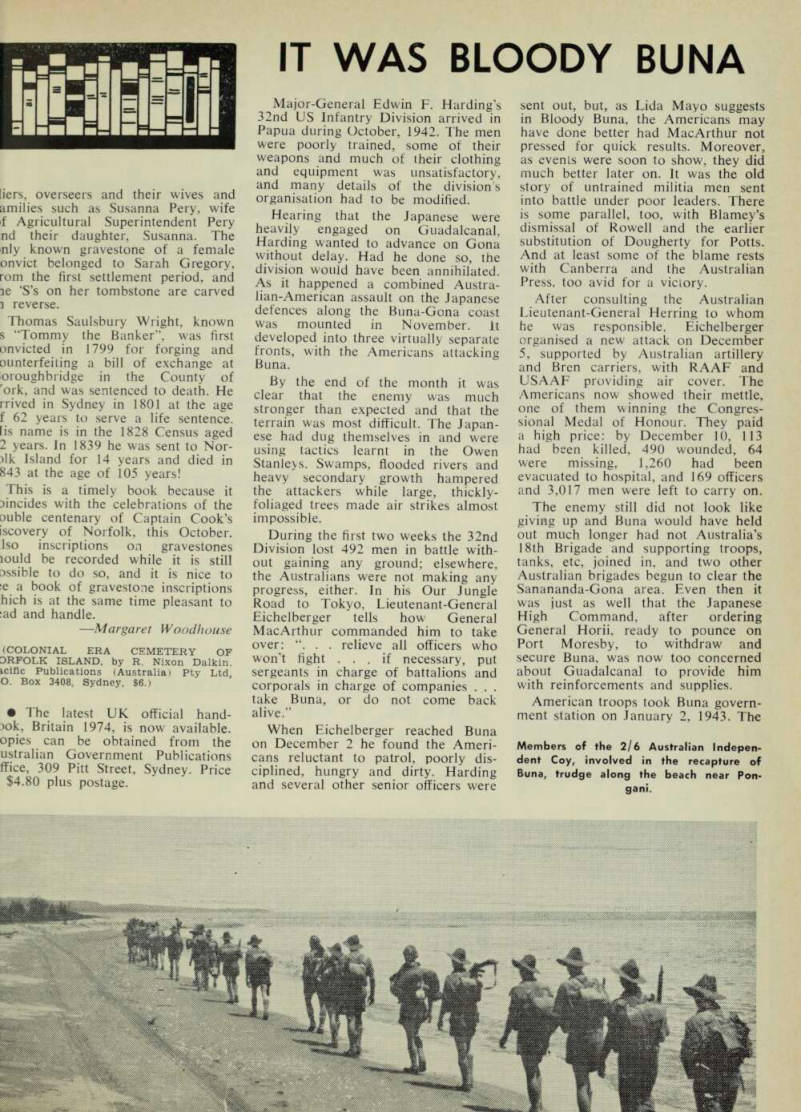
Members of the 2/6 Australian Indepen dent Coy, involved in the recapture of Buna, trudge along the beach near Pon gani.
Mlies suffered 2,870 casualties in the irea, 913 of them Australians. In the inal stages alone, the enemy lost ,390 men. That it was the bloodiest ►attle in Papua is clear from the final igures for that part of the islands; ,163 Australians and 671 Americans illed, 3,533 of the former wounded nd 2,171 of the latter.
There have been few Austerlitzes, lost battles have been won in spite f errors made by the victors—be ause the losers made more of them.
Tiere was too little planning for Buna nd too little appreciation of the nemy’s fighting qualities. The author laims that MacArthur’s ignorance of ic terrain in New Guinea cost many ves, an ignorance “that led him iroughout the campaign to make im ossible demands on his front-line Dmmanders”.
The southern Philippines have lenty of jungle country, too, and, loreover, MacArthur had met some f the Australian generals who fought i the Owen Stanleys. Was it really norance, or a search for personal ados? After the Allies had taken obodura on December 20, the ipanese could have been by-passed, ; was later done in other areas, istead, MacArthur wanted a clear-cut ctory and Blarney went along with m. They did learn from the Buna ona campaign but many of their mntrymen paid for the lesson with eir lives.
This book brings together some of e material in the two nations’ official ar histories and in books by writers ce George Johnston, Osmar White, aymond Pauli and John Vader. On is score alone it deserves to be read few people have the time to go rough the lengthy and often tedious ficial accounts, and most of the )oks alluded to are out of print. Lida ayo has, however, done more: she the first American writer to see her iuntry’s effort in Papua in its oper context.
There are some errors; eg 2/10 Bn is at Wanigela on October 5, nine ivs before 128th US Regiment and '6 Independent Coy, and the AIF -re certainly not “regulars”—only oody amateurs as every recruit was Id ad nauseam. And Bloody Buna 3uld have been enhanced by the nd of maps contained in official war stories.
To sum up, this is a useful book, helns Americans, Australians and 5W Guineans alike to become better quainted with an important period the Islands’ history. Only if we iderstand what the last war was e can we hope to take the steps cessary to prevent the recurrence
such a calamity.
Harry Jackman.
fBLOODY BUNA, by Lida Mayo. Double y & Inc, New York, 1974. $U57.95.)