from pioneer headstones
pp. 69-71 · Read in the full issue

Colourful Norfolk stories from pioneer headstones
“For like a lily fresh and green I am cut down and no more be seen”.
This text comes from the headstone of John Smith, late Private in HM 96th Regiment, who departed this life, August 14, 1843, aged 28 years.
It is one of the gravestones illustrated in Colonial Era Cemetery of Norfolk Island, written by Air Commodore (Ret) R. Nixon Dalkin, who was Administrator from 1968 to 1972.
'Die gravestones eloquently tell their own sad stories, but time has dealt badly with many of the inscrip tions. Some gravestones have been excavated from under the drifting sand dunes. Not all of the graves have been identified, but Air Com modore Dalkin has carefully trans cribed as much of the inscriptions as has been possible.
The book has a pleasant design.
The pages are printed with the text in two or three columns, so that the photographs of the gravestones can be shown on the same page or the following page with the transcription, and detailed historical notes. Over 180 gravestones are arranged in numerical sequence with good alpha betical, numerical, regimental and convict indexes. Graveyard buffs will enjoy the fold-out plan of the cemetery, with the numbered graves, and the book is especially recom mended for visitors to Norfolk Island who wish to make a historical tour of the cemetery. This book in the hand will be worth two on the bookshelves.
The gravestones belong mainly to the second penal settlement, of the people who died between 1825 and
1855, with some earlier ones. The first settlement established by Lieut Gidley King was abandoned in 1813 and the settlers taken to Port Dal rymple in Van Diemen’s Land.
The second penal settlement was established to take the worst criminals from New South Wales and Van Diemen’s Land. Their treatment was harsh and there were convict upris ings. Crimes were committed so that their comrades could come to Sydney to give evidence, and so escape for a while from the misery of Norfolk Island.
Mr Justice Therry tells of a bush ranger, William Webber, sentenced to death in Sydney. Therry suggested trying to get the death sentence com muted to life imprisonment. Webber answered, “All I could gain by it would be to get sent to Norfolk Island, and I would rather be hanged than go there. Don’t trouble yourself about me, leave me to my fate”.
Webber was later executed.
A Norfolk prisoner said, “When I landed here I had the heart of a man in me, but you have plucked it out and planted the heart of a brute in its stead”. The commandants of the second penal colony, 13 in all, varied from the harsh disciplinarian John Price to the more moderate Alexander Maconochie who in the year of his arrival, 1840, allowed the gaols to be thrown open on the Queen’s Birthday, and the 1,800 prisoners were allowed to join in various amusements.
Gravestones are social history.
About half of the gravestones belong to convicts. There are 26 known graves of infants and children and 12 gravestones of men who were drowned. There are graves of sol-
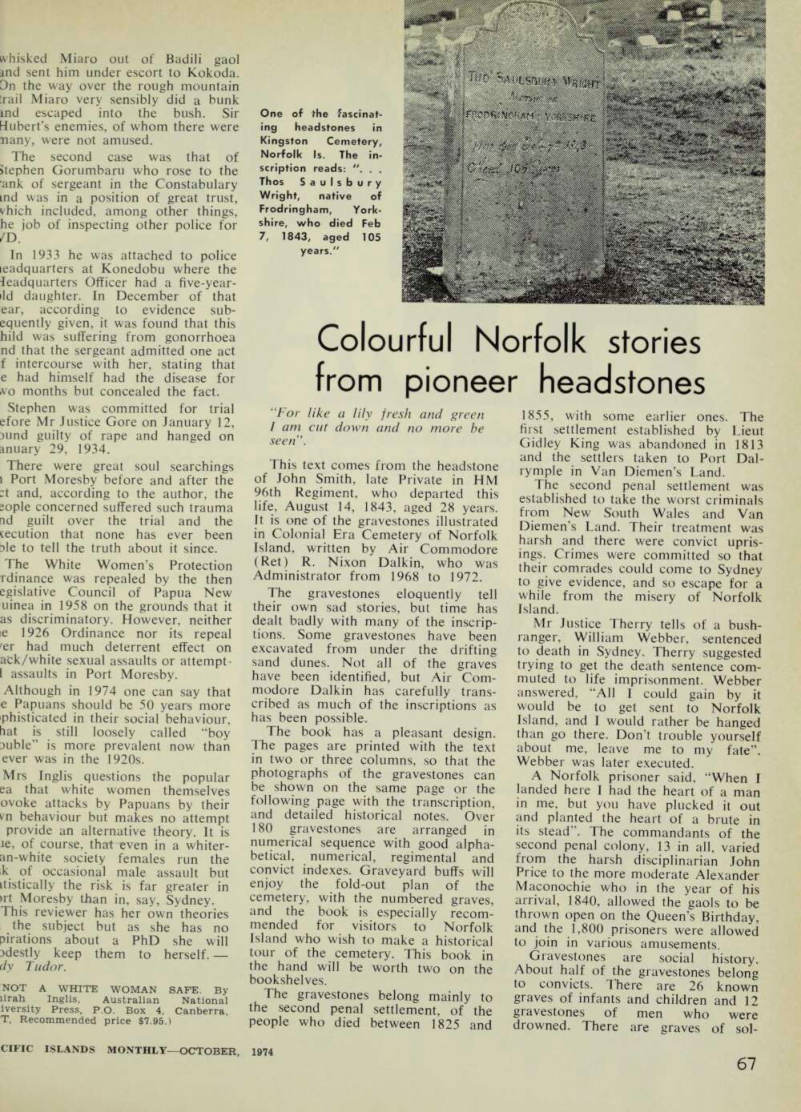
One of the fascinat ing headstones in Kingston Cemetery, Norfolk Is. The in scription reads: ". . .
Thos Salisbury Wright, native of Frodringham, York shire, who died Feb 7, 1843, aged 105 years."
liers, overseers and their wives and amilies such as Susanna Pery, wife
if Agricultural Superintendent Pery
nd their daughter, Susanna. The nly known gravestone of a female onvict belonged to Sarah Gregory, rom the first settlement period, and 3e ‘S’s on her tombstone are carved 1 reverse.
Thomas Saulsbury Wright, known s “Tommy the Banker”, was first onvicted in 1799 for forging and ounterfeiting a bill of exchange at oroughbridge in the County of r ork, and was sentenced to death. He rrived in Sydney in 1801 at the age f 62 years to serve a life sentence, [is name is in the 1828 Census aged 2 years. In 1839 he was sent to Nor )lk Island for 14 years and died in 843 at the age of 105 years!
This is a timely book because it Dincides with the celebrations of the Quble centenary of Captain Cook’s iscovery of Norfolk, this October.
Iso inscriptions on gravestones tould be recorded while it is still Dssible to do so, and it is nice to :e a book of gravestone inscriptions hich is at the same time pleasant to :ad and handle. —Margaret Woodhouse
(Colonial Era Cemetery Of
DRFOLK ISLAND, by R. Nixon Dalkin. iciflc Publications (Australia) Pty Ltd, O. Box 3408, Sydney, $6.) • The latest UK official hand x)k, Britain 1974, is now available, opies can be obtained from the ustralian Government Publications ffice, 309 Pitt Street, Sydney. Price $4.80 plus postage.