The Cut-Off District
p. 67 · Read in the full issue
By John Antonio
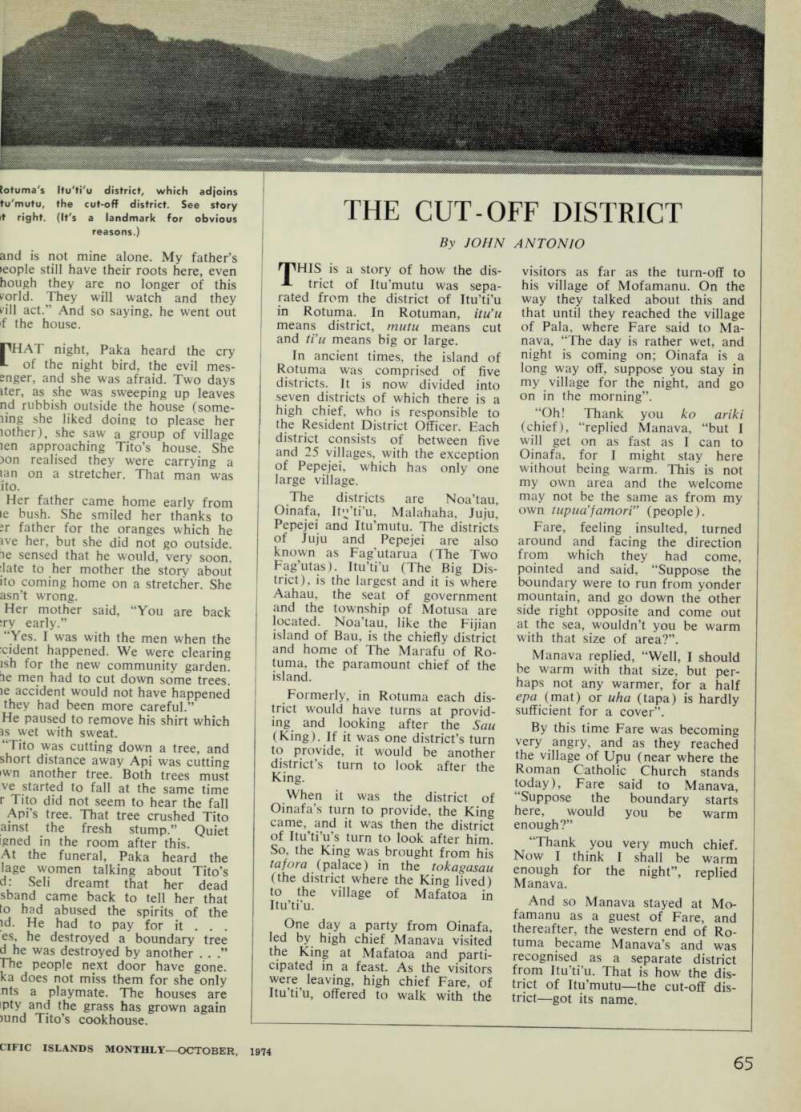
fPHIS is a story of how the dis trict of Itu’mutu was sepa rated from the district of Itu’ti’u in Rotuma. In Rotuman, itu’u means district, mutu means cut and ti’u means big or large.
In ancient times, the island of Rotuma was comprised of five districts. It is now divided into seven districts of which there is a high chief, who is responsible to the Resident District Officer. Each district consists of between five and 25 villages, with the exception of Pepejei, which has only one large village.
The districts are Noa’tau, Oinafa, Malahaha, Juju, Pepejei and Itu’mutu. The districts of Juju and Pepejei are also known as Fag'utarua (The Two Fag’utas). Itu’ti’u (The Big Dis trict), is the largest and it is where Aahau, the seat of government and the township of Motusa are located. Noa’tau, like the Fijian island of Bau, is the chiefly district and home of The Marafu of Ro tuma, the paramount chief of the island.
Formerly, in Rotuma each dis trict would have turns at provid ing and looking after the Sau (King). If it was one district’s turn to provide, it would be another district’s turn to look after the King.
When it was the district of Oinafa’s turn to provide, the King came, and it was then the district of Itu’ti’u’s turn to look after him.
So, the King was brought from his tafora (palace) in the tokagasau (the district where the King lived) to the village of Mafatoa in Itu’ti’u.
One day a party from Oinafa, led by high chief Manava visited the King at Mafatoa and parti cipated in a feast. As the visitors were leaving, high chief Fare, of Itu’ti’u, offered to walk with the
visitors as far as the turn-off to his village of Mofamanu. On the way they talked about this and that until they reached the village of Pala, where Fare said to Ma nava, “The day is rather wet, and night is coming on; Oinafa is a long way off, suppose you stay in my village for the night, and go on in the morning”.
“Oh! Thank you ko ariki (chief), “replied Manava, “but I will get on as fast as I can to Oinafa, for I might stay here without being warm. This is not my own area and the welcome may not be the same as from my own tupua'jamori" (people).
Fare, feeling insulted, turned around and facing the direction from which they had come, pointed and said, “Suppose the boundary were to run from yonder mountain, and go down the other side right opposite and come out at the sea, wouldn’t you be warm with that size of area?”.
Manava replied, “Well, I should be warm with that size, but per haps not any warmer, for a half epa (mat) or uha (tapa) is hardly sufficient for a cover”.
By this time Fare was becoming very angry, and as they reached the village of Upu (near where the Roman Catholic Church stands today), Fare said to Manava, “Suppose the boundary starts here, would you be warm enough?”
“Thank you very much chief.
Now I think I shall be warm enough for the night”, replied Manava.
And so Manava stayed at Mo famanu as a guest of Fare, and thereafter, the western end of Ro tuma became Manava’s and was recognised as a separate district from Itu’ti’u. That is how the dis trict of Itu’mutu—the cut-off dis trict—got its name.