Neighbours
pp. 64-67 · Read in the full issue
The New
By Makereta Manueli
She was on her way out of the door when her mother said, “Where are you going, Paka?”
“Just outside to play,” Paka replied quietly, hoping her mother would not ask her to stay inside the house.
“Well, don’t play out in the sun,” was all her mother said.
With a quick yes, she ran out and down to the well where they drew washing-water and bath water from.
She walked round the well singing a song she had learned at school. With a child’s perception she knew her mother would not call if she could hear her. At the end of her song, she ran out onto the road and, with a quick glance at the house, she walked rapidly away, heading for her friend’s house at the other end of the village.
The road ran behind the cluster of houses in their brown thatch. A few of the houses had given way to white washed cement cottages and little wooden buildings. It was mid-morning and a few women were still sweeping
up leaves and rubbish around their houses.
Some would call out the expected: “Where are you off to?”, and she would reply, with a little movement of the head, “Just over there.”
Every time she made this trip to her friend’s house she was asked the same question, and she never changed her reply. This exchange had come to mean nothing but a way of greeting a little child, and Paka knew that the question was not asked out of curio sity.
On arrival at her friend’s house, she was told by the mother that her friend had gone with the others to the bush to fetch fruit. She turned and returned home quickly.
PAKA heard the sound of a truck as she neared her home, and she was astonished to see the truck slowing down and turning m to their compound. Excitement and cunosi y put speed to her little legs and she
! be track - before she cached it, she could see that it was oaded with family belongings, but it f?- r then ? f ? r * he ? aw a hP frnrt B H g K OU i ° f f he of l°V he h 9 us <: ext door which, so far had remained £nn!; UP h e H aka t° Ped ; that u ,f th u Se >eople had come to stay, they had tt.,V ittle gir ‘ W ‘ th Whom she PtTiro Io A tv, * i J . he rahin P !f P ,! d mt ° ?hnm b e “f° llowei J ‘he man hihMinm I dr J Ver c /!l ed u TIt °’ ight u p to the back door of the house. he could find no little friend. Inside be house was a woman who, she saw, 'as as old as her own mother. The 'Oman was nursing a baby She turned away in disappointment nly to find herself looking at the fiddle of the thin old woman who 'as sitting in the cabin of the truck he old woman rasped out in a thin Dice, “Who are you child*?” She »oked up at the old woman’s face nd. answering, turned and ran across le stretch of grass to her home. Her lother was coming out of the house.
“Where have you been? 44 her lother asked.
“From that house,” Paka answered, finting at the new family’s house! ooking again at her mother, she id, “Where are you going?” ’
Her mother started to walk away ymg, “Come with me.” ’
Paka saw that her mother was headg for their new neighbours 4 house, id she dm not follow mother. She t in the shade of their house and irted playing with fine round little Dnes, waiting for her mother to urn ’ . , , INh night, about two months later, Paka and her parents were sitting fir C ? a * n f , arter of their house f r t thei r supper, when some- ' d °Vi 16 wooden frame of e open door. They looked round to
see Tito lowering himself onto the doormat, which was only a sack folded in two.
Without stirring from his chair, the one and only comfortable chair in the house ’ had a canvas back rest), Paka’s father said, “Come right in Right in * There ’ S a chair here for you ”
Tito advanced further in but sat down on the mat on the floor. “I have come to you ’ my mother’s relation.
I have a little need.” He looked up for a moment at Paka’s father, and then brought down his gaze to his folded hands resting immediately in front of him on his crossed legs. V
n,i„ / , f
, ka s P af cnts understood that Tito had i ome s P, me serious busi ‘ Fr ° m h i?. mble manner. Paka’s ! ather gl f, s ? ed J lto needed to a * k a hlm ‘ l* er paren * s abandoned Ir cbairs and sat , on the floor Wlt h / lto ., in acknowledgement of his humbleness.
Paka stopped her playing to watch Tito. She dec i de d she did not like the man — be was not Bke her father; he bad a Beard and there was a fierce look about him, and his low harsh v °i ce added to the quality of sup- Pressed violence that Paka sensed, Sbe to ° abandoned her place to sit close to her mother.
The next morning Paka asked her mother, “Why did Tito came to father in the night, mother?”
Her mother parried with another question, “Why do you want to know? You are too small to question the doings of older people.”
“I don’t like him,” said Paka.
“Sh! Tito is your father’s relative, a distant cousin. And you must not talk like that.” She paused and then asked, “Why don’t you like him?”
“Because he looks like a bad man.”
Her mother gave a little laugh and told her to take her stones and play outside in the shade.
TITO’S house stood on a raised stone foundation and there was not enough room on that raised foundation for another house, even a little one, and so Tito built his kitchenette and cook-house on land borrowed from Paka’s father.
About two weeks after the comple tion of the kitchenette and cook-house, Paka and her parents cleaned up their compound. Father cut the grass with his cane-knife and mother swept up the grass cutting into piles. Paka col lected the grass cutting in a basket.
Every time she made a trip to the rubbish dump, she had to go past Tito’s house. She made many trips because her basket was small and there were many piles of grass cut tings to cart away.
On one of her return trips, she saw Tito’s mother, the old woman, work ing on the grass outside their little kitchenette. She stopped to watch. The old woman did not swing the cane knife like her father did. (She pro bably couldn’t.) The old woman just pushed the knife forward into the soil and pulled out the grass by the roots.
Paka started to move away when the old woman started talking in her wavering high voice, "1 do not know why your father lets the grass grow, my child.”
Her misshapen fingers, looking more like claws, tugged at the grass and, when it came out by the roots, she continued: “Let the grass grow, my child, and you give the family a lot of work. Every month the grass must be cut . .
Paka watched the patch of sand grow as the old woman worked.
Shaking sand from the grass, the old woman went on, “Then the rubbish must be swept up. This grass always
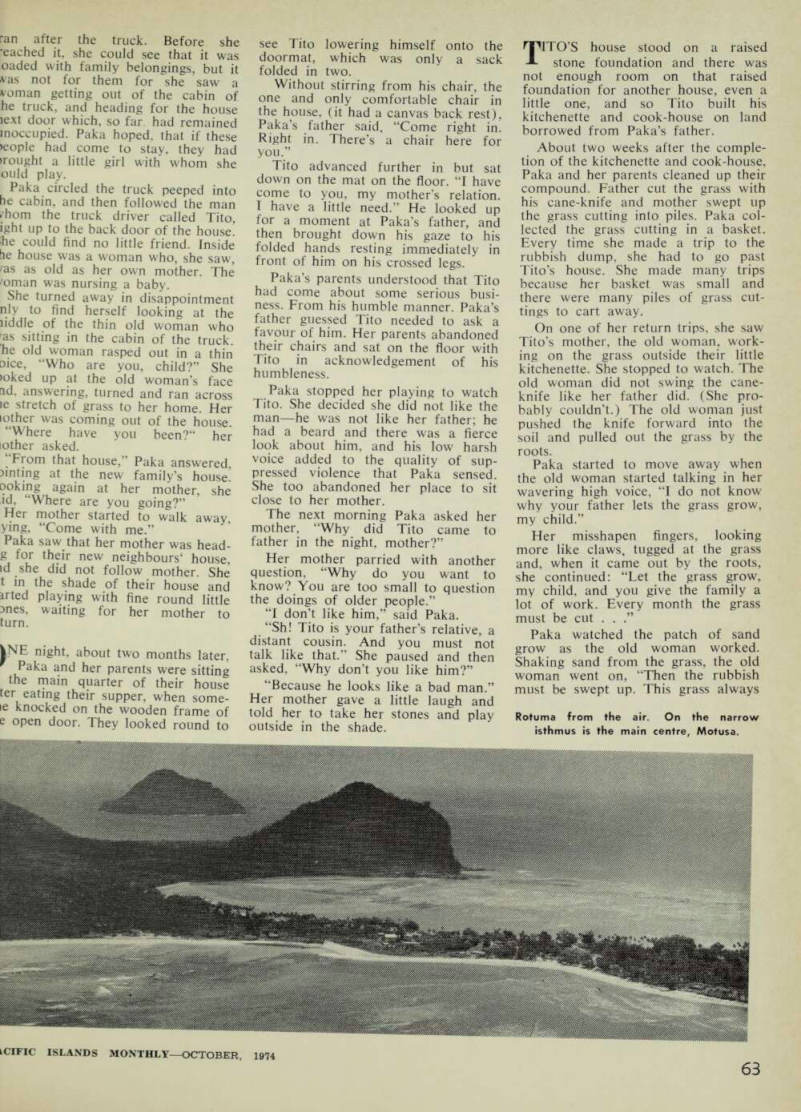
Rotuma from the air. On the narrow isthmus is the main centre, Motusa.
looks ugly and is worse when long.”
Paka stopped taking in those words as she moved away, the old woman’s high voice fading.
That very afternoon, Tito cut down some large branches from one of the big trees, the one nearest his cook house. The branches made ideal fire wood and they burned even when still raw. Paka’s father returned from feeding his animals and went across to Tito’s place.
“Tito, I want to make it known to you that those boundary trees are not to be touched. They have been there ever since I can remember, and we have never touched them.”
“Yes, but during strong winds branches may break off and damage my houses,” Tito said.
“The tree is not yours to do what you like with. These boundary trees were planted by my great-grandfather.
I do not want you to take into your hand the trimming of the trees.” He turned away, leaving Tito to stand stroking his beard.
PAKA often saw the fat old man, the village story-teller, going to Tito’s house in the evenings. The old man’s stories often raised doubts and stirred up quarrels between neigh bours; he was a good talker and could be very amusing.
One afternoon Paka came home from the village school to see an amazing sight. The big boundary tree near Tito’s house was swaying in the breeze and then it slowly came down with a big crash. She stood still and watched the bright empty space where the tree had been. That place looked different, very different, with out the tree. She turned when she heard her mother at the door.
“What was that noise?” her mother dskcd “The tree fell down”. She pointed it out for her mother to see.
“Oh!” was all her mother said. She stepped out and took Paka’s lunch can, and stood watching Tito slashing the smaller branches off with his cane knife.
“Why did Tito cut down the tree?
Paka asked.
“I don’t know, Paka.”
She looked up at her mother, smiled, and said, “That was a big crash.”
“Yes, but your father wont like it.” Then she turned and went into the house to start preparing their evening meal. She thought of the fallen tree and of what her husband would probably say.
She was transferring the boiled root vegetables onto a plate when she heard a muffled thump of a heavy object being dropped onto the ground.
She knew her husband had come home. (The sound had been made by
his dropping the baskets of root vegetables and coconuts onto the ground.) Soon after, he came into the house.
Paka came running in expectantly and her father, smiling all the while, produced four oranges out of his pockets. Taking the oranges she said, “Have you seen the tree?”
“What tree?” her father asked.
“You know, the big one,” said Pcikci “Where is the tree?”
“Near Tito’s house.”
“Well, what about the tree?”
“It fell down with a big bang.”
Paka took the oranges and one of her mother’s kitchen knives and went outside. The man turned to his wife, his eyes questioning.
She said, “Tito has cut down the boundary tree, the one nearest his cook-house. He is still working on it.”
“The fool! The lazy, go<pd-for nothing fool! Who does he think he is?” her husband exclaimed.
The woman went to the door to watch her husband striding towards Tito’s place.
He must have called, for she saw Tito emerge from the green jumble of branches and leaves.
She could not catch all that was said but she could see that both men were angry. Tito appeared to be the angrier of the two for he was now speaking in a very loud voice and> as he talked, he gestured wildly with his cane-knife. She knew that her husband would not allow the two of them to come to blows, but even so, she was afraid. She called Paka to her and they both went inside the house. , . , Soon after, Paka’s father came into
the house. He went straight to their I sleeping quarters, saying to his wife, I “He even ordered me off my own j land, ‘His piece of land,’ he said. His I piece of land. When did he come by I it, I’d like to know!” He disappeared behind the curtain and came out a J few minutes later with a clean shirt I on.
His wife asked quietly, “Where are j you going to?”
“To see the chief. Tito will not get away with what he has done. He even told me that he owned that piece of land which he borrowed only a few months ago. That his own people planted the tree.” He paused to read just the belt holding up his sulu.
His wife enquired, “Is there any truth in what he says?”
She regretted having said it when her husband almost shouted. Do you doubt me, woman? That tree is as old as the other trees on the boundary.
So it must have been planted with those other trees at the same time.
Since when did one of his people begin planting trees on other peoples boundaries?” . I Spotting his hair brush on the table, he picked it up and applied it three times to his short hair. “I know those iolly evening stories. That old goat has put these ideas into Titos head.
Who else could have made up this story of my looking after a piece ot land that is not mine?”
His wife asked. “What are you going to do to Tito?
“Nothing” he replied. “The man does not know his own history and I am not the one to help him. I just want him and his houses off my land.
But we will wait and see, for dont our people have a saying: The land has eyes and the land has teeth, inis
and is not mine alone. My father’s icople still have their roots here, even hough they are no longer of this yorld. They will watch and they yill act.” And so saying, he went out if the house.
PHAT night, Paka heard the cry of the night bird, the evil mes snger, and she was afraid. Two days iter, as she was sweeping up leaves nd rubbish outside the house (some ling she liked doing to please her lother), she saw a group of village len approaching Tito’s house. She )on realised they were carrying a lan on a stretcher. That man was ito.
Her father came home early from ie bush. She smiled her thanks to *r father for the oranges which he ive her, but she did not go outside, ie sensed that he would, very soon, ■late to her mother the story about ito coming home on a stretcher. She asn’t wrong.
Her mother said, “You are back sry early.”
“Yes. I was with the men when the ;cident happened. We were clearing ish for the new community garden, tie men had to cut down some trees, ie accident would not have happened they had been more careful.”
He paused to remove his shirt which is wet with sweat.
“Tito was cutting down a tree, and short distance away Api was cutting •wn another tree. Both trees must ve started to fall at the same time r Tito did not seem to hear the fall Api’s tree. That tree crushed Tito ainst the fresh stump.” Quiet igned in the room after this.
At the funeral, Paka heard the lage women talking about Tito’s d: Seli dreamt that her dead sband came back to tell her that to had abused the spirits of the id. He had to pay for it . . . es, he destroyed a boundary tree d he was destroyed by another . . .”
The people next door have gone, ka does not miss them for she only nts a playmate. The houses are pty and the grass has grown again >und Tito’s cookhouse.
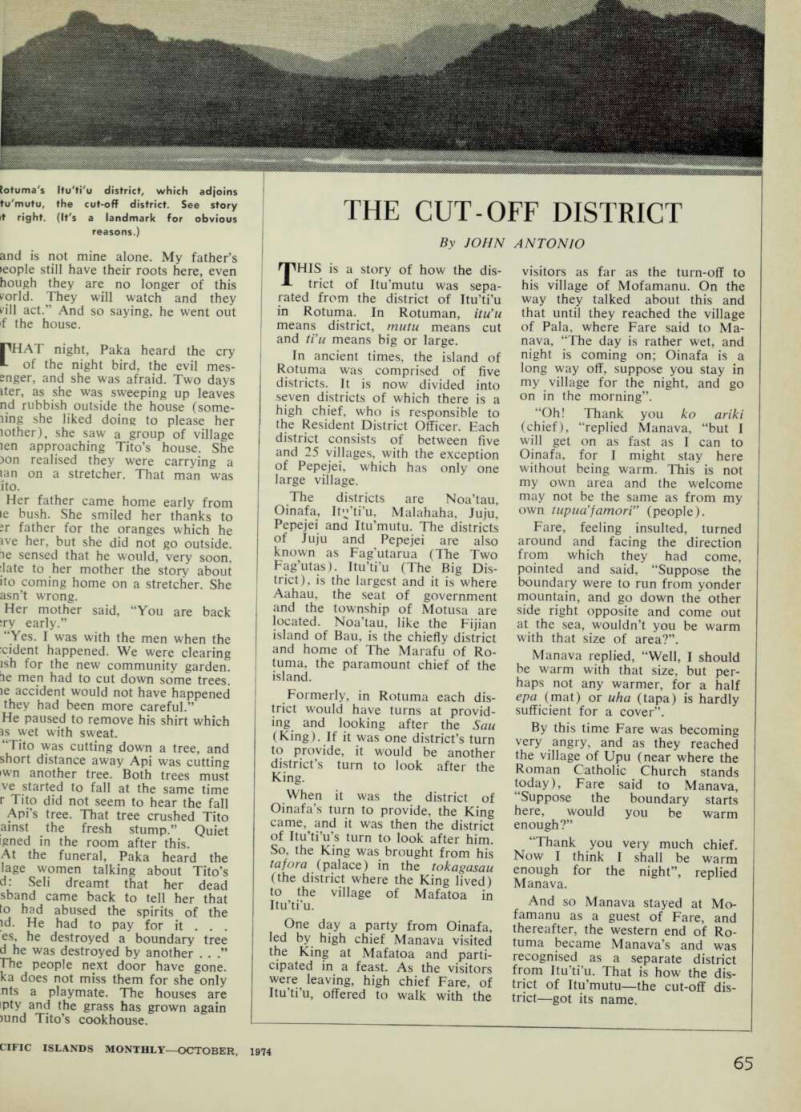
Rotuma's Itu'ti'u district, which adjoins [?]tu'mutu, the cut-off district. See story [?]t right. (It's a landmark for obvious reasons.)