Tropicalities
pp. 12-13 · Read in the full issue
Rebel newspaper folds
Noumea’s most vociferous “rebel” newspaper, Alain Bernut’s Voix du Cagou, has suspended publication, at least until 1975. The paper has for several years fed the local population a consistent diet of hard-hitting criticism of the “colonialist” policies of the local French Administration as well as attacking any personalities who have displeased the editor.
Much read and well-informed of local grievances, Bernut himself has tended to be a one-man-show and re peatedly split with his associates. A member of the Territorial Assembly, it is only in latter days that he came out as a fighting autonomist, but ap parently has been unable to work in suitable collaboration with other autonomist leaders.
It was announced recently in Nou mea that his weekly was under police investigation. At that time front page cartoons had been directed at the strong-man tactics of French Governor Eriau. One cartoon depicted a portrait gallery featuring pictures of Hitler, Stalin and Eriau. Another caricature depicted a head, resemb ling Eriau and backed up by a bat talion of armed militia.
Among recent incidents, following the governor’s banning of a July pub lic meeting planned by the militant Union of Caledonian Youth (UJC), Bernut’s paper widely publicised the sending of protest letters to overseas organisations, including the French Society for the Rights of Man.
Following this, in early September, Governor Eriau authorised the UJC to hold a public meeting to protest against rising prices, unemployment of Caledonians and racial discrimina tion as well as to call for a “Cale donian nation”. However a proposed march to the centre of town was banned.
As far as the Caledonian Youth claims over unemployment of locals, particularly Melanesians, is con cerned, figures are fairly inaccessible since the Melanesians are usually
readily absorbed back into tribal liv ing. On the rising prices issue, how ever, local authorities are aware of the situation and expect that con sequent wage and salary increases on the island this year could be around 25 per cent.
Finally, on the political front, the new French Minister for Overseas Territories, Mr Olivier Stirn, is ex pected to arrive on November 21 for a visit to New Caledonia. At a time when Paris is showing an increasingly firm hand in the territory and when many Caledonians’ livelihood depends directly or indirectly upon the co operation, if not the favours, of the French Administration, the Minister will face a situation where the auto nomy game seems well under control.
Plenty of room
on Pitcairn
The population of Pitcairn Island has dropped to 66, the smallest figure for many years. It is now difficult to get enough men to man the long boats when a ship stops off the island.
But there are no immediate plans for abandoning the island, Tom Chris tian, the radio engineer, reported in a recent message to the Voice of Prophecy International Radio Pro duction Centre of the Seventh-day Adventist Church in Glendale, Cali fornia.
He reported he would like to build a new house to replace the older one he is living in, but is hold ing off till the island’s future is more settled. He hopes the population will build up, and the island will continue to be inhabited.
The island is now visited by ships from the UK about every three
months. This has seriously jeopard- ,| ised the economy of the island. In ! the 1960 s between 60 and 70 ships! a year would stop off the island. The i ships are the main source of income, . as the passengers buy the islanders’l souvenirs and handcrafted items.
Medical problems have caused a j number of people to leave the island.!
There is no doctor, nor is there a j hospital. Young people leave to fur-| ther their education.
In 1936, Pitcairn had a population I of 200. Twenty years later the figure was down to 161. It dropped to 1521 in 1957, and in 1963 it was down to 86. There was a slight rise, to 90, in 1 1964, but by 1968 it was down to I 76, and the present figure of 66 is I expected to drop away in the next! few months as more people leave. J
New Caledonia’s
aililt'tfie mill
A 46 year-old French nun was! among those who took part in the latest “Operation Guam”, a massive! foot-race organised in Noumea ini August to raise further funds for New Caledonia’s team going to the forth-j coming sth South Pacific Games in Guam.
Keenly applauded by her young > pupils, Sister Marie-Stephane enthusi-1 astically joined some 3,000 parti-j
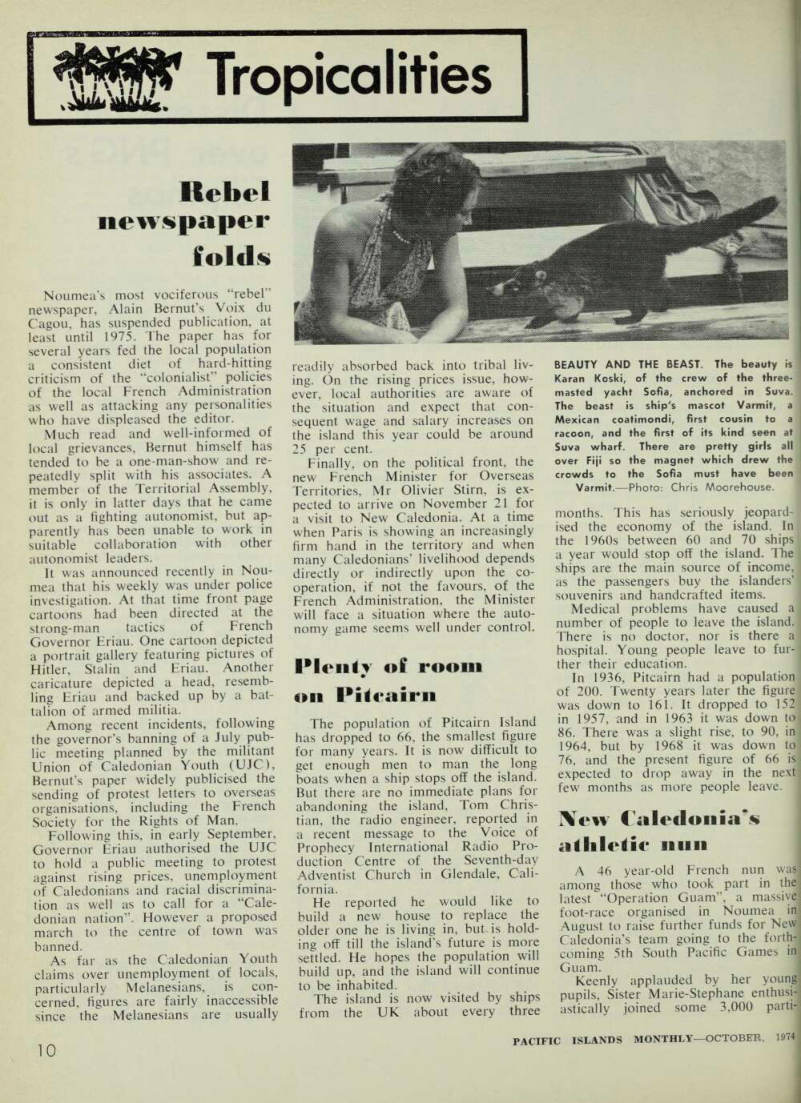
BEAUTY AND THE BEAST. The beauty is Karan Koski, of the crew of the three masted yacht Sofia, anchored in Suva.
The beast is ship's mascot Varmit, a Mexican coatimondi, first cousin to a racoon, and the first of its kind seen at Suva wharf. There are pretty girls all over Fiji so the magnet which drew the crowds to the Sofia must have been Varmit. — Photo: Chris Moorehouse.
ipants divided into 12 categories to in their various courses around the lagenta aerodrome and sporting adiums.
Raising funds for sport has become uite a popular pastime in Noumea, here high school boys and girls re sntly challenged their teachers, men id women, to a cycling race. Entry ;es in this case were donated towards ipporting the annual round-New aledonia Tour Cycliste bicycle trial, hich in September again attracted itrants from France, Australia and ew Zealand.
lello dad
ind goodbye
A father, 92, and a son, 60, met •r the first time for 43 years for a ere 20 minutes at Tonga’s Vavau rfield recently.
New Zealander, George Raymond /den, settled at Vavau many years ;o, running a plantation and a store, is wife took their three sons back New Zealand in 1931 for school g. Time passed, Mr Lyden took the mgan name of Peti Faiteni, and a ingan “wife” and brought up an her family.
Early in August, his son John, on Pacific cruise from Auckland, was Nukualofa for a day. He made up s mind to see his father, so boarded Tonga Tourist and Development Co rcraft, bound for Vavau. The pilot, aptain Adrian Barralet, set up the eeting, with some difficulty, over s radio, Mr Lyden, Sen, or Peti iiteni, living the life of a semi cluse near Neiafu, agreed to come the airstrip only on condition the n paid the taxi fare. Five minutes
The son (left) meets his old dad at Vavau. after the plane landed, the father’s vehicle drew up. Father and son shook hands, talked for 20 minutes.
The son was then off again to rejoin the cruise ship.
Peti Faiteni remarked afterwards, “When you get to 90, life holds few surprises”. But there were a number of surprised people on Vavau that day. They were surprised to see him alive. He was so much out of touch with the local community that many people presumed him dead.
Won mea’s
Avenue Cook
Anglo-Saxon visitors disembarking in the Port of Noumea should now feel more at home in their French surroundings when greeted by the street sign Avenue Cook, erected in September on what was formerly known as Nouville Causeway (Digue de Nouville), linking Noumea to the offshore island of Nou.
The new street sign is accompanied by a monument to Captain James Cook, who “discovered” New Cale donia in September, 1774. The monu ment consists of a coral-encrusted anchor, laid on a concrete base covered with nickel and is installed outside the port’s new tourist recep tion pavilion (Gare Maritime).
The Cook memorial was finally a local effort, not sponsored by Anglo- Saxon interests as the French had earlier suggested. Preparations in volved the efforts of the French Navy and a private engineering company (CITRA) who salvaged the rusty old anchor from the coral reefs of the
west coast. The base upon which it rests includes 36 triangular blocks of nickel metal weighing a total of tons and poured at the SLN’s Nou mea smelters.
A bronze plaque commemorates the bi-centenary of Cook’s discovery of New Caledonia, all of which serves to link the beginnings of European settlement in the South Pacific islands.
Kaaiio wants to
kee|) its wreck
The Melanesian Tourist Federation wants the wreck of the President Coolidge, stranded underwater on a reef in Santo Canal in World War 11, preserved as a tourist attraction. The federation, when it learned recently that attempts would be made to salvage the ship, wrote to the Resi dent Commissioners, asking them to have legislation enacted to preserve and control war relics.
The federation considers the wreck is a valuable asset to Santo’s growing tourist industry. Overseas tour pro moters, who arrange diving trips, say the ship should be declared a national monument. One promoter called it one of the “great underwater ship wrecks of the world”. The federation recognises the pollution danger from leaking fuel tanks, but says this prob lem can be overcome by pumping.
IHII-pickles
Social note from the September 13 issue of the Arawa Bulletin, Bougain ville: “For all those people who went to the cocktail party for the Dutch Ambassador, his name is not Mr Pickled Herring but Mr Pekel Haring”,
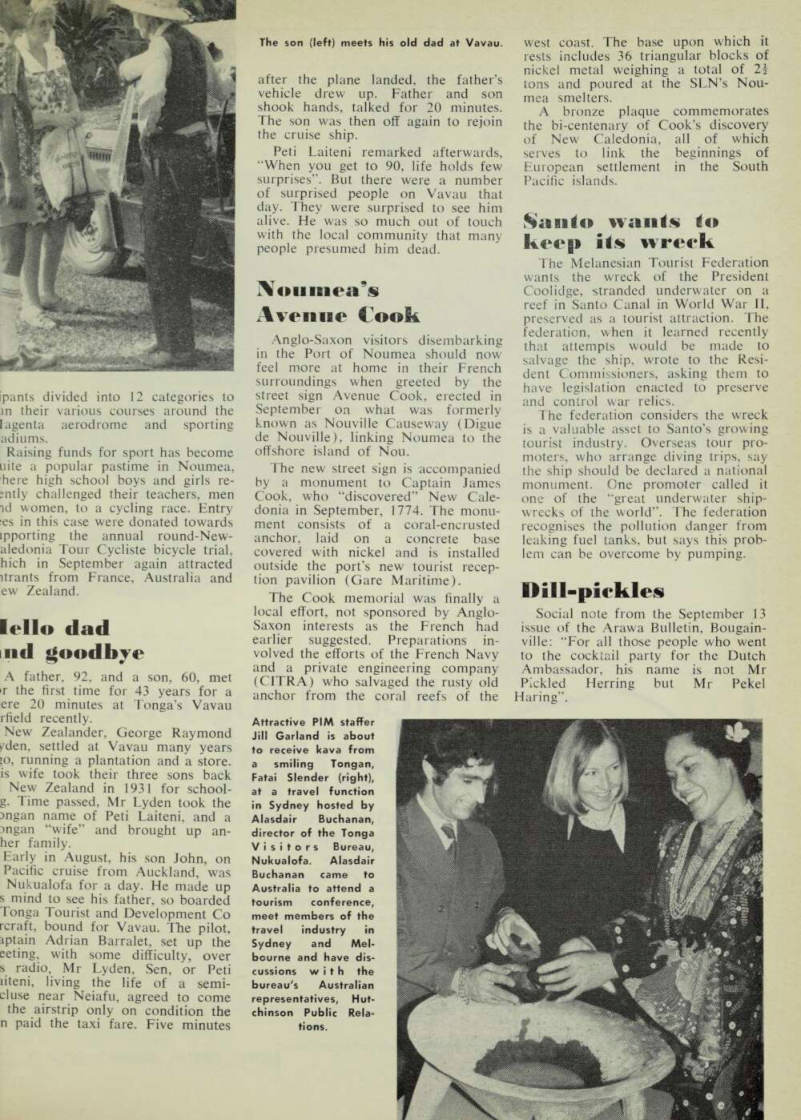
Attractive PIM staffer Jill Garland is about to receive kava from a smiling Tongan, Fatai Slender (right), at a travel function in Sydney hosted by Alasdair Buchanan, director of the Tonga Visitors Bureau, Nukualofa. Alasdair Buchanan came to Australia to attend a tourism conference, meet members of the travel industry in Sydney and Mel bourne and have dis cussions with the bureau's Australian representatives, Hut chinson Public Rela tions.