Filipinos
p. 11 · Read in the full issue
Dissension over PNG's Filipinos
rHE scheme to use Filipinos in Papua New Guinea to fill the acuum left by departing professional Australian expatriates has run into un xpected snags and raised the ire of be PNG Public Service Association
Psa).
The government is also embarrassed y a number of Filipinos who have efused to work in rural areas and ave been sent home.
The PSA has described the Filipino rofessionals as being third-rate and lleged that the 300 in Papua New iuinea on contract are being pam ered.
Mr Jacob Lemeki, general secretary f the PSA, which represents about 0,000 government employees, threat ned that his association would do 11 in its power to stop any govern lent move to improve salaries and Dnditions of employment of Filipinos ntil the urban workers’ wage is im roved.
He said the Filipinos were being aid higher wages than their New uinean colleagues, were refusing to ork in rural areas and were being ven free transport to and from their ork.
“The association will no longer derate the continuing insult by the jvemment which ignores the prob ms of the people of this country hile it continues hand-outs to •reigners who are nothing but third ite public servants in their own luntry,” he said.
“Such treatment is nothing but an suit to the national public servants id workers in the private sector, who ive to rely on public transport and e often disciplined when they are te for work.”
Mr Lemeki alleged that the lipinos, recruited three months ago,
had very little interest in Papua New Guinea and had taken the opportunity to come to Papua New Guinea as they regarded it as a jumping-off place for migration to Australia.
The PSA made it clear at the out set to the Public Service Board that recruits from a developing country should not be paid more than they would get on returning to their own country. They should be paid at the same rate as PNG nationals.
A spokesman for the newly-formed Filipino Contract Officers Association described Mr Lemeki’s attack as saddening but refused further com ment.
Later, however, Mr Tony Casimiro, a Filipino electrician with the Public Works Department, speaking for his group in Rabaul, said Filipinos’ skills were for sale on the market the same as any other commodity. Papua New Guinea had bought or hired those skills because they were the cheapest for the available price. He was sure Papua New Guinea would have had to pay more for the same quality skills in other countries.
“We may be new in this country,” said Mr Casimiro, “but we realise that Mr Lemeki’s attack is only partly against us. We are the pawns in his attacks against the Public Service Board and the government.”
Dealing with the allegation that they were using PNG as a jumping off place for migration to Australia, Mr Casimiro said the majority of Filipinos in Papua New Guinea wished to save money and had no intention of migrating to Australia.
In any case it was none of Mr Lemeki’s business once the recruits had completed their contract obliga tions.
“We want to work and fulfil our
From a Port Moresby correspondent
obligations and to help by teaching Papua New Guinea nationals to achieve a better life and to build a nation where all men are equal and live in harmony regardless of race, colour or creed,” he said.
The Minister for National Develop ment, Mr Gavera Rea, defended the recruiting scheme and said, two days after Mr Lemeki’s attack, that Fili pinos could provide valuable assistance in areas where New Guineans were not at present available. He felt strongly that, in the future, with training and experience New Guineans could undertake any of the jobs now being held by Filipinos.
He said he agreed with Mr Lemeki that more Filipinos should be assist ing in rural areas and that they should have the same conditions as other public servants as far as travel to and from work was concerned. There was a need, however, for the assistance of Filipino workers at this stage of the country’s development.
Back came Mr Lemeki with the statement that Mr Gavera Rea should study the facts before championing a dubious cause. If the minister looked hard enough he should be able to learn for himself that the Transport Authority local staff had already threatened to take industrial action because transport was not provided for them. Filipinos were better paid than the drivers, yet they had free transport.
Was that, he asked, part of the incentive scheme to obtain Filipino workers and at the same time deny the facility to PNG’s own public servants.
Meanwhile, the Philippines Govern ment has opened a consulate in Papua New Guinea to look after its nationals’ welfare while serving in PNG. Consul is Mr Ruben Mendosa.
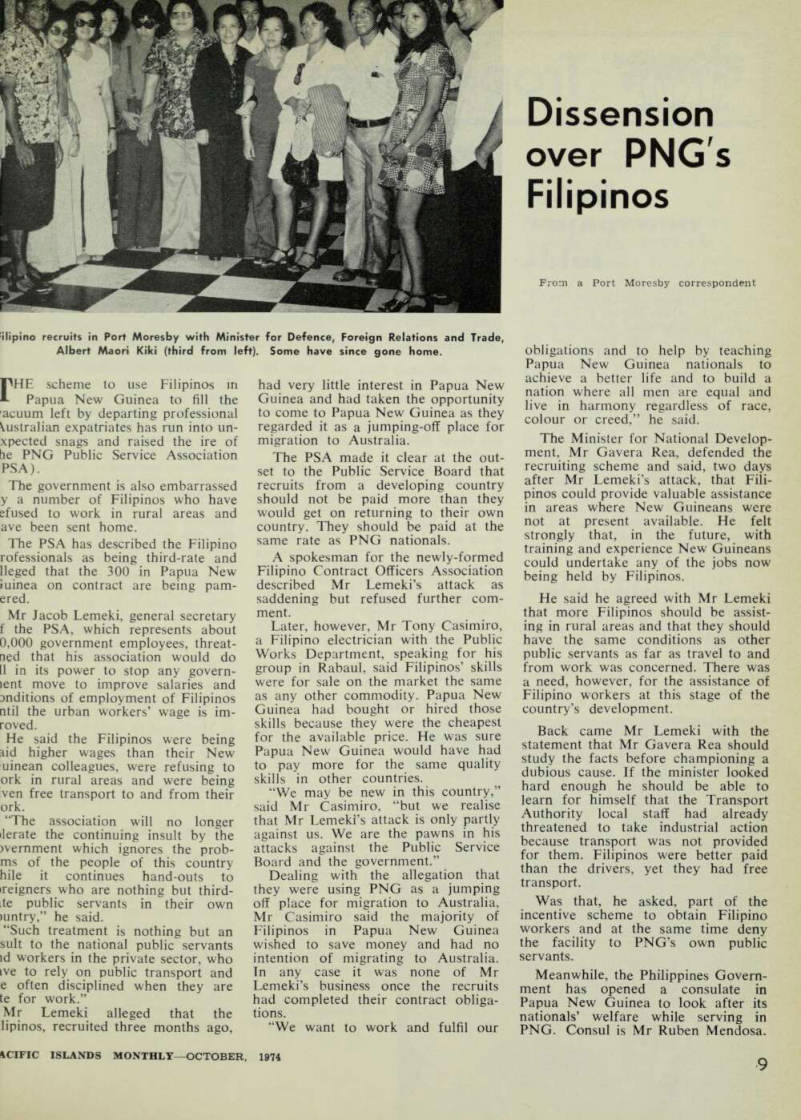
[?]ilipino recruits in Port Moresby with Minister for Defence, Foreign Relations and Trade, Albert Maori Kiki (third from left). Some have since gone home.