Books, Reviews, writers
pp. 69-71 · Read in the full issue

Bicentenary Recollections Of
Cook & Co's Caledonia
The French have suggested allow ing the English to build a memorial in New Caledonia to Captain Cook, who “discovered” the island in 1774.
Ironically, the suggestion is made at a time when Paris is seeking to at tract Anglo-Saxon visitors to New Caledonia as a showcase of French culture in the Pacific. The idea is launched in a book just published in Noumea to coincide with the bi centenary of Cook’s discovery in September.
The Discovery of New Caledonia (La Decouverte de la Nouvelle- Caledonie), a collection of documents presented by Georges Pisier, a former French public servant on the island, is published by the Historical Society of New Caledonia to honour Cook’s discovery voyage aboard the Reso lution. It was Cook’s second time sailing around the Pacific: after Tonga, then the New Hebrides, he was en route for New Zealand when midshipman James Colnett sighted land at Balade, near the north-east tip of New Caledonia.
Pisier presents the adventure through translated accounts of six men aboard, ranging from the captain to astronomer, botanists and an ordinary seaman.
The Resolution spent just under four weeks in Caledonian waters, with only one week actually in con tact with the local Melanesians. Con sidering that most of the remaining time was spent navigating at sea, often in peril of shipwreck on the reef and severely short of fresh pro visions, present-day tourists, whose main concern tends to be for currency
and consumer comfort, must marvel at the perceptive observations of their predecessors 200 years ago.
How much of Cook’s experience can still be shared by today’s traveller to New Caledonia? Well, even with a navigator better-equipped than Cook, he could actually end up on the reef. But, apart from that dis traction he could still fall victim, like Cook, to the unpleasant effects of la gratte, or fish poisoning. He could also still find traces of the weapons, houses, food, agricultural methods and outrigger fishing pirogues used by the Melanesians.
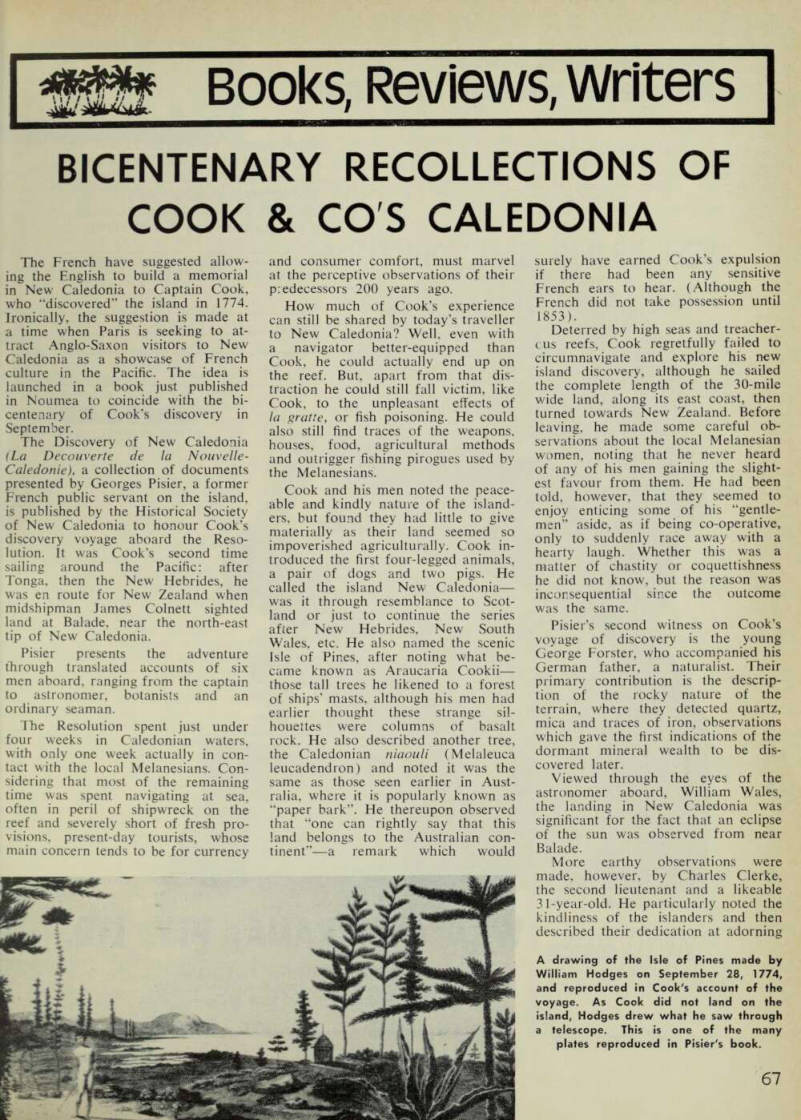
Cook and his men noted the peace able and kindly nature of the island ers, but found they had little to give materially as their land seemed so impoverished agriculturally. Cook in troduced the first four-legged animals, a pair of dogs and two pigs. He called the island New Caledonia— was it through resemblance to Scot land or just to continue the series after New Hebrides, New South Wales, etc. He also named the scenic Isle of Pines, after noting what be came known as Araucaria Cookii— those tall trees he likened to a forest of ships’ masts, although his men had earlier thought these strange sil houettes were columns of basalt rock. He also described another tree, the Caledonian niaouli (Melaleuca leucadendron) and noted it was the same as those seen earlier in Aust ralia, where it is popularly known as “paper bark”. He thereupon observed that “one can rightly say that this land belongs to the Australian con tinent”—a remark which would
surely have earned Cook’s expulsion if there had been any sensitive French ears to hear. (Although the French did not take possession until 1853).
Deterred by high seas and treacher cus reefs, Cook regretfully failed to circumnavigate and explore his new island discovery, although he sailed the complete length of the 30-mile wide land, along its east coast, then turned towards New Zealand. Before leaving, he made some careful ob servations about the local Melanesian women, noting that he never heard of any of his men gaining the slight est favour from them. He had been told, however, that they seemed to enjoy enticing some of his “gentle men” aside, as if being co-operative, only to suddenly race away with a hearty laugh. Whether this was a matter of chastity or coquettishness he did not know, but the reason was inconsequential since the outcome was the same.
Pisier’s second witness on Cook’s voyage of discovery is the young George Forster, who accompanied his German father, a naturalist. Their primary contribution is the descrip tion of the rocky nature of the terrain, where they detected quartz, mica and traces of iron, observations which gave the first indications of the dormant mineral wealth to be dis covered later.
Viewed through the eyes of the astronomer aboard, William Wales, the landing in New Caledonia was significant for the fact that an eclipse of the sun was observed from near Balade.
More earthy observations were made, however, by Charles Clerke, the second lieutenant and a likeable 31-year-old. He particularly noted the kindliness of the islanders and then described their dedication at adorning
A drawing of the Isle of Pines made by William Hodges on September 28, 1774, and reproduced in Cook's account of the voyage. As Cook did not land on the island, Hodges drew what he saw through a telescope. This is one of the many plates reproduced in Pisier's book.
one particular feature of the anatomy, the organ peculiar to the male sex which received every article of deco ration. Clerke says he offered a man a stocking and it was immediately drawn over this spot. A bead neck lace, offered next, was used to attach the stocking, while a souvenir medal lion was applied to the same location, with apparent disregard for the nakedness of the rest of the body.
It is with the observations of the Swedish doctor and botanist aboard, Anders Sparrman, that the reader obtains some comparisons with French experiences at Balade 19 years afterwards, since the Swede wrote later and was then familiar with the 1793 voyage of d’Entre :asteaux. This leads to discussion of the cannibalistic practices of the Caledonian indigenes.
Such practices were not generally suspected by the English and they re :all the shocked retreat of islander :ompanions who found them eating from a bone of beef and could not be persuaded that it came from a four-legged animal. On the other band, the ship’s doctor, Mr Patten, found the islanders expressed quite appreciative interest in his well-fat ;ened arms and calves.
Pisier’s final witness to the dis :overy of New Caledonia is second junmaster John Marra. This young Irish seaman’s most dramatic me mory is almost a whole day the ordinary seamen spent taking two aour shifts at the oars of two boats, vhich were lowered over the side and used to row the Resolution away Torn the reef, against a heavy swell vith no wind.
Most of Pisier’s reference docu nents were located in London, Paris and Sydney and included recent writ ngs of New Zealander J. C. Beagle aole. The main intention of Pisier and his publishers was to make available to French readers some of he wealth of observations on early Vew Caledonia contained generally n English sources.
In New Caledonia itself Pisier ound few traces of Cook’s passage, either verbal or material. He did, aowever, find records and hand drafted objects from the expedition at the Australian Museum and Vlitchell Library, in Sydney, which s where Caledonians have tradition ally entrusted material they wished
to have safely guarded for posterity.
Efforts are now being made in Noumea to have the Caledonians make articles available for safe-keeping by local French authorities.
Pisier also suggests that the Eng- “ authorised to erect in New Caledonia a monument to Cap tain Cook which would be a way of returning the courtesy allowed to the French when they built their menu- ,•/ t “ ment to navigator La Perouse at bydney S Botany Bay.
Actually, suggesting that the Eng lish should come and build a monu ment to Cook seems to be a clever French way of inviting English enter prise to subsidise the promotion of Caledonian tourism.
Helen Rousseau.
(la decouverte de la nouvelle- CALEDONIE, presented by Georges Pisier, Published by Societe d'Etudes Historiques de la Nouvelle-Caledonie, P.O. Box 7, Noumea 1974, 196 pp with charts, portraits and photographs. No price indicated.)