Caledonian-style
pp. 13-103 · Read in the full issue
Storming the Bastille Caledonian-style
From a Noumea correspondent If July 14 is specially remembered i Tahiti for the gaiety of hip vinging dancers, it seems that Nou lea is really getting closer to the riginal spirit of the French national ay with real-life re-enactments of ic storming of the Bastille—that old rench challenge to authority.
The events sparking off the Nou lea incidents centred on protests om the Territorial Assembly and ic trade unions over staggering rises the island’s cost of living and the ss of jobs by Caledonians who feel asted by metropolitan French, seme mes better qualified recent arrivals, 'ten including former military men • wives of army and public officials.
One target of the rising storm was ;parting Secretary-General, Michel svallois, second to the governor as ;ad of the French public service on e island and representative of the wernor at debates of the Territorial ssembly. Four bullet holes were iund in Levallois’ Noumea residence i July 19. A week later, attempts ere made to fire a building occu ed by other top French officials.
While the instigators of these acts ere not immediately known, it must 5 explained that by now most in icntial Caledonians have been rectly or indirectly persuaded by e French administration not to ruggle for local political responsibil /, but to be content simply with aking money and leaving the werning decisions to Paris. This eans the only real forces left ittling for autonomy are the lesser iid workers and Melanesians.
Nevertheless, the Assembly major f by 17 to 15 voted in June a fur er demand for internal self-govem ent. The French President and ime Minister both acknowledged re ipt of this motion, whereupon, to ark July 14, the same three parties cided to send their joint project r autonomy to the Paris authorities.
Meanwhile, as the bitter resentment ntinued over rising unemployment, e island’s largest party, Union aledonienne, was reportedly accused “fascism” by Mr Levallois, during i assembly debate demanding prior r for jobs to Caledonians. In reply, e party asked what kind of “ism”
should be applied to a “represent ative of the administration who criticises and opposes the propositions put forward by the representatives of the people?”
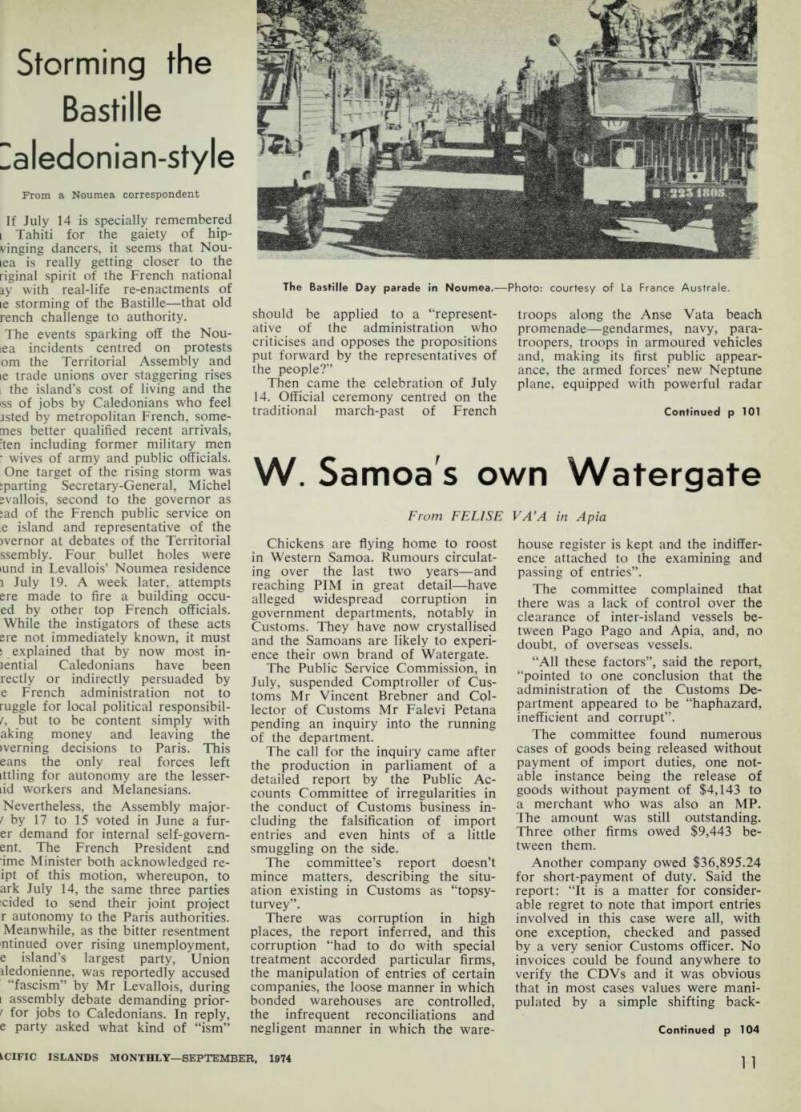
Then came the celebration of July 14. Official ceremony centred on the traditional march-past of French
troops along the Anse Vata beach promenade—gendarmes, navy, para troopers, troops in armoured vehicles and, making its first public appear ance, the armed forces’ new Neptune plane, equipped with powerful radar
Continued p 101
The Bastille Day parade in Noumea. — Photo: courtesy of La France Australe.
to survey the sea approaches to New Caledonia and detect submarines or other vessels.
However, amid the drinking of this holiday weekend, various disturbances resulted in clashes with the police and some $15,000 worth of damage, with smashed shop windows, battered cars and French flags torn from pub lic buildings. Governor Eriau then insisted that he would not tolerate public disturbances by “irresponsible kids”, but some locals countered that the incidents were “provoked” by the authorities. That such damage was allowed to occur, despite the number of police and others available, again suggested, as in the 1970 Naisseline affair, that the French administration must find such events useful. The whole affair was certainly timely, to frighten the locals over the auto nomists, shortly before the September senate elections.
Several days later came the bullet traces on the residence of Secretary- General Levallois. This was followed by the news conference of a visiting military chief of staff from Paris, General F. Maurin, who stated that present military strength on the island was considered sufficient, so there were no immediate plans to bring in reinforcements from the Foreign Legion. However greater mobility was required and for this purpose the Puma troop-transporting helicopters were awaited. Local army and naval installations are also to be extended at Plum and Pte Chaleix.
The militant autonomists of the Union of Caledonian Youth (UJC) had been planning a public demon stration downtown on July 27 to pro test over rising prices, increasing un employment of Caledonians and racial discrimination. However, in view of the preceding events Governor Eriau promptly took out an edict prohibiting the public meeting, under threat of severe penalties. The UJC called off their outdoor rally, while denouncing “the anti-demo cratic nature of the colonial regime we endure, which forbids us to de monstrate in public”. Still the authorities remained on the alert, and at the appointed time three columns of gendarmes and riot squad police were at the ready on the scene.
Equipped with helmets, arms and cameras they were left to spend several idle hours in the sun without incident.
It all added up to the sort of stuff making French national day the kind of Pacific celebrations tourists will really want to pay to see.