Sacking underlines PNG
p. 12 · Read in the full issue
internal divisions
From a Port Moresby correspondent
Personality clashes involving lead ing New Guineans highlighted events in the nation in July and August.
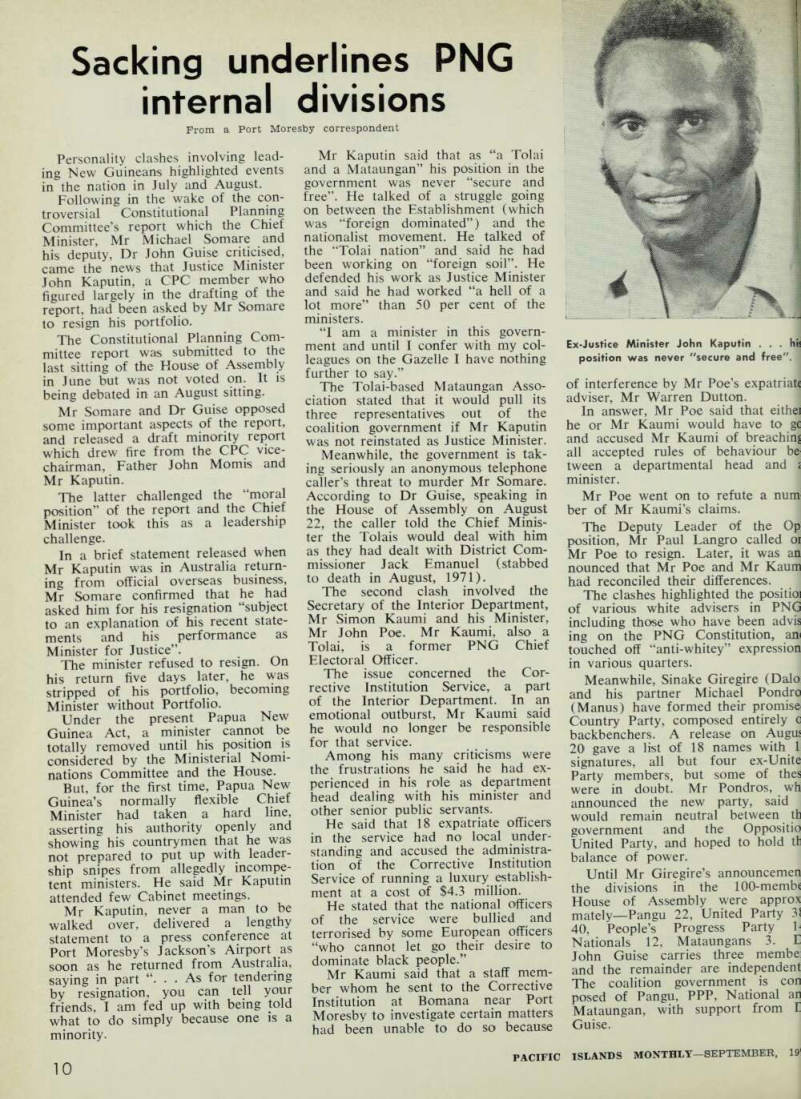
Following in the wake of the con troversial Constitutional Planning Committee’s report which the Chief Minister, Mr Michael Somare and his deputy, Dr John Guise criticised, came the news that Justice Minister John Kaputin, a CPC member who figured largely in the drafting of the report, had been asked by Mr Somare to resign his portfolio.
The Constitutional Planning Com mittee report was submitted to the last sitting of the House of Assembly in June but was not voted on. It is being debated in an August sitting.
Mr Somare and Eh- Guise opposed some important aspects of the report, and released a draft minority report which drew fire from the CPC vice chairman, Father John Momis and Mr Kaputin.
The latter challenged the “moral position” of the report and the Chief Minister took this as a leadership challenge.
In a brief statement released when Mr Kaputin was in Australia return ing from official overseas business, Mr Somare confirmed that he had asked him for his resignation “subject to an explanation of his recent state ments and his performance as Minister for Justice”.
The minister refused to resign. On his return five days later, he was stripped of his portfolio, becoming Minister without Portfolio.
Under the present Papua New Guinea Act, a minister cannot be totally removed until his position is considered by the Ministerial Nomi nations Committee and the House.
But, for the first time, Papua New Guinea’s normally flexible Chief Minister had taken a hard line, asserting his authority openly and showing his countrymen that he was not prepared to put up with leader ship snipes from allegedly incompe tent ministers. He said Mr Kaputin attended few Cabinet meetings.
Mr Kaputin, never a man to be walked over, delivered a lengthy statement to a press conference at Port Moresby’s Jackson’s Airport as soon as he returned from Australia, saying in part .. As for tendering by resignation, you can tell your friends, I am fed up with being told what to do simply because one is a minority.
Mr Kaputin said that as “a Tolai and a Mataungan” his position in the government was never “secure and free”. He talked of a struggle going on between the Establishment (which was “foreign dominated”) and the nationalist movement. He talked of the “Tolai nation” and said he had been working on “foreign soil”. He defended his work as Justice Minister and said he had worked “a hell of a lot more” than 50 per cent of the ministers.
“I am a minister in this govern ment and until I confer with my col leagues on the Gazelle I have nothing further to say.”
The Tolai-based Mataungan Asso ciation stated that it would pull its three representatives out of the coalition government if Mr Kaputin was not reinstated as Justice Minister.
Meanwhile, the government is tak ing seriously an anonymous telephone caller’s threat to murder Mr Somare.
According to Dr Guise, speaking in the House of Assembly on August 22, the caller told the Chief Minis ter the Tolais would deal with him as they had dealt with District Com missioner Jack Emanuel (stabbed to death in August, 1971).
The second clash involved the Secretary of the Interior Department, Mr Simon Kaumi and his Minister, Mr John Poe. Mr Kaumi, also a Tolai, is a former PNG Chief Electoral Officer.
The issue concerned the Cor rective Institution Service, a part of the Interior Department. In an emotional outburst, Mr Kaumi said he would no longer be responsible for that service.
Among his many criticisms were the frustrations he said he had ex perienced in his role as department head dealing with his minister and other senior public servants.
He said that 18 expatriate officers in the service had no local under standing and accused the administra tion of the Corrective Institution Service of running a luxury establish ment at a cost of $4.3 million.
He stated that the national officers of the service were bullied and terrorised by some European officers “who cannot let go their desire to dominate black people.”
Mr Kaumi said that a staff mem ber whom he sent to the Corrective Institution at Bomana near Port Moresby to investigate certain matters had been unable to do so because
of interference by Mr Poe’s expatriat* adviser, Mr Warren Dutton.
In answer, Mr Poe said that eithei he or Mr Kaumi would have to gc and accused Mr Kaumi of breaching all accepted rules of behaviour tween a departmental head and i minister.
Mr Poe went on to refute a num her of Mr Kaumi’s claims.
The Deputy Leader of the Op position, Mr Paul Langro called oi Mr Poe to resign. Later, it was an nounced that Mr Poe and Mr Kaum had reconciled their differences.
The clashes highlighted the positioi of various white advisers in PNG including those who have been advis ing on the PNG Constitution, am touched off “anti-whitey” expression in various quarters.
Meanwhile, Sinake Giregire (Dalo and his partner Michael Pondro (Manus) have formed their promise Country Party, composed entirely c backbenchers. A release on Augm 20 gave a list of 18 names with 1 signatures, all but four ex-Unite Party members, but some of thes were in doubt. Mr Pondros, wh announced the new party, said would remain neutral between th government and the Oppositio United Party, and hoped to hold tL balance of power.
Until Mr Giregire’s announcemen the divisions in the 100-membe House of Assembly were approx mately—Pangu 22, United Party 3! 40, People’s Progress Party h Nationals 12, Mataungans 3. E John Guise carries three membe and the remainder are independent The coalition government is con posed of Pangu, PPP, National an Mataungan, with support from E Guise.
Ex-Justice Minister John Kaputin . . . his[?] position was never "secure and free".