'Come Visit Us' Says Mara To
pp. 24-26 · Read in the full issue
Islands' stake in Europe
The Common Marketeers
Doubts about the future of key exports in major markets should dis appear for Fiji, Western Samoa and Tonga in February, 1975. The three countries are likely to be associate members of the European Economic Community by then. That status would give them access, with some strings attached, to a market of up wards of 250 million people for sugar and copra, as well as other com modities.
Two officials from EEC head quarters in Brussels recently visited Fiji. They were Mr Michael Laidler, head of the Pacific and Caribbean Affairs Department, and Mr Pirzio Biroli, head of the Department for Development Aid and Co-operation.
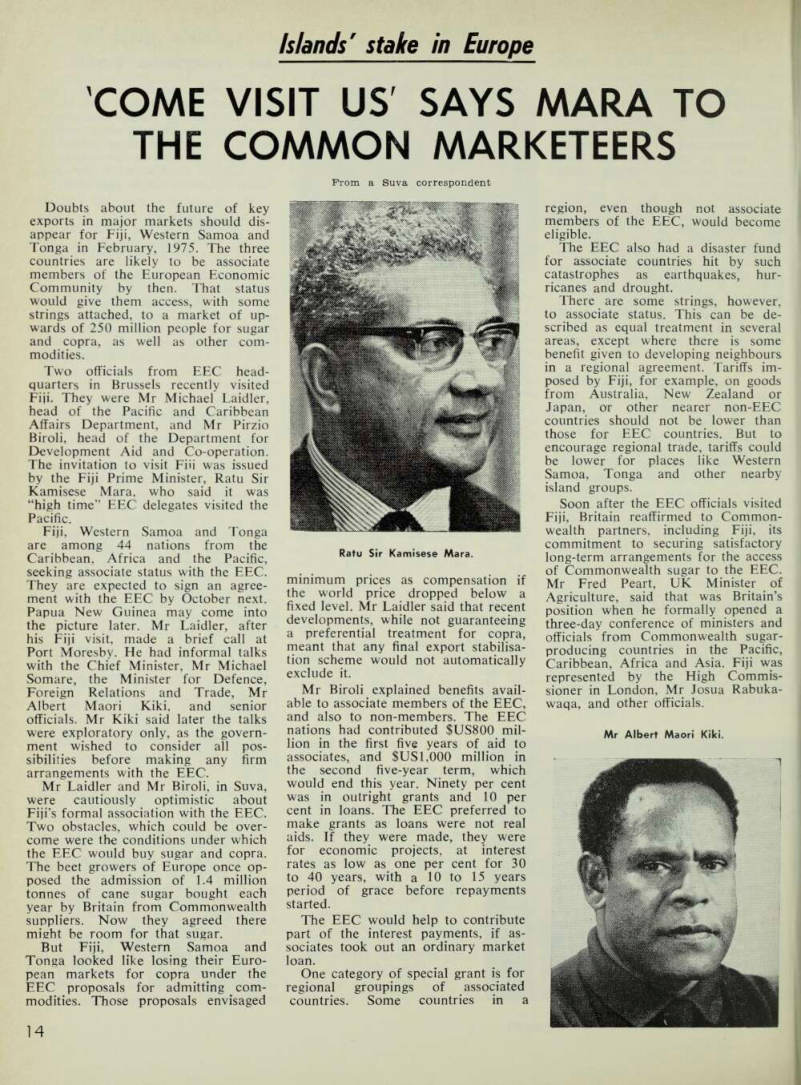
The invitation to visit Fiii was issued by the Fiji Prime Minister, Ratu Sir Kamisese Mara, who said it was “high time” EEC delegates visited the Pacific.
Fiji, Western Samoa and Tonga are among 44 nations from the Caribbean, Africa and the Pacific, seeking associate status with the EEC.
They are expected to sign an agree ment with the EEC by October next.
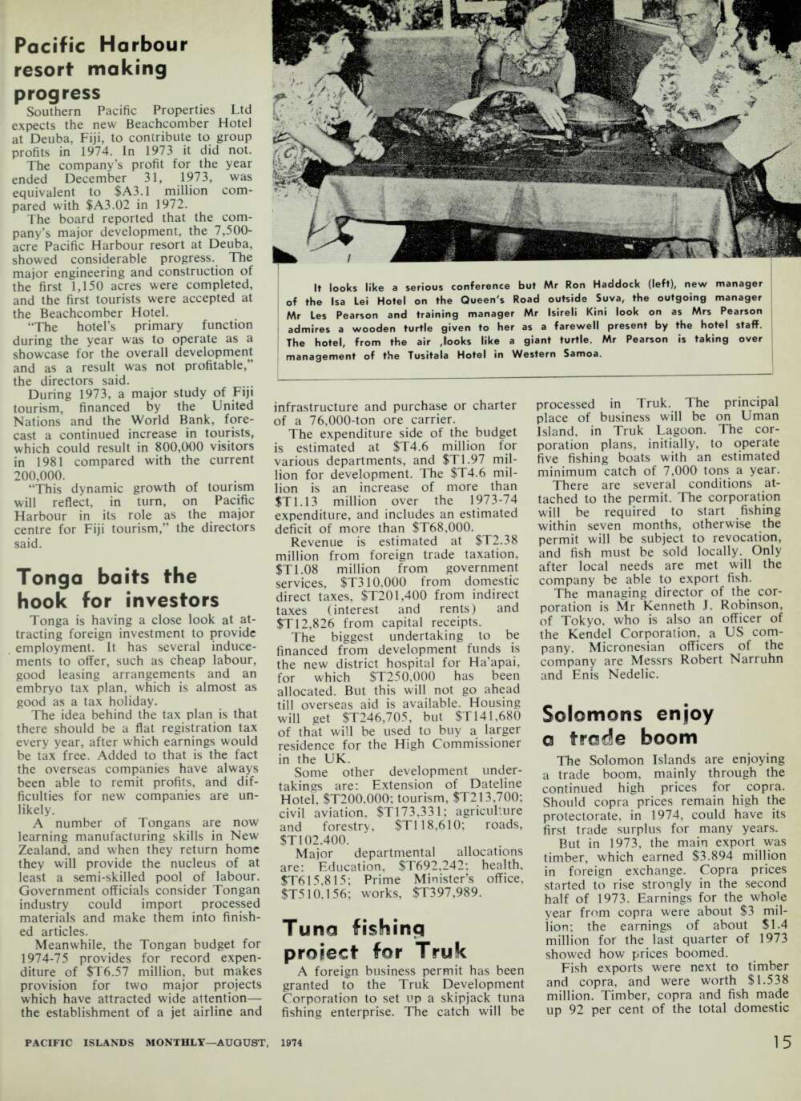
Papua New Guinea may come into the picture later. Mr Laidler, after his Fiji visit, made a brief call at Port Moresby. He had informal talks with the Chief Minister, Mr Michael Somare, the Minister for Defence, Foreign Relations and Trade, Mr Albert Maori Kiki, and senior officials. Mr Kiki said later the talks were exploratory only, as the govern ment wished to consider all pos sibilities before making any firm arrangements with the EEC.
Mr Laidler and Mr Biroli, in Suva, were cautiously optimistic about Fiji’s formal association with the EEC.
Two obstacles, which could be over come were the conditions under which the EEC would buy sugar and copra.
The beet growers of Europe once op posed the admission of 1.4 million tonnes of cane sugar bought each year by Britain from Commonwealth suppliers. Now they agreed there misht be room for that sugar.
But Fiji, Western Samoa and Tonga looked like losing their Euro pean markets for copra under the EEC proposals for admitting com modities. Those proposals envisaged
Prom a Suva correspondent
minimum prices as compensation if the world price dropped below a fixed level. Mr Laidler said that recent developments, while not guaranteeing a preferential treatment for copra, meant that any final export stabilisa tion scheme would not automatically exclude it.
Mr Biroli explained benefits avail able to associate members of the EEC, and also to non-members. The EEC nations had contributed SUSBOO mil lion in the first five years of aid to associates, and SUS 1,000 million in the second five-year term, which would end this year. Ninety per cent was in outright grants and 10 per cent in loans. The EEC preferred to make grants as loans were not real aids. If they were made, they were for economic projects, at interest rates as low as one per cent for 30 to 40 years, with a 10 to 15 years period of grace before repayments started.
The EEC would help to contribute part of the interest payments, if as sociates took out an ordinary market loan.
One category of special grant is for regional groupings of associated countries. Some countries in a
region, even though not associate members of the EEC, would become eligible.
The EEC also had a disaster fund for associate countries hit by such catastrophes as earthquakes, hur ricanes and drought.
There are some strings, however, to associate status. This can be de scribed as equal treatment in several areas, except where there is some benefit given to developing neighbours in a regional agreement. Tariffs im posed by Fiji, for example, on goods from Australia, New Zealand or Japan, or other nearer non-EEC countries should not be lower than those for EEC countries. But to encourage regional trade, tariffs could be lower for places like Western Samoa, Tonga and other nearby island groups.
Soon after the EEC officials visited Fiji, Britain reaffirmed to Common wealth partners, including Fiji, its commitment to securing satisfactory long-term arrangements for the access of Commonwealth sugar to the EEC.
Mr Fred Peart, UK Minister of Agriculture, said that was Britain’s position when he formally opened a three-day conference of ministers and officials from Commonwealth sugar producing countries in the Pacific, Caribbean, Africa and Asia. Fiji was represented by the High Commis sioner in London, Mr Josua Rabuka waqa, and other officials.
Ratu Sir Kamisese Mara.
Mr Albert Maori Kiki.
Pacific Harbour
resort making
progress
Southern Pacific Properties Ltd expects the new Beachcomber Hotel at Deuba, Fiji, to contribute to group profits in 1974. In 1973 it did not.
The company’s profit for the year ended December 31, 1973, was equivalent to SA3.I million com pared with 5A3.02 in 1972.
The board reported that the com pany’s major development, the 7,500acre Pacific Harbour resort at Deuba, showed considerable progress. The major engineering and construction of the first 1,150 acres were completed, and the first tourists were accepted at the Beachcomber Hotel.
“The hotel’s primary function during the year was to operate as a showcase for the overall development and as a result was not profitable,” the directors said.
During 1973, a major study of Fiji tourism, financed by the United Nations and the World Bank, fore cast a continued increase in tourists, which could result in 800,000 visitors in 1981 compared with the current 200,000.
“This dynamic growth of tourism will reflect, in turn, on Pacific Harbour in its role as the major centre for Fiji tourism,” the directors said.
Tonga baits the
hook for investors
Tonga is having a close look at at tracting foreign investment to provide employment. It has several induce ments to offer, such as cheap labour, good leasing arrangements and an embryo tax plan, which is almost as good as a tax holiday.
The idea behind the tax plan is that there should be a flat registration tax every year, after which earnings would be tax free. Added to that is the fact the overseas companies have always been able to remit profits, and dif ficulties for new companies are un likely.
A number of Tongans are now learning manufacturing skills in New Zealand, and when they return home they will provide the nucleus of at least a semi-skilled pool of labour.
Government officials consider Tongan industry could import processed materials and make them into finish ed articles.
Meanwhile, the Tongan budget for 1974-75 provides for record expen diture of 5T6.57 million, but makes provision for two major projects which have attracted wide attention — the establishment of a jet airline and
infrastructure and purchase or charter of a 76,000-ton ore carrier.
The expenditure side of the budget is estimated at 5T4.6 million for various departments, and 5T1.97 mil lion for development. The 5T4.6 mil lion is an increase of more than 5T1.13 million over the 1973-74 expenditure, and includes an estimated deficit of more than 5T68,000.
Revenue is estimated at 5T2.38 million from foreign trade taxation, ST 1.08 million from government services, 5T310,000 from domestic direct taxes, 5T201,400 from indirect taxes (interest and rents) and $T12,826 from capital receipts.
The biggest undertaking to be financed from development funds is the new district hospital for Ha’apai, for which 5T250,000 has been allocated. But this will not go ahead till overseas aid is available. Housing will get 5T246/705, but $T141,680 of that will be used to buy a larger residence for the High Commissioner in the UK.
Some other development under takings are; Extension of Dateline Hotel, ST200.000; tourism, $T213,700; civil aviation, $T173,331; agriculture and forestry, $T118,610; roads, 5T102.400.
Major departmental allocations are; Education, $T692,242; health, 5T615,815; Prime Minister’s office, $T510,156; works, 5T397,989.
Tuna fishing
proiect for Truk
A foreign business permit has been granted to the Truk Development Corporation to set up a skipjack tuna fishing enterprise. The catch will be
processed in Truk. The principal place of business will be on Uman Island, in Truk Lagoon. The cor poration plans, initially, to operate five fishing boats with an estimated minimum catch of 7,000 tons a year.
TTiere are several conditions at tached to the permit. The corporation will be required to start fishing within seven months, otherwise the permit will be subject to revocation, and fish must be sold locally. Only after local needs are met will the company be able to export fish.
The managing director of the cor poration is Mr Kenneth I. Robinson, of Tokyo, who is also an officer of the Kendel Corporation, a US com pany, Micronesian officers of the company are Messrs Robert Narruhn and Enis Nedelic.
Solomons enjoy
a trade boom
The Solomon Islands are enjoying a trade boom, mainly through the continued high prices for copra.
Should copra prices remain high the protectorate, in 1974, could have its first trade surplus for many years.
But in 1973, the main export was timber, which earned 53.894 million in foreign exchange. Copra prices started to rise strongly in the second half of 1973. Earnings for the whole year from copra were about S 3 mil lion; the earnings of about 51.4 million for the last quarter of 1973 showed how prices boomed.
Fish exports were next to timber and copra, and were worth $1,538 million. Timber, copra and fish made up 92 per cent of the total domestic
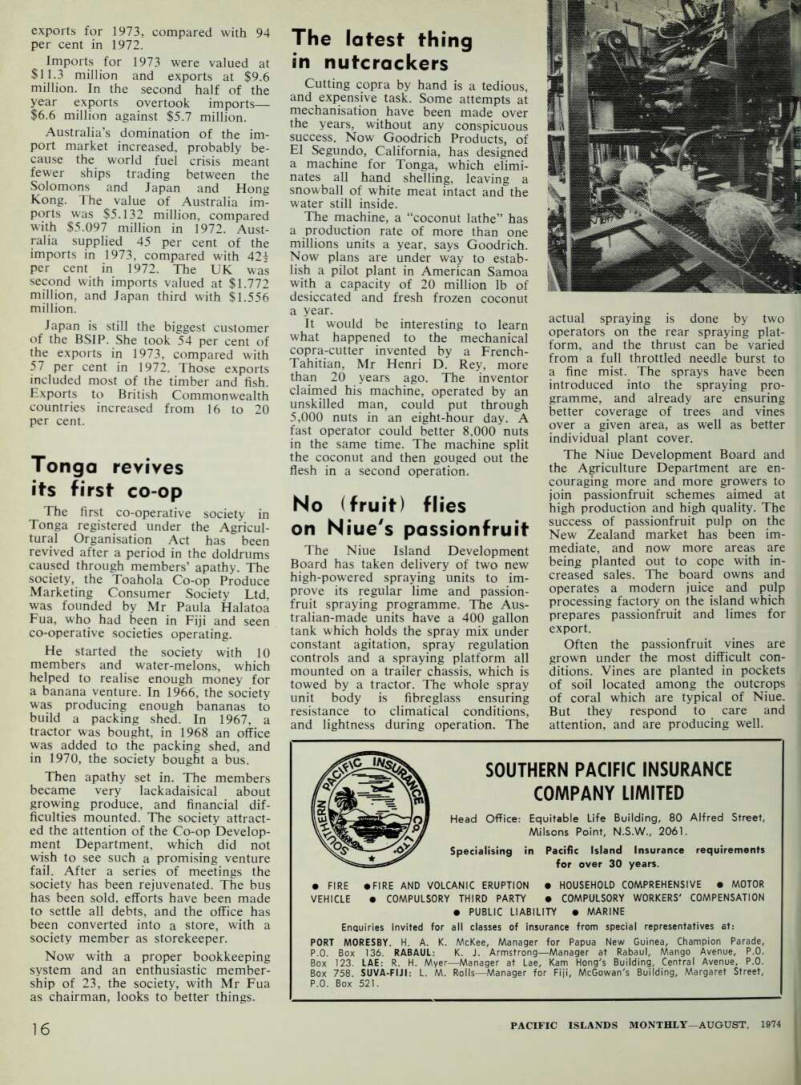
It looks like a serious conference but Mr Ron Haddock (left), new manager of the Isa Lei Hotel on the Queen's Road outside Suva, the outgoing manager Mr Les Pearson and training manager Mr Isireli Kini look on as Mrs Pearson admires a wooden turtle given to her as a farewell present by the hotel staff.
The hotel, from the air looks like a giant turtle. Mr Pearson is taking over management of the Tusitala Hotel in Western Samoa.
exports for 1973, compared with 94 per cent in 1972.
Imports for 1973 were valued at $11.3 million and exports at $9.6 million. In the second half of the year exports overtook imports— s6.6 million against $5.7 million.
Australia’s domination of the im port market increased, probably be cause the world fuel crisis meant fewer ships trading between the Solomons and Japan and Hong Kong. The value of Australia im ports was $5,132 million, compared with $5,097 million in 1972. Aust ralia supplied 45 per cent of the imports in 1973, compared with 42i per cent in 1972. The UK was second with imports valued at $1,772 million, and Japan third with $1,556 million.
Japan is still the biggest customer of the BSIP. She took 54 per cent of the exports in 1973, compared with 57 per cent in 1972. Those exports included most of the timber and fish.
Exports to British Commonwealth countries increased from 16 to 20 per cent.
Tonga revives
its first co-op
The first co-operative society in Tonga registered under the Agricul tural Organisation Act has been revived after a period in the doldrums caused through members’ apathy. The society, the Toahola Co-op Produce Marketing Consumer Society Ltd, was founded by Mr Paula Halatoa Fua, who had been in Fiji and seen co-operative societies operating.
He started the society with 10 members and water-melons, which helped to realise enough money for a banana venture. In 1966, the society was producing enough bananas to build a packing shed. In 1967, a tractor was bought, in 1968 an office was added to the packing shed, and in 1970, the society bought a bus.
Then apathy set in. The members became very lackadaisical about growing produce, and financial dif ficulties mounted. The society attract ed the attention of the Co-op Develop ment Department, which did not wish to see such a promising venture fail. After a series of meetings the society has been rejuvenated. The bus has been sold, efforts have been made to settle all debts, and the office has been converted into a store, with a society member as storekeeper.
Now with a proper bookkeeping system and an enthusiastic member ship of 23, the society, with Mr Fua as chairman, looks to better things.
The latest thing
in nutcrackers
Cutting copra by hand is a tedious, and expensive task. Some attempts at mechanisation have been made over the years, without any conspicuous success. Now Goodrich Products, of El Segundo, California, has designed a machine for Tonga, which elimi nates all hand shelling, leaving a snowball of white meat intact and the water still inside.
The machine, a “coconut lathe” has a production rate of more than one millions units a year, says Goodrich.
Now plans are under way to estab lish a pilot plant in American Samoa with a capacity of 20 million lb of desiccated and fresh frozen coconut a year.
It would be interesting to learn what happened to the mechanical copra-cutter invented by a French- Tahitian, Mr Henri D. Rey, more than 20 years ago. The inventor claimed his machine, operated by an unskilled man, could put through 5,000 nuts in an eight-hour day. A fast operator could better 8,000 nuts in the same time. The machine split the coconut and then gouged out the flesh in a second operation.
No (fruit) flies
on Niue's passionfruit
The Niue Island Development Board has taken delivery of two new high-powered spraying units to im prove its regular lime and passion fruit spraying programme. The Aus tralian-made units have a 400 gallon tank which holds the spray mix under constant agitation, spray regulation controls and a spraying platform all mounted on a trailer chassis, which is towed by a tractor. The whole spray unit body is fibreglass ensuring resistance to climatical conditions, and lightness during operation. The
actual spraying is done by two operators on the rear spraying plat form, and the thrust can be varied from a full throttled needle burst to a fine mist. The sprays have been introduced into the spraying pro gramme, and already are ensuring better coverage of trees and vines over a given area, as well as better individual plant cover.
The Niue Development Board and the Agriculture Department are en couraging more and more growers to join passionfruit schemes aimed at high production and high quality. The success of passionfruit pulp on the New Zealand market has been im mediate, and now more areas are bein£ planted out to cope with in creased sales. The board owns and operates a modern juice and pulp processing factory on the island which prepares passionfruit and limes for export.
Often the passionfruit vines are grown under the most difficult con ditions. Vines are planted in pockets of soil located among the outcrops of coral which are typical of Niue.
But they respond to care and attention, and are producing well.